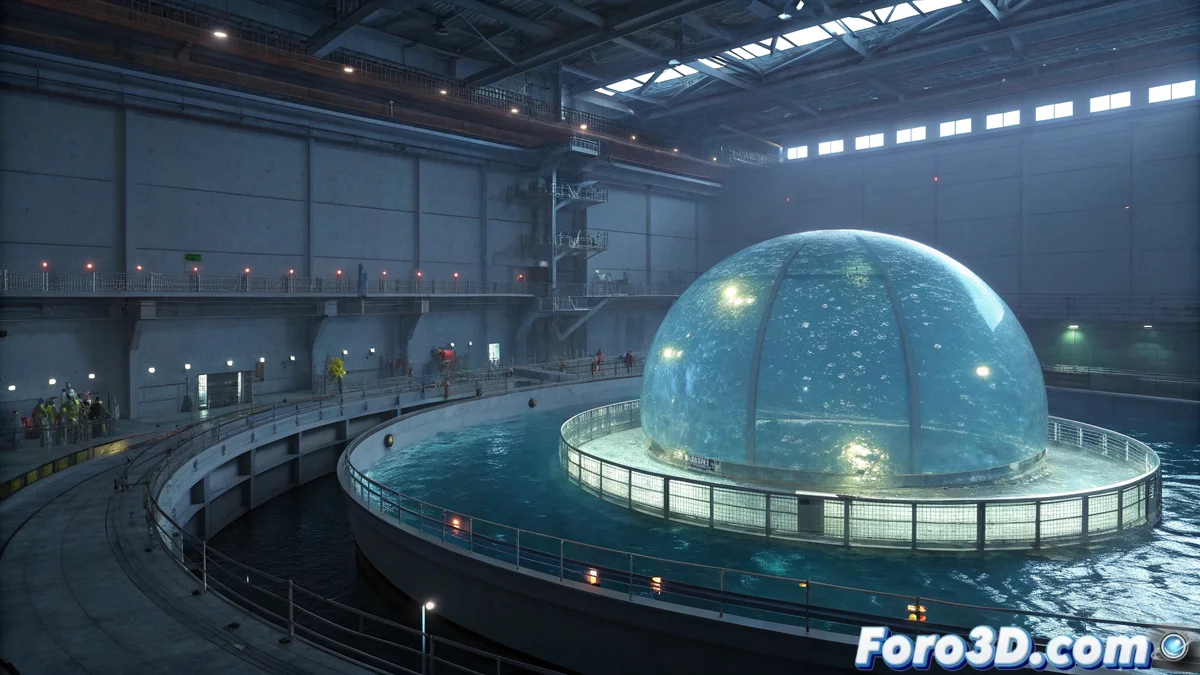
Visualizing the Invisible: The JUNO Observatory in 3D
China has inaugurated the Jiangmen Underground Neutrino Observatory (JUNO) 🚀, a scientific facility located 700 meters underground in Guangdong province. This observatory houses the world's largest neutrino detector: a 35.4-meter diameter acrylic sphere submerged in a tank of purified water, designed to study the so-called "ghost particles" that barely interact with matter. Recreating this scientific marvel in 3D offers unique opportunities for educational and scientific visualization.
Recreation of the Observatory in 3D Software
The process begins with precise modeling of the facility:
- Sphere Modeling: Creation of the 35.4-meter acrylic sphere
- Water Tank: Main container and support systems
- Underground Environment: Tunnels and caverns at 700 meters depth
- Technical Details: Supports, cables, and scientific instrumentation
- Precise Scale: Maintenance of realistic proportions
- Optimization: Geometry management for performance
This structural base is essential for subsequent animation 🏗️.
Preparation for MotionBuilder
The transition to MotionBuilder requires careful preparation:
- FBX Export: Transfer of models from Blender/Maya/3ds Max
- Layer Organization: Logical separation of structural elements
- Functional Groups: Sphere, tank, environment, and animatable elements
- Mesh Optimization: Polygon reduction for real-time
- Pivot Preparation: Correct rotation and animation points
- Basic Materials: Initial assignment of simple shaders
This organization facilitates animation and real-time manipulation ⚙️.
Particle Animation and Movement
MotionBuilder offers tools to visualize the invisible:
- Neutrino Trajectories: Animation with splines and expressions
- Locators and Markers: Visual representation of particles
- Camera Animation: Educational tours through the facility
- Symbolic Interactions: Visualization of neutrino detection
- Precise Timeline: Synchronization of events and movements
- Preview: Real-time verification of animations
These techniques make the intangible tangible 🔬.
Rendering and Final Presentation
The final phase takes the visualization to the next level:
- Export to Render Engines: Arnold, V-Ray, or Unreal Engine
- Advanced Materials: Shaders for acrylic, water, and metals
- Volumetric Lighting: Light effects and atmospheric particles
- Visual Effects: Artistic representation of neutrino interactions
- Post-Processing: Color adjustments and effects for scientific clarity
- Output Formats: Educational video or interactive applications
This process transforms complex data into comprehensible visual experiences 🌌.
Animating neutrinos in 3D is fascinating until they decide not to follow the trajectories
In the end, recreating the JUNO Observatory in MotionBuilder demonstrates that 3D visualization can make even the most abstract science accessible. While real physicists hunt for neutrinos 700 meters underground, we hunt them in our software timelines... and sometimes we both have detection issues 😅.