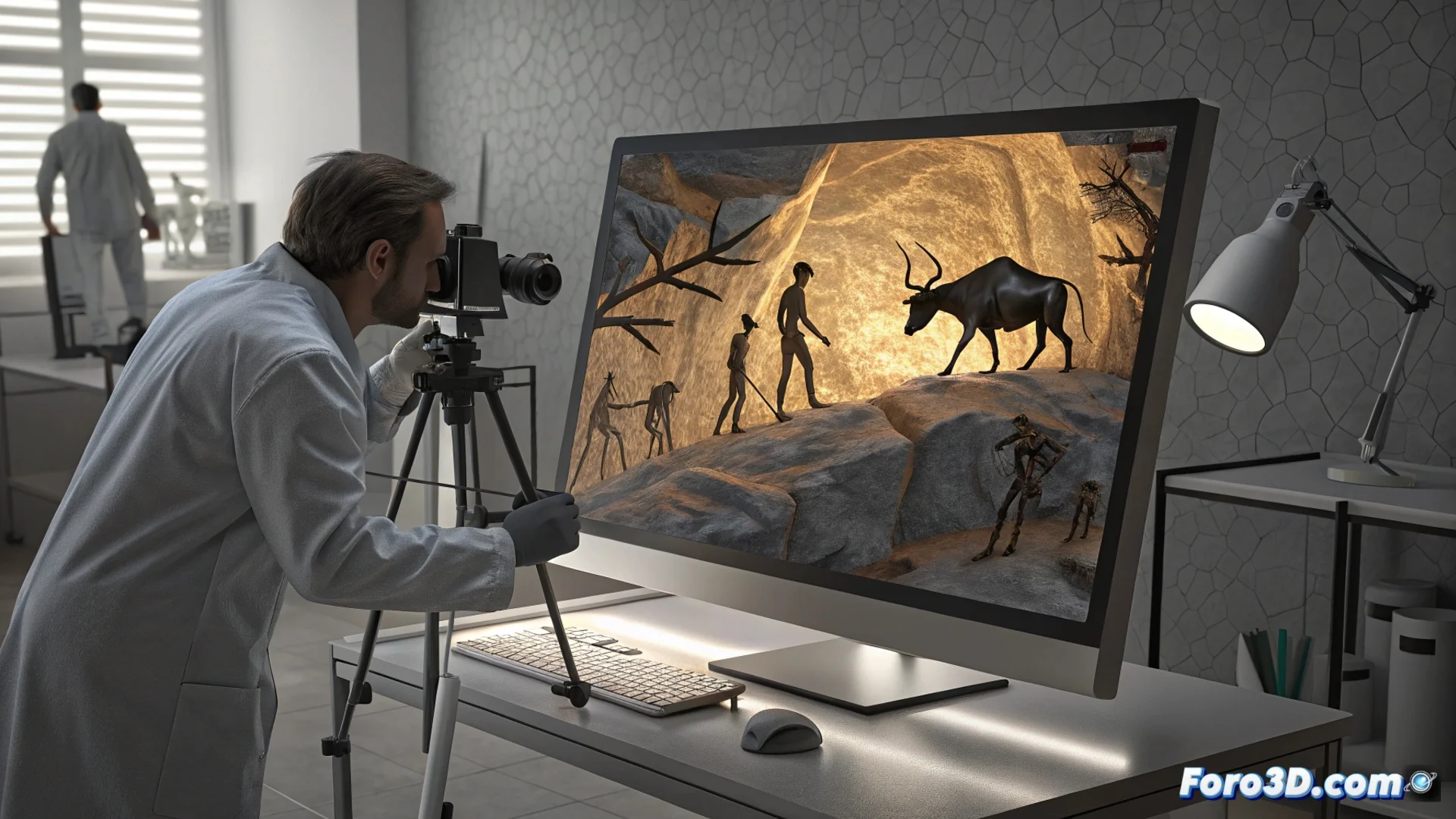
Recovering Invisible Rock Art with 3D Scanning and Algorithms
Current technology allows rescuing prehistoric artistic manifestations that had been hidden by time. Through the synergy between capturing high-precision 3D data and processing that data with specialized software, what erosion had concealed becomes visible. 🕵️♂️
A Workflow that Fuses Physical Capture and Digital Analysis
The method begins by digitizing the cave surface. A terrestrial laser scanner or short-range photogrammetry techniques are used to generate an extremely dense point cloud. This dataset is converted into a polygonal mesh that records the rock's topography with millimeter fidelity.
Key Processes in the Analysis Software:- Import the 3D model into applications designed for surface analysis.
- Apply filters and computational shaders that simulate controlled directional lighting.
- Virtually adjust parameters such as angle, intensity, and type of light to maximize contrast in altered areas.
Digitally illuminating the model from multiple angles accentuates micro-variations, bringing to light figures that were buried in the substrate.
A Methodology that Preserves Heritage Comprehensively
This approach is fundamentally non-invasive. It requires no physical contact with the paintings, thus avoiding degradation of these fragile remnants. Researchers can study, measure, and analyze the revealed works in a completely safe digital environment.
Main Advantages of Digital Documentation:- Create permanent files to preserve and share the discovery with the global community.
- Process and visualize the data under different virtual lighting conditions, documenting complete sets with unprecedented detail.
- Offer a new perspective for understanding artistic techniques and how art was distributed in the cave space.
The Challenge of Interpreting What is Revealed
Now archaeologists can see what was literally invisible. However, the software also highlights cracks and natural rock textures, which sometimes generate digital pareidolias where some shapes may be mistaken for animal figures, requiring careful and expert interpretation. 🔍