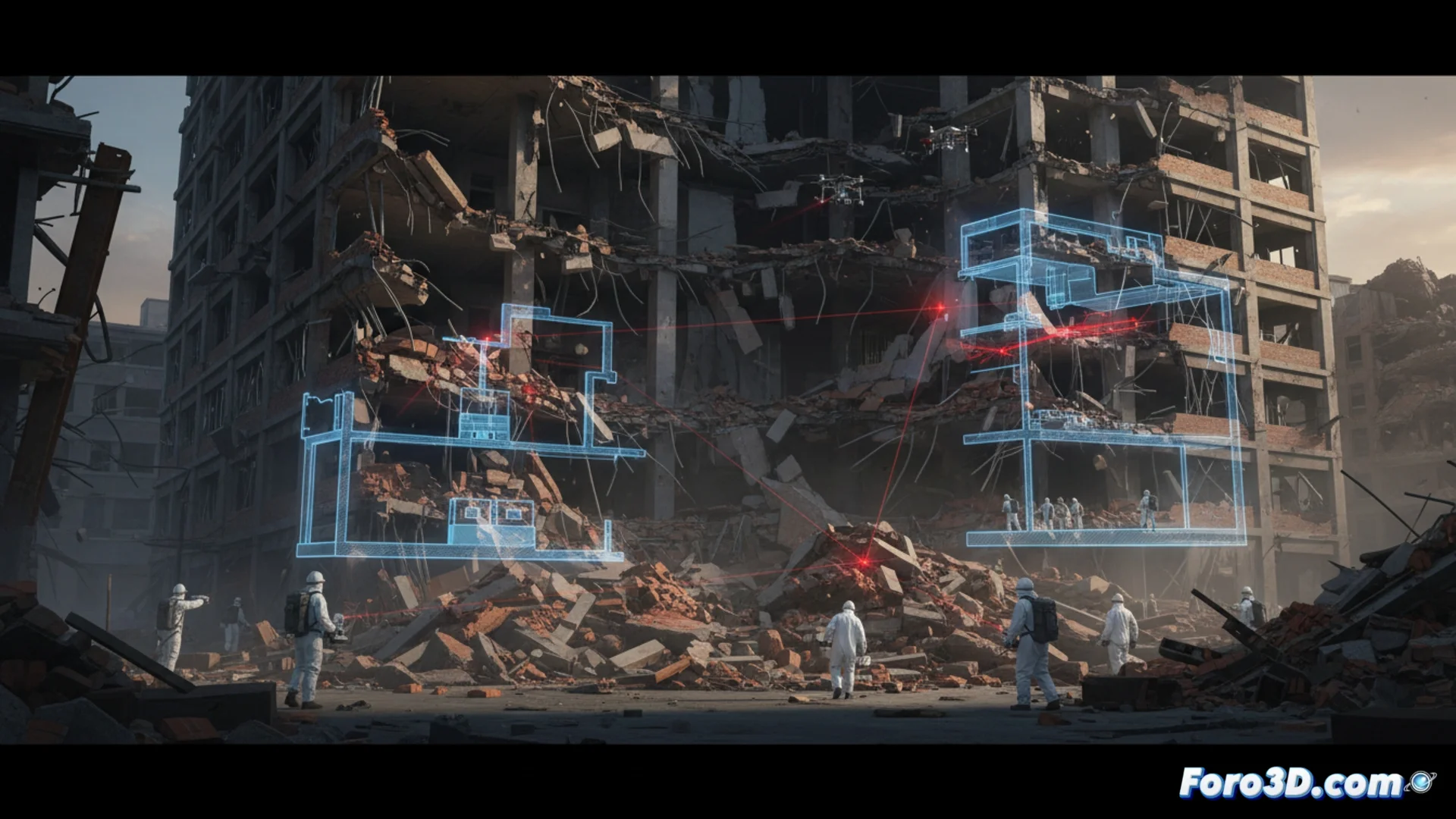
Reconstructing a Gas Explosion Collapse Using 3D Forensic Techniques
To investigate a structural collapse caused by a gas explosion, experts apply a methodical 3D forensic procedure. This path begins by documenting the scene with cutting-edge technology and culminates in producing an interactive digital recreation that serves as key evidence. 🔍
Workflow for Capturing and Processing the Scene
The first stage is fundamental: collecting data from the debris environment. Laser scanners are used for precise measurements and aerial photogrammetry with drones to obtain textures and details of broken surfaces. Then, this massive point cloud data is cleaned and aligned in specialized programs, generating a dense and accurate point cloud. This base model allows reconstructing the building's geometry before it failed.
Central Modeling Stages:- Document the area with LiDAR technology and drones for comprehensive capture.
- Process raw data to create an aligned and clean point cloud.
- Generate a detailed 3D mesh from the point cloud.
The accuracy of the 3D model is crucial, as it must withstand cross-examination by other experts in court.
Simulating the Explosion and Analyzing Causes
With the geometric model ready, the next step is to simulate the event. Engineers integrate the models into fluid dynamics and finite element software. This allows recreating the deflagration forces, determining the leak origin point, and understanding how the shockwave propagated to cause structural failure. The goal is to validate hypotheses about the exact collapse sequence.
Post-Analysis Technical Steps:- Integrate 3D models into advanced simulation software (CFD, FEA).
- Recreate explosion forces to locate the leak epicenter.
- Analyze fractures in beams, columns, and other structural elements.
Digital Evidence in the Legal Field
The final 3D model becomes an interactive evidentiary tool. It allows experts, judges, and lawyers to virtually tour the scene, isolate layers of information, and visualize animations showing progressive failure. This resource is decisive for illustrating complex technical causes, clearly showing how accumulated gas, the ignition point, and the building structure interacted. Sometimes, the reconstruction reveals critical details, such as a gas cylinder located in the wrong place, making the analysis as revealing as finding a key puzzle piece. ⚖️