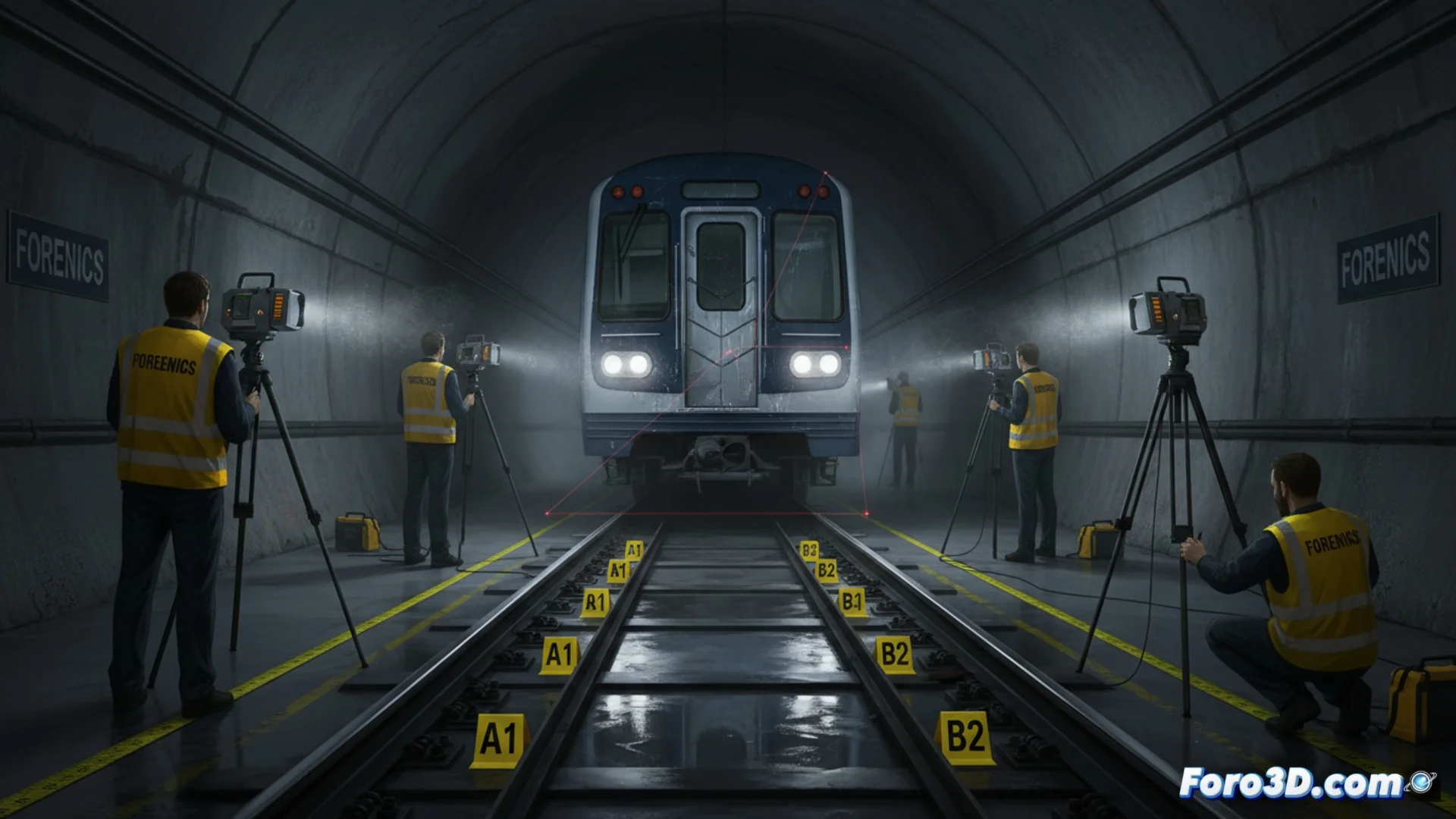
Reconstructing a Fatal Subway Hit-and-Run with a 3D Forensic Workflow
When a tragic incident occurs in the metropolitan railway, experts turn to an advanced digital methodology. This technical procedure, known as the 3D forensic workflow, allows recreating the event with high fidelity to analyze what happened. It starts from physical and digital evidence from the scene to build a virtual replica where all variables are examined 🕵️♂️.
The Key Stages to Digitally Recreate the Incident
The first step consists of documenting the scene exhaustively. Specialists use technology such as long-range laser scanners and photogrammetry techniques to record every geometric and surface detail. This raw data is then processed to assemble a precise three-dimensional model of the platform, tracks, signals, and other fixed elements.
Main Phases of the Workflow:- Field Capture: Laser measurements, high-resolution photographs, and surveillance camera recordings are collected.
- Modeling and Positioning: The involved train is generated digitally, including its mechanical systems, and the affected person is positioned using biomechanical studies.
- Simulation and Calculation: In specialized software, the impact dynamics are reproduced, the probable train speed is calculated, and factors affecting visibility are evaluated.
- Generate Visual Reports: Animations and renderings are produced that explain the sequence of events clearly and understandably for the court.
The metric precision of the model is fundamental, as any deviation can compromise the value of the evidence in court.
Software Used and How the Model is Verified
To run these simulations, forensic investigators use programs like PC-Crash, MADYMO, or even Blender enhanced with specific add-ons for engineering analysis. Digital model validation is a critical step; it must be rigorously contrasted with the physical evidence found during the inspection, such as braking marks on the rails or structural damage to the vehicle.
Crucial Aspects of Validation:- Contrast with Physical Evidence: Marks on the scene and material damage are used to calibrate and adjust the simulation parameters.
- Hypothesis Analysis: The model allows testing different scenarios non-destructively, evaluating which one best fits all the collected evidence.
- Dimensional Accuracy: Fidelity in scales and distances is a priority for technically solid conclusions.
The Human Dimension Behind the Technical Data
Although the process is based on polygons, algorithms, and physics calculations, it never loses sight of the fact that a human loss is being analyzed. The objective coldness of the simulation sometimes contrasts with the rawness of the event being represented, reminding that behind every vertex and every animation there is a tragic personal story. This method, however, seeks to provide clarity and objectivity to help clarify the facts 🧩.