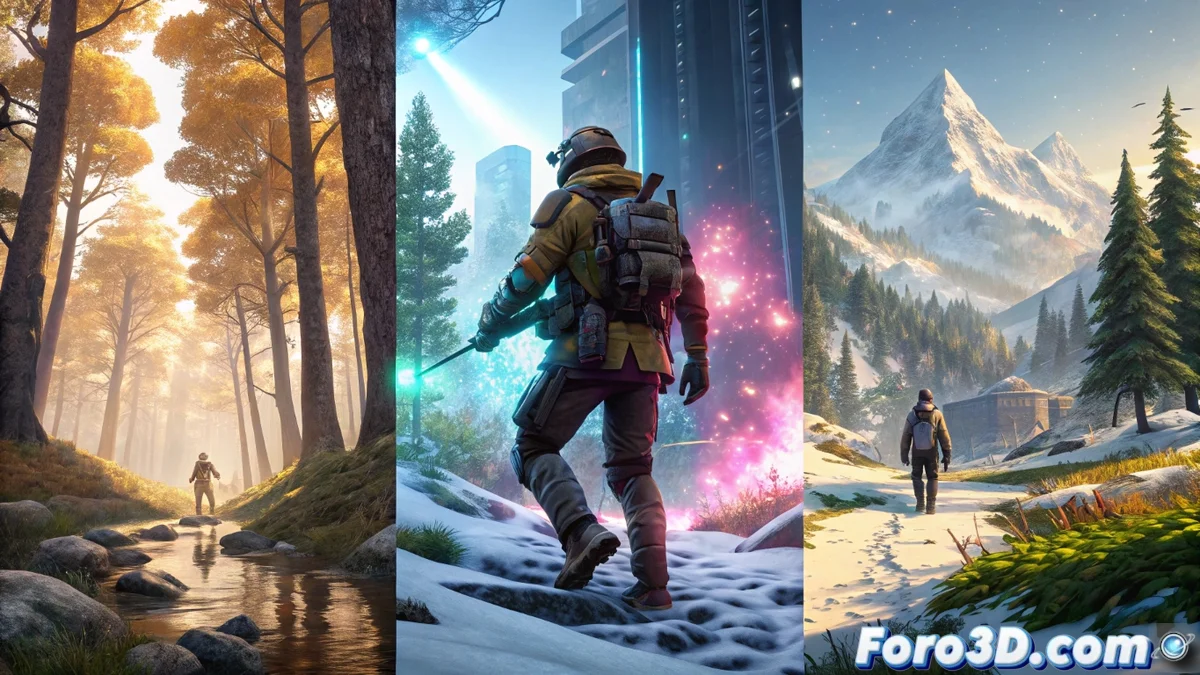
Real-Time Rendering Engine Comparison: Unreal, Unity, CryEngine, and Godot
Selecting real-time rendering technology is one of the most crucial decisions in digital project development, defining not only visual capabilities but also workflow and technical possibilities. In the current ecosystem, four engines stand out as references for their power and adoption: Unreal Engine, Unity, CryEngine, and Godot. This comparison breaks down their fundamentals to provide a clear view of their strengths in creating interactive images. 🎮
Unreal Engine: the paradigm of extreme fidelity
Unreal Engine establishes itself as the undisputed standard for high-end graphics. Its core is a state-of-the-art physically based renderer (PBR), powered by systems like Lumen for dynamic global illumination and Nanite for virtualized geometry. Its node-based material editor provides enormous flexibility, and tools like MetaSounds offer cinematic-quality spatial audio. It is the predominant choice for AAA projects, film and television productions, and any application where visual quality is the top priority. Its learning curve is more demanding, and its business model is based on royalties after exceeding an income threshold.
Key features of Unreal:- Ultra-high fidelity renderer: With Lumen for real-time global illumination and Nanite for detailed geometry.
- Cinematic workflow: Integrated tools like Sequencer for creating complex cinematics.
- Professional ecosystem: Wide adoption in large studios, with a large amount of resources and learning materials available.
Unreal Engine is not just a game engine; it is a complete platform for creating interactive and cinematic visual experiences.
Unity, CryEngine, and Godot: differentiated philosophies and niches
While Unreal dominates in fidelity, the alternatives cover different spectra of development. Unity stands out for its accessibility and native multi-platform support. Its strength lies in a massive ecosystem of assets, tutorials, and a gigantic community. Although historically a step behind in extreme graphics, its new Render Pipelines (URP for efficiency and HDRP for high definition) aim to match up. It is ideal for rapid prototyping, mobile development, augmented/virtual reality, and indie or mid-scale projects.
CryEngine has traditionally been the less adopted but no less powerful sibling. It is famous for its cutting-edge graphics technology, especially in advanced lighting (SVOGI) and rendering of vegetation and natural environments. Its focus is on developers seeking absolute control over the final image, although its documentation and learning curve can be more arduous.
Godot represents the philosophy of open source and simplicity. Its own renderer is lightweight, efficient, and integrated into a very cohesive workflow. Although its 3D engine does not compete in ultra-advanced features with Unreal, its evolution is rapid and it is a formidable option for 2D/3D indie projects, educational ones, or where restrictive licenses are an issue.
Recommended usage profiles:- Unity: For projects that prioritize agility, multi-platform reach, and rapid iterative development.
- CryEngine: For specialized teams seeking total graphical control and not fearing technical complexity.
- Godot: For developers who value openness, simplicity in workflow, and have license or budget restrictions.
Conclusion: choosing the tool for your vision
The final choice of rendering engine must align with the project vision and team resources. If the goal is to achieve cinematic visual quality, Unreal Engine is the way. If the priority is versatility and development speed for multiple platforms, Unity is the perfect ally. For those who crave deep technical control over every graphical aspect, CryEngine offers that power. And for advocates of the open-source philosophy