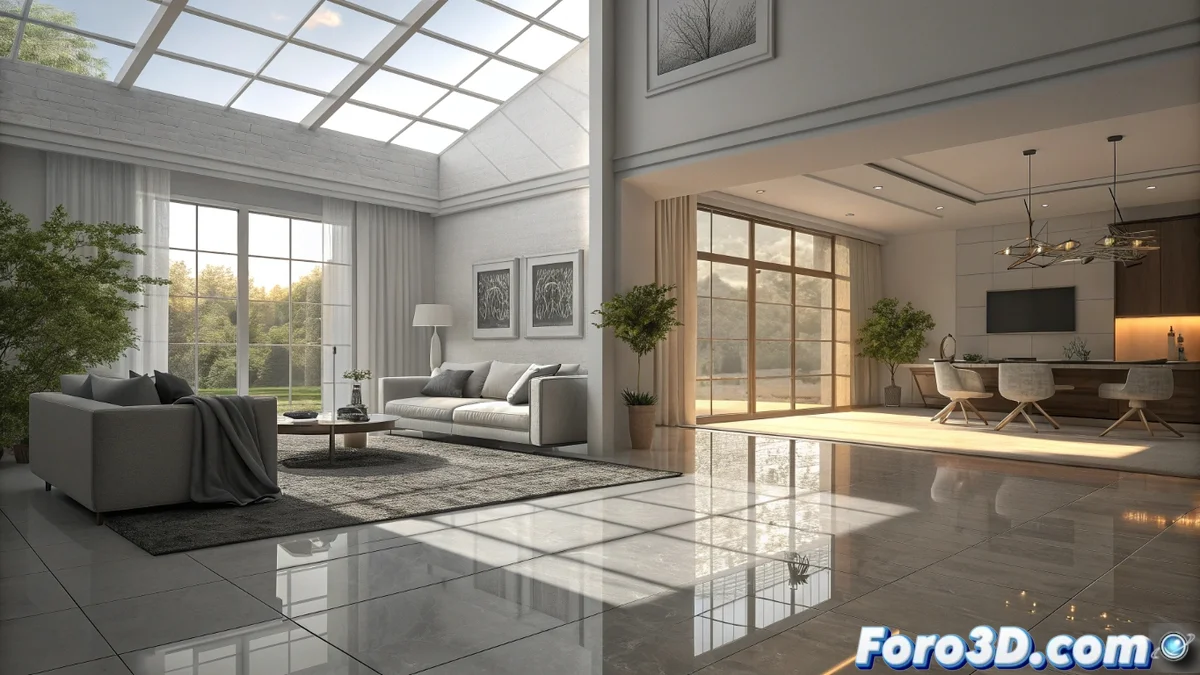
Real-Time Lighting: Chaos Vantage vs D5 Render
Visualizing architecture relies heavily on how light is handled. Two standout engines, Chaos Vantage and D5 Render, tackle this challenge with opposing technical philosophies, defining distinct workflows for artists and architects. 🏗️
Divergent Technical Approaches
The core difference lies in how they calculate light. Chaos Vantage relies entirely on real-time ray tracing, allowing it to process complex V-Ray scenes with immediate physical fidelity. On the other hand, D5 Render uses a hybrid rasterization and ray tracing method, designed to prioritize smooth interactivity and direct integration with modeling software.
Key points for deciding:- Asset origin: Vantage is ideal if you already work with V-Ray or 3ds Max scenes.
- User priority: Choose between extreme physical accuracy or responsiveness and exploration speed.
- Required hardware: Vantage needs NVIDIA RTX GPU to perform optimally.
Patience is a rendering parameter as important as samples per pixel.
Chaos Vantage: Fidelity to the Physical Engine
This tool excels at loading V-Ray scenes directly, maintaining the original lighting setup without converting lights. Its engine, optimized for RTX, processes global illumination, reflections, and refractions via pure ray tracing. This generates a preview consistent with a final render, invaluable for validating lighting in early design phases.
Main features of Vantage:- Maintains total coherence with the V-Ray rendering engine.
- Calculates complex lighting effects instantly with high physical accuracy.
- Requires specific hardware (NVIDIA RTX GPU) to perform at its best.
D5 Render: Interactivity and Integrated Ecosystem
D5 Render is built around delivering a very fast real-time experience. It integrates its lighting tools within its environment, with an extensive library of HDRI lights, emissives, and lumens that users can adjust on the fly. Its hybrid system handles scenes with many polygons while maintaining high frame rates, facilitating interactive exploration of lighting options.
Main features of D5 Render:- Very fast workflow integrated into its own ecosystem.
- Hybrid system that handles complex geometry fluidly.
- Streamlines the process if starting a project from scratch within the application.
Conclusion: Adapt the Pipeline or Adapt to It
In the end, choosing between Vantage and D5 Render for lighting often boils down to a workflow decision. Do you prefer the software to adapt to your existing V-Ray-based pipeline, or adapt your method to D5's integrated and fast ecosystem? The answer defines whether you prioritize absolute physical fidelity or iteration and exploration speed. 🔦