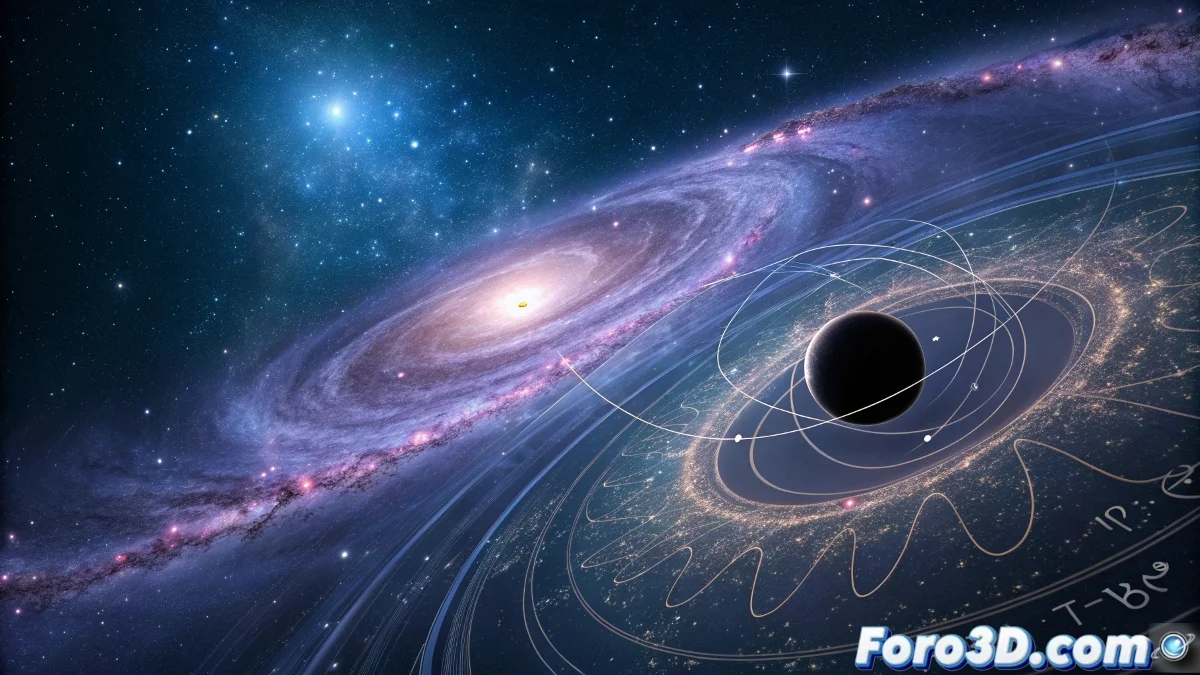
When the Infinitely Large Meets the Infinitely Small
In the far reaches of the universe where relativity and quantum mechanics wage their eternal battle, a new hope emerges: black holes that obey both queens of physics, challenging a century of established paradigms 🌌⚛️.
The Problem That Keeps Physicists Awake
Why these theories resist unification:
- General Relativity: Describes the macro (planets, galaxies)
- Quantum Mechanics: Governs the micro (particles, atoms)
- Black Holes: Where both worlds collide
- Singularities: The point of conceptual breakdown
Calmet's Solution: A Cosmic Hybrid
Keys to the innovative approach:
- Use of Vilkovisky-DeWitt effective action
- Quantum corrections to field equations
- Prediction of a new class of objects
- Classical behavior at large scales
"These quantum black holes are like cosmic translators, allowing relativity and quantum mechanics to finally understand each other." - Theoretical Physicist
Revolutionary Implications
Why this study changes everything:
- First mathematically consistent solution
- No fundamental logical contradictions
- Possible future detection with advanced telescopes
- Path toward the theory of everything
The Future of Theoretical Physics
Next steps in this research:
- Search for observational signatures
- Extension to other compact objects
- Development of more complete formalisms
- Integration with string theory/LQG
As the Event Horizon Telescope continues to scan the sky, these quantum black holes could be out there, waiting to be discovered, carrying in their horizons the answer to the greatest mystery of modern physics. Who would have thought: the Holy Grail might be hidden in the darkest places of the universe. 🌠