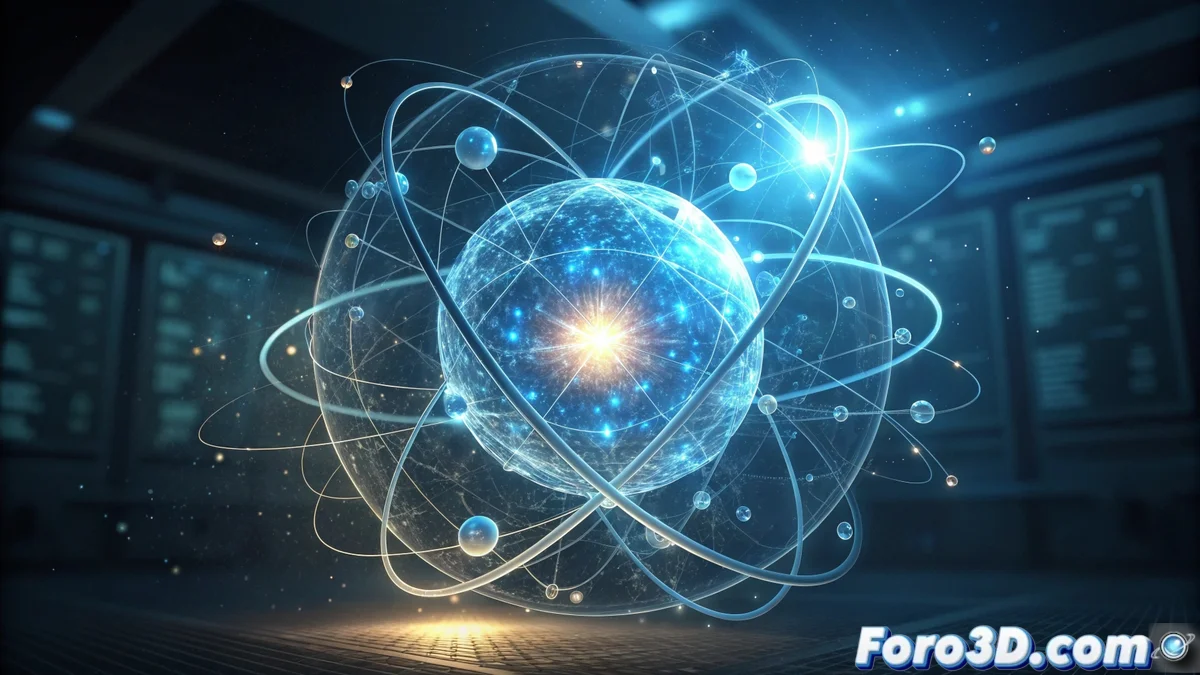
Quantum Batteries Seek Instant Charging
The future of energy storage could take a radical leap thanks to quantum physics. Scientists are investigating a new paradigm: quantum batteries. This theoretical model proposes using phenomena like quantum entanglement to completely transform how a device is recharged. Instead of the current sequential method, the entire battery would charge in unison. ⚡
The Mechanism of Quantum Superradiance
The central principle is called superradiance. In a quantum system, atoms can link or entangle, behaving as a single collective entity. This makes their capacity to absorb energy grow exponentially with the number of particles. Researchers model this behavior using structures like quantum wells, where the excited states of the atoms synchronize.
Key features of this approach:- Collective charging: All atoms in the battery store energy simultaneously, not one after another.
- Exponential speed: Recharge time could be reduced from hours to mere seconds.
- Theoretical efficiency: The process leverages the laws of quantum mechanics to be potentially more efficient.
The dream of recharging an electric car in the time it takes to serve a coffee depends on quantum physics behaving well outside the laboratory.
The Obstacles to Materializing the Technology
Although the theory is solid, building a practical device presents enormous challenges. The main one is maintaining quantum coherence. The entanglement state is extremely fragile, and any interaction with the environment destroys it, a problem called decoherence.
Current challenges:- System isolation: Materials and designs are needed to protect the quantum state long enough to operate.
- Microscopic scale: Successful experiments so far are only proof-of-concept tests in highly controlled laboratory environments.
- Transition to macro: Scaling the principle from the quantum world to an everyday device is a fundamental barrier.
The Path from the Laboratory to Reality
The promise of instant recharging for devices or electric vehicles remains on the horizon. Progress depends on overcoming decoherence and finding a way to preserve entanglement in real conditions. Meanwhile, research on quantum batteries continues, exploring the limits of how we can store energy for the future. 🔬