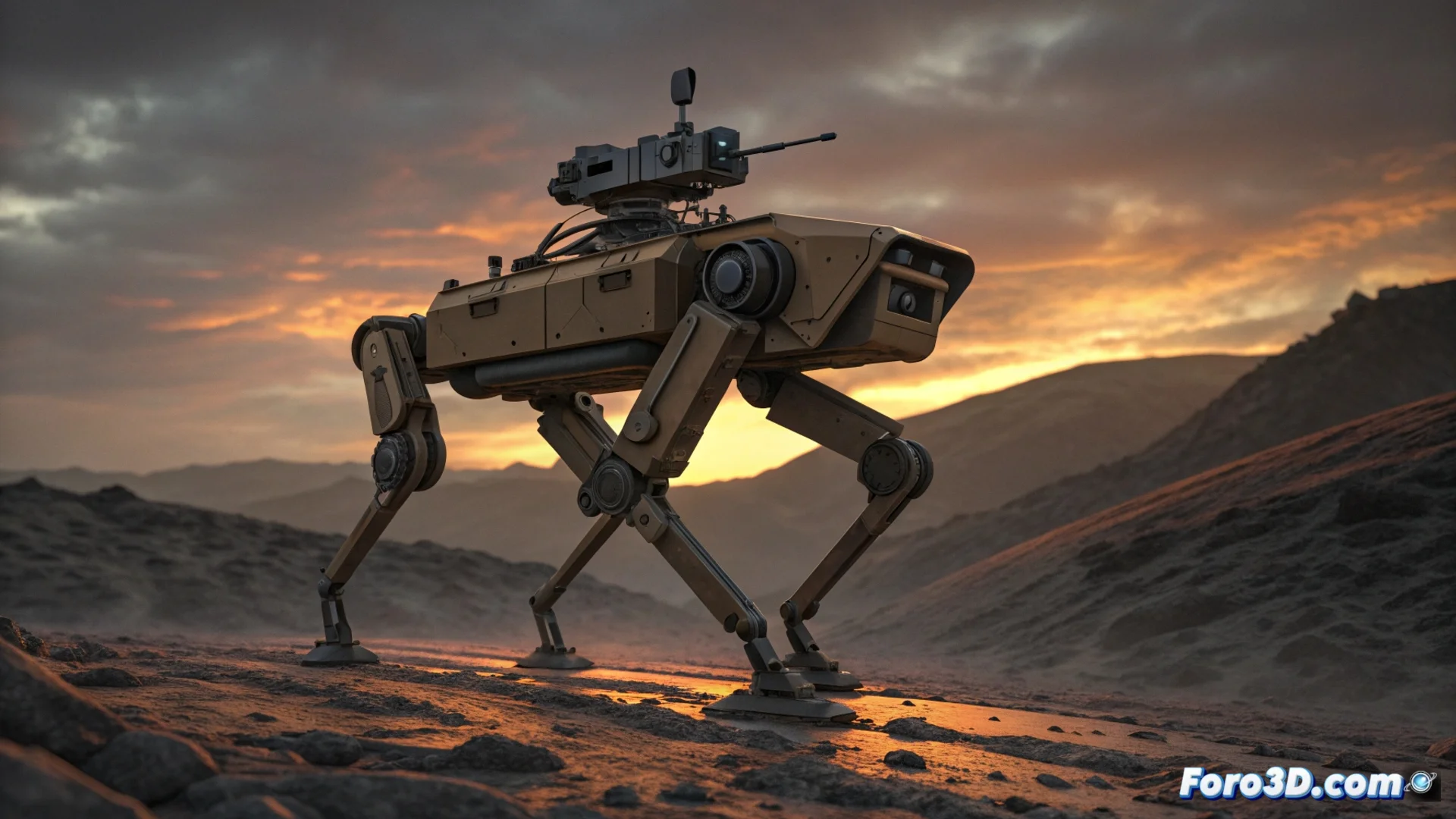
The Quadruped Gemini Robot for Defense Missions
Ghost Robotics develops the Gemini, an autonomous quadruped system created specifically to operate in complex outdoor environments. Its design prioritizes applications within the defense and national security sector, facing extreme environmental conditions where other systems would fail. 🦾
A Modular and Resilient Platform
The robot's open architecture is its backbone. Users can integrate a wide range of sensors and weapon systems, allowing to adapt each unit to the specific requirements of a mission. This flexibility is crucial for responding quickly to new threats.
Key features of its design:- Mobility in hostile terrains: Advances through mud, water, snow, and sand without its performance degrading immediately.
- Rugged construction: Its joints avoid traditional bearings, minimizing dirt entry and causing jams.
- Payload capacity: Carries considerable payloads without sacrificing its agility, suitable for reconnaissance and logistical support tasks.
The modularity of the Gemini allows units to reconfigure the robot quickly in the face of new targets or threat scenarios.
Enhancing Human Personnel Safety
The Gemini's main function is to reduce direct exposure of personnel in high-risk scenarios. By deploying this system, forces can explore buildings, patrol perimeters, or inspect suspicious artifacts from a safe distance. 🎯
Tactical applications in the field:- Surveillance and reconnaissance: Equipped with day and night vision systems, as well as chemical or radiological detectors.
- Remote fire support: Some configurations include a precision rifle mounted on its back, operated remotely by a soldier.
- Secure communications: Uses encrypted links to transmit data and instructions in real time.
Ethical Considerations and Operational Future
Although it combines the mobility of an animal with the precision of a controlled weapon system, its active use in combat generates considerable ethical and tactical debates. More than a mechanical dog looking for a ball, the Gemini identifies threats while resisting enemy fire and the most adverse conditions. Its evolution will continue to define the role of autonomous robotics in modern security.