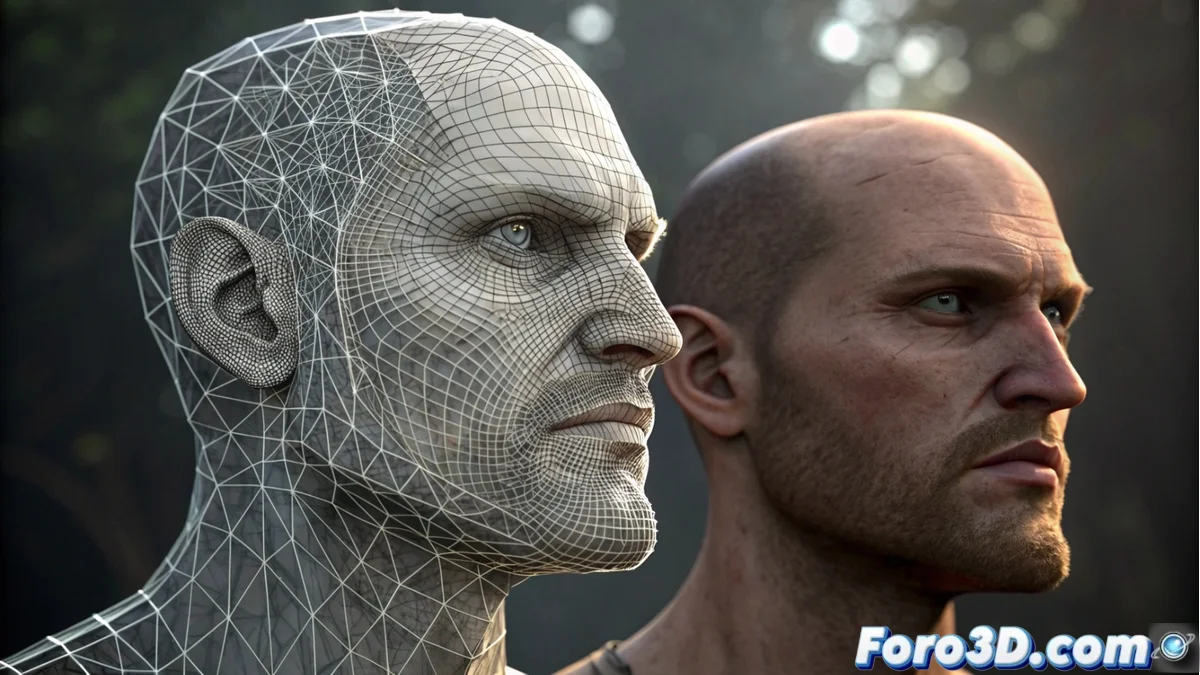
Quad Remeshing: Reorganizing 3D Meshes with Quadrilateral Polygons
In 3D modeling, quad remeshing is a key technique for restructuring an object's geometry. It takes dense or chaotic models, such as those from scanning or digital sculpting, and converts them into an ordered grid of quadrilaterals. This fundamental change in topology is achieved through specialized software that processes the original shape. 🛠️
Advantages of Using a Quad Mesh
Opting for a quads mesh offers immediate practical benefits. For animating characters, quadrilaterals deform more naturally and controllably with rigging, minimizing visual errors. When texturing, they facilitate creating efficient UV maps with less stretching. Additionally, they are essential for surface subdivision workflows, which require this topology to smooth the model without losing definition.
Main Benefits:- More predictable deformation in skeletal animation.
- Unfold the mesh in 2D for textures with less distortion.
- Optimal results when applying subdivisions to increase detail.
The real challenge is not that the algorithm works, but avoiding the artist spending hours manually cleaning a result with strange patterns.
Methods Used by Remeshing Algorithms
Programs implement different strategies to generate the new mesh. Some techniques track the principal curvature lines of the model to orient the edge directions. Others convert the surface into a vector field and then generate quadrilaterals aligned to this field. The user can adjust parameters like polygon density or edge angles, but the process consumes a lot of computational resources.
Common Approaches:- Follow the directions of maximum curvature of the geometry.
- Generate and align to a vector field over the surface.
- Adjust the density and orientation of the resulting polygons.
The Balance Between Automation and Manual Control
The effectiveness of quad remeshing is measured by the quality of the final mesh and the time it saves. An algorithm can produce a clean topology in seconds, but sometimes generates illogical patterns that require extensive manual intervention. The goal is to achieve a result that is directly usable for animating, texturing, or subdividing, without introducing new problems. ✅