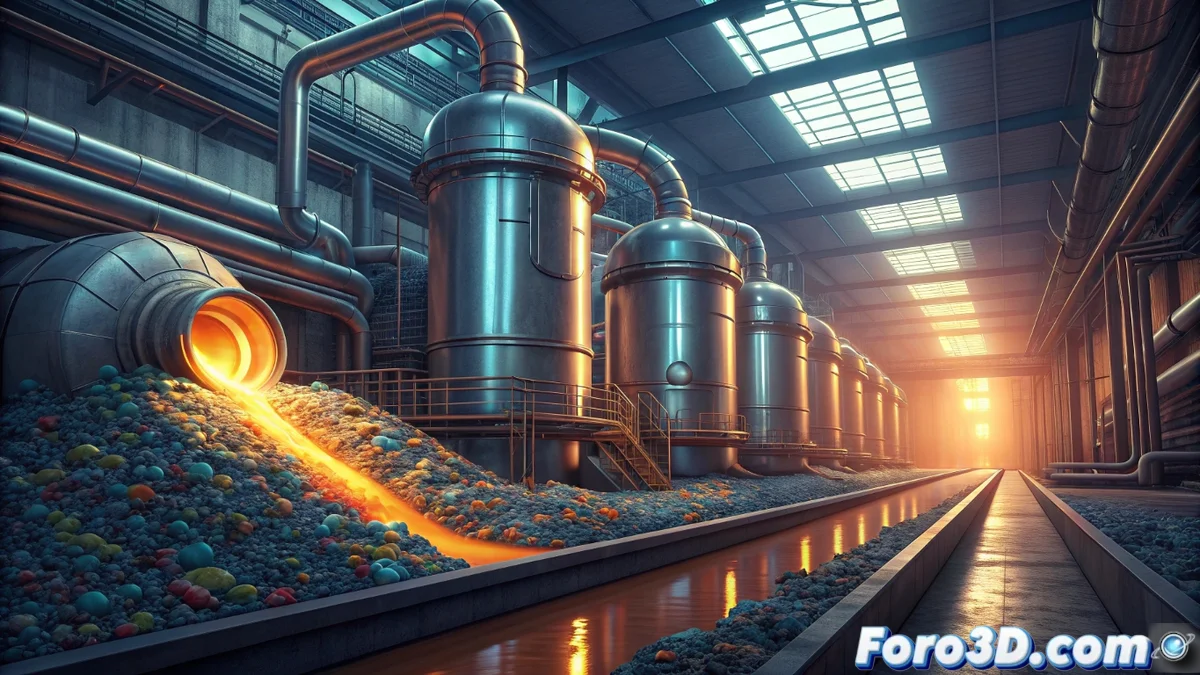
Pyrolysis: An Innovative Solution to Transform Plastic Waste into Resources
Facing the growing plastic waste crisis requires solutions that go beyond conventional recycling. Pyrolysis positions itself as a revolutionary technology capable of giving a second life to mountains of waste considered non-recyclable. This process, which operates in the absence of oxygen, not only reduces the volume of garbage but transforms it into raw materials and energy, marking a crucial shift toward a true circular economy. 🔥
The Thermochemical Mechanism and Its Valuable Results
The core of a pyrolysis plant is a specialized reactor where shredded plastics are subjected to high temperatures, typically between 400°C and 800°C. In this controlled environment, complex polymer chains break down into simpler molecular components. The magic lies not in creating a single product, but in a mixture that is separated and purified to obtain high-value resources.
The three main products of pyrolysis:- Pyrolysis oil (Bio-crude): A liquid that can be refined to produce fuels like diesel or gasoline, or serve as a raw material in the petrochemical industry to manufacture new plastics, effectively closing the cycle.
- Synthesis gas (Syngas): An energy-rich gaseous mixture that can be used to power the pyrolysis process itself, significantly increasing its energy efficiency and sustainability.
- Carbonaceous residue (Char): A solid that, depending on its composition and purity, can be used in industrial applications such as the production of carbon black or activated carbon for filters.
Pyrolysis transforms a pollution problem into a resource supply opportunity, redefining the concept of "waste."
Tangible Benefits and Challenges to Overcome
The most outstanding advantage of this thermochemical technology is its ability to process contaminated, multi-layer, or mixed plastics that mechanical recycling rejects. This drastically reduces the need to extract virgin fossil fuels and prevents these wastes from ending up in landfills or oceans. However, the path to its widespread implementation is not without considerable challenges.
Key challenges for the expansion of pyrolysis:- High initial investment: The cost of building and commissioning industrial-scale pyrolysis plants is significant, requiring substantial financial commitments.
- Supply logistics: To be profitable, the plant needs a constant and homogeneous flow of plastic waste, which demands highly efficient collection, sorting, and pretreatment systems.
- Quality control and emissions: It is essential to ensure that the produced fuels meet standards and that the entire process manages and minimizes its own emissions to be truly sustainable.
The Future of Plastic Management
Despite these challenges, continuous innovation is making pyrolysis more efficient and economically competitive. It is consolidating as a fundamental pillar in the global strategy against plastic pollution, acting as an essential complement to traditional recycling. While society strives to sort its waste, this technology offers a pragmatic and powerful solution: apply intense and controlled heat to, literally, reverse the manufacturing process and recover the energy and basic components trapped in our waste. 🚀