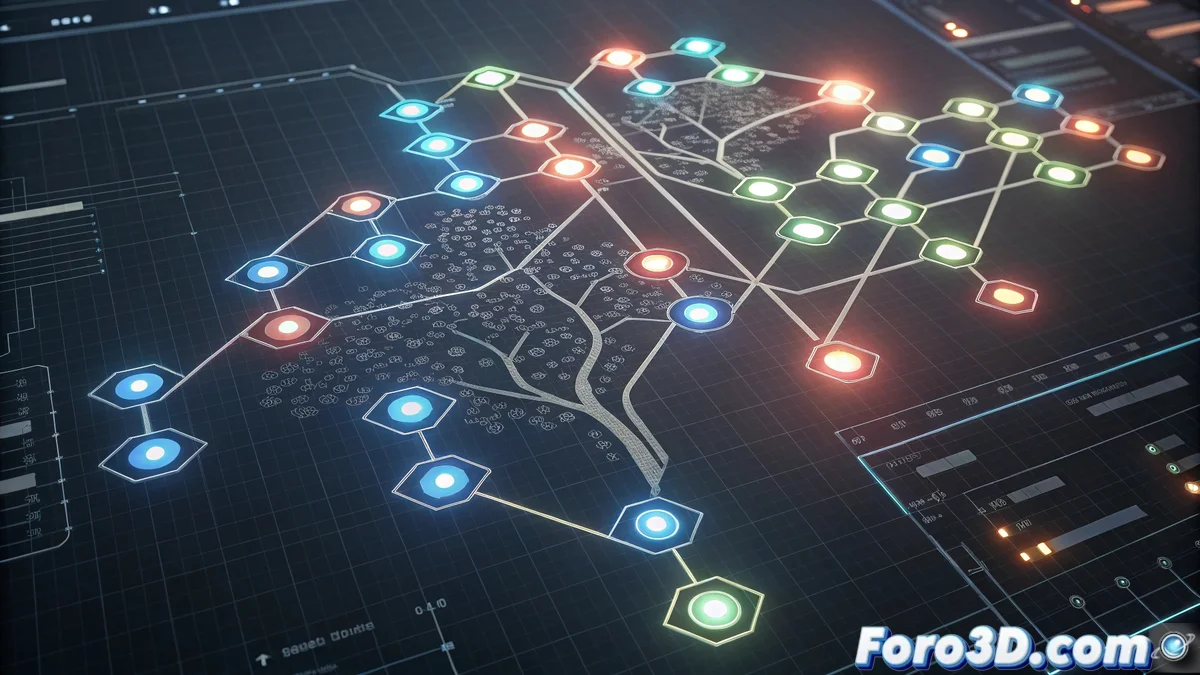
Project Organization in Godot: Scene and Node System
The Godot engine implements a unique architecture based on scenes and nodes that revolutionizes the way development projects are structured. Every game component, whether a character, enemy, or UI element, is conceptualized as an independent node that can be combined flexibly. 🎮
The Magic of the Node Hierarchy
The true power of the system emerges when nodes are organized into tree structures where each element automatically inherits transformations, visibility, and behaviors from its parent node. This intelligent design allows that by modifying a higher node, all its descendants update in cascade, greatly simplifying the creation of complex systems. You can integrate various specialized types like Spatial for 3D environments, Node2D for 2D projects, or Control for user interfaces.
Key advantages of the hierarchical structure:- Automatic inheritance: Child nodes inherit transformations and visual properties from their parent without additional configuration
- Visual organization: The editor clearly displays parent-child relationships through indentation and connecting lines
- Batch modification: When moving, rotating, or scaling a parent node, all its descendants adjust proportionally
Godot's modular composition represents a more intuitive paradigm than traditional inheritance chains in object-oriented programming.
Composition versus Traditional Inheritance
Godot actively promotes composition over inheritance, an approach that avoids the long and fragile class chains typical of other engines. Instead, you build entities by assembling specialized nodes like a puzzle. A playable character might integrate nodes for visual representation (Sprite), collision detection (CollisionShape), behavior logic (Script), and sound effects (AudioStreamPlayer).
Benefits of the compositional approach:- Accelerated prototyping: Quickly assemble complex entities by combining pre-existing nodes
- Simplified maintenance: Modify individual components without affecting the rest of the system
- Maximum reuse: Complete scenes can be instantiated multiple times in different contexts
Managing Complexity in Elaborate Scenes
When you start developing sophisticated scenes, the number of nodes can become overwhelming, similar to an architect with plans spread across the floor. However, Godot includes advanced organization tools such as the ability to collapse entire branches of the node tree, filter by type, and search for specific elements. These features prevent the madness of searching for that one misconfigured node among hundreds of elements. 🧩