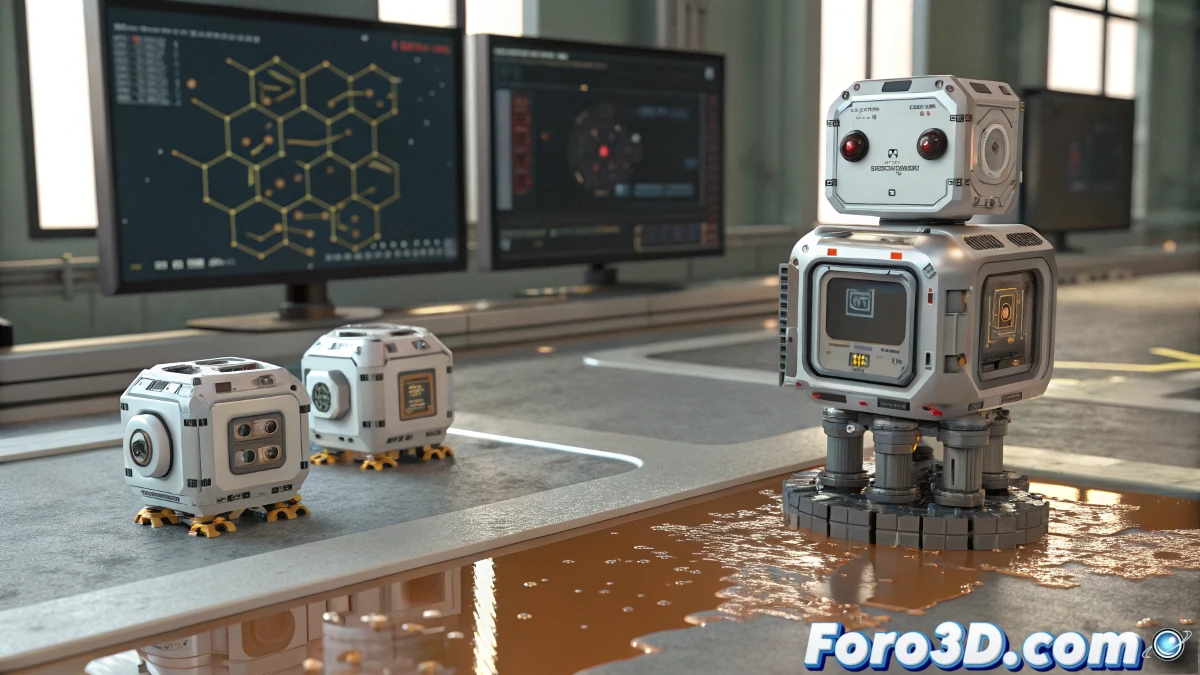
A team of researchers from the University of California has developed a revolutionary material composed of programmable micro-robots capable of acting together. The most surprising thing is their ability to change state, going from liquid to solid, which opens up a range of possibilities in fields such as medicine, engineering, and more.
An advance beyond traditional robotics
Unlike conventional robots, which are usually rigid and static, these micro-robots stand out for their ability to dynamically adapt to the environment. This makes them a versatile tool for tasks that require flexibility and precision, such as human tissue repair or exploration of confined spaces.
"We are facing a paradigm shift in robotics. These micro-robots not only imitate nature but surpass it in some aspects."
Inspiration from nature and science fiction
The design of these micro-robots is inspired by biological processes, such as embryonic morphogenesis, where cells change shape to create specific tissues. Additionally, their ability to transform reminds us of technologies seen in science fiction, such as the T-1000 from Terminator 2, although their development is purely scientific.
- State change: from liquid to solid and vice versa.
- Ability to navigate through confined spaces.
- Inspiration from biological processes and science fiction.
The key: imitating cellular adaptation
The researchers based their work on the behavior of embryonic tissues, which can mold and repair themselves. Using magnets and motorized gears, they managed to replicate these capabilities in the micro-robots, allowing them to join and reorganize into different structures according to needs.
First tests and upcoming challenges
In the initial tests, the scientists managed to assemble a group of 20 micro-robots, demonstrating their ability to adopt various shapes. The next step is to reduce their size and increase the number of units, which could revolutionize applications in medicine, exploration, and construction.
- First successful tests with 20 micro-robots.
- Size reduction and increase in units as the next goal.
- Potential applications in medicine, engineering, and exploration.
A future full of possibilities
This advance not only represents a milestone in robotics but also envisions a future where robots can adapt to unpredictable situations. From minimally invasive surgeries to the exploration of unknown terrains, programmable micro-robots promise to transform the way we interact with technology.
In summary, we are facing a discovery that combines the best of biology, engineering, and human imagination. One more step toward a future where the boundaries between the natural and the artificial blur.