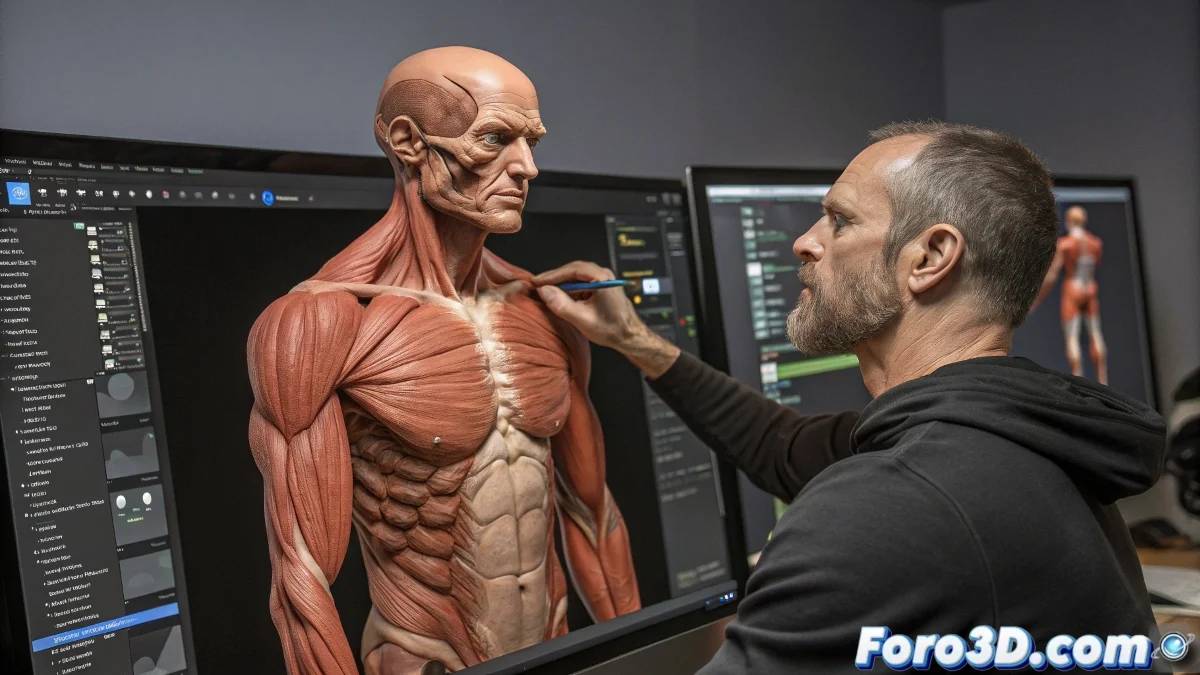
The Digital Gym: How to Bulge Muscles in 3D Without Steroids
Want your 3D character to look like Popeye after a can of spinach? 🏋️ In the 3D world, growing muscles is more about technique than protein. From the classic method to advanced techniques, there are several ways to achieve that muscular look that would make any bodybuilder cry with envy.
The Traditional Method: Bones on Steroids
The most direct way to simulate muscles is by adding extra bones that act like inflatable pumps:
- Control Bones: Small bones strategically placed in muscular areas
- Smart Scaling: Scale animation to simulate contraction
- Prepared Skinning: Vertex weights adjusted for credible deformations
A well-muscled 3D character is like a good cake: it requires well-prepared layers and the oven at the right temperature (or in this case, well-adjusted skinning).
Advanced Techniques for Digital Mr. Olympia
For results that would make Arnold Schwarzenegger blush:
- Maya Muscle System: Professional deformers for realistic simulation
- Ziva Dynamics: Advanced physics for muscles that breathe
- Blender Shape Keys: Combination of morphs and drivers for precise control
These systems are like having a personal trainer, a masseuse, and a nutritionist all in one for your 3D creations. 💪
Training Routine for Beginners
Before diving into creating the next superhero:
- Start with additional bones and basic skinning
- Experiment with scaling and bone positioning
- Once you master the basics, try advanced deformers
- Look for real references (your character shouldn't look like an inflated balloon)
Remember that in the art of muscle rigging, less is more... unless you're creating Hulk, in which case more is still not enough. And if your first attempt looks more like a lab accident than an athletic body, don't worry: even the 3D gods started making characters that looked like they came from a bad dream. 😅