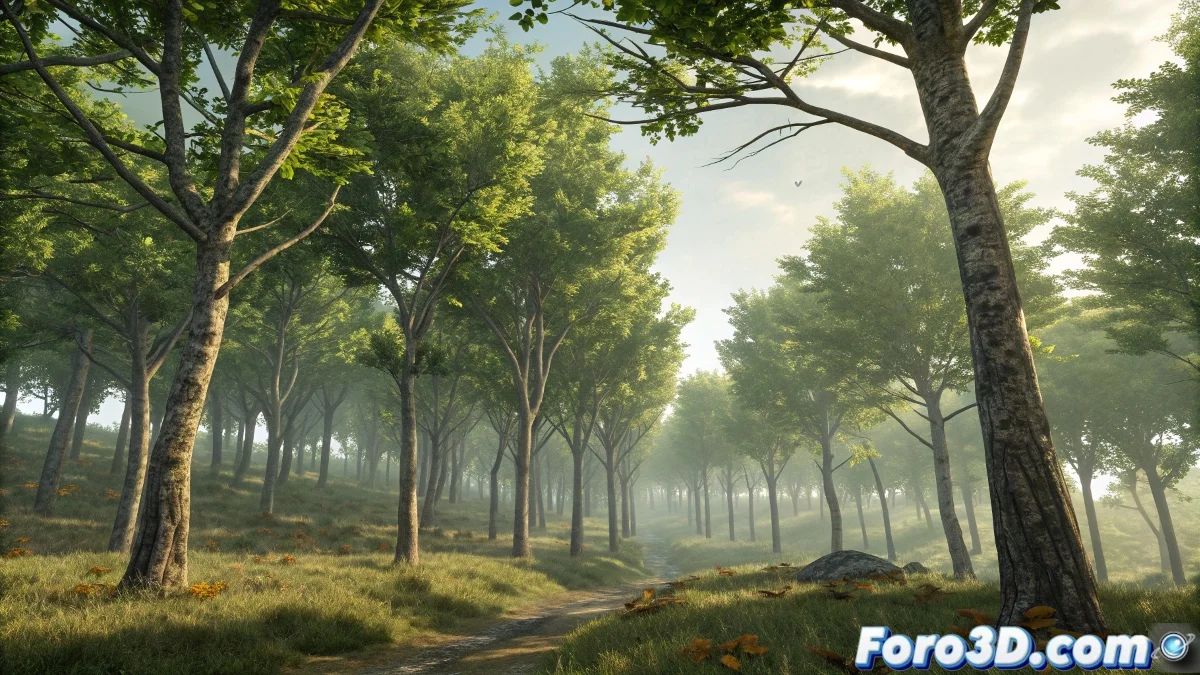
The Art of Bringing Digital Forests to Life
Animating trees convincingly is one of those challenges that separate static scenes from truly immersive environments 🌳. The key lies in understanding that each tree species has its own language of movement – from the gentle swaying of a weeping willow to the more rigid motion of an ancient oak. Combining automatic simulation with manual adjustments is the secret to achieving that realism that makes viewers almost feel the breeze.
Wind Simulation: The Invisible Force
Wind simulation systems form the backbone of modern foliage animation. These systems apply consistent physical forces across large expanses of vegetation, creating coherent movement patterns that replicate how real wind interacts with tree surfaces. Adjusting parameters like intensity, turbulence, and direction allows for creating everything from gentle spring breezes to epic storms 💨.
A well-animated forest is like an orchestra: each tree plays its score but all follow the wind conductor.
Specialized Plugins for Efficiency
Tools like Forest Pack, Forest Pro, and Vue have revolutionized the creation of animated tree environments. These plugins not only optimize performance with intelligent instancing but also incorporate procedural animation systems that automate natural foliage movement.
- Forest Pack: Ideal for large vegetation densities in 3ds Max
- Vue: All-in-one solution for complex ecosystems
- SpeedTree: Specialized in creating and animating custom trees
- Laubwerk: Library of pre-animated plants for different seasons
Manual Deformation Techniques for Close-Ups
For trees in the foreground or that interact directly with characters, automatic simulation alone is usually not enough. This is where manual deformers and custom rigs come into play, providing that extra level of artistic control.
- Bone systems: Skeletal rigs for individual control of main branches
- Flex modifier: Simulation of flexibility and natural oscillation
- Morph targets: For seasonal changes or wind damage
- Physics constraints: Movement limiters to avoid unnatural bends
Optimization for Rendering and Real-Time
Vegetation animation can quickly become a performance nightmare. Intelligent optimization strategies allow maintaining visual fidelity while controlling render times and computational demands.
- Levels of detail: Different resolutions based on distance to camera
- Instancing: Reuse animated geometry with variations
- Wind maps: Textures that control movement intensity
- Simulation cache: Pre-calculate animation to save resources
Integration of External Library Models
Libraries like Evermotion provide excellent bases for building animated vegetation. The key is understanding how to apply animation systems to these models without compromising their visual or topological integrity.
And when your forest decides to dance like it's in a 70s disco, you can always argue it's a rare meteorological phenomenon 🌪️. After all, in the 3D world, sometimes simulation bugs turn into unexpected artistic features.