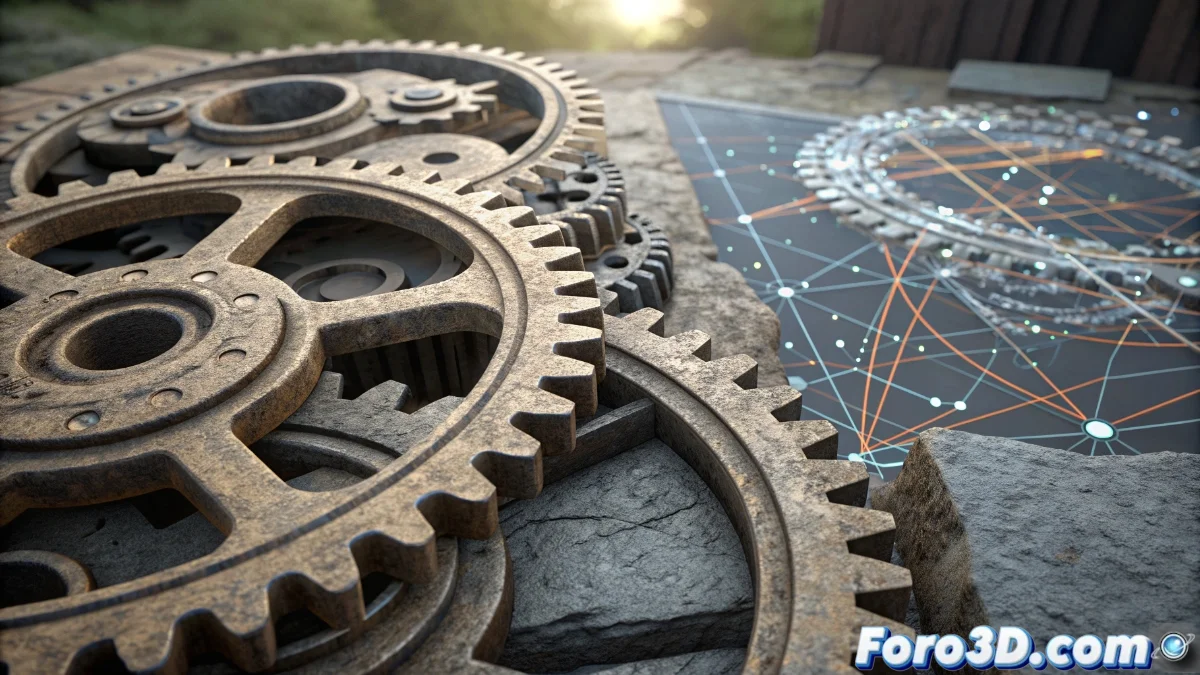
Procedural Design: OpenSCAD vs Material Maker in 3D Modeling
Procedural design represents a methodology where complexity emerges through the systematic application of fundamental rules. This philosophy transforms creative processes through algorithms that generate sophisticated results from basic elements. 🎯
OpenSCAD: Mathematical Precision in 3D Modeling
OpenSCAD implements procedural design through an approach based exclusively on programming code. Users define three-dimensional geometries using variables, boolean operations, and mathematical transformations, creating perfectly parameterized models. This approach is ideal for technical components, precision mechanisms, and any design where dimensional accuracy is critical.
Key Features of OpenSCAD:- Model generation through textual scripting with syntax similar to programming languages
- Ability to create complex geometries through boolean operations and mathematical transformations
- Complete parameterization allowing design modifications through changes in source code variables
"With OpenSCAD, every modification in the code completely redefines the model, guaranteeing absolute precision in each iteration"
Material Maker: Visual Creativity in Procedural Textures
Material Maker translates the procedural philosophy to the realm of texture creation through a visual node system. Each node represents a specific operation - noise generation, filter application, blending - that interconnects with others to produce complex material maps. This visual interface fosters immediate experimentation and intuitive parameter adjustment.
Highlights of Material Maker:- Visual node-based interface that facilitates understanding of the generation flow
- Ability to create from organic surfaces to industrial materials through layer combination
- Significant textural variations through small modifications in the node network
Complementary Approaches in the Procedural Ecosystem
Both tools share the procedural essence but diverge radically in implementation and application. OpenSCAD demands abstract thinking and mathematical logic, producing models defined with millimeter precision but with limitations for organic or random elements. In contrast, Material Maker prioritizes intuitive visual exploration, where users see immediate results when modifying connections between nodes, albeit with less control over exact mathematical aspects. While OpenSCAD generates STL files for 3D printing, Material Maker produces textures for rendering engines and video game development. 🚀