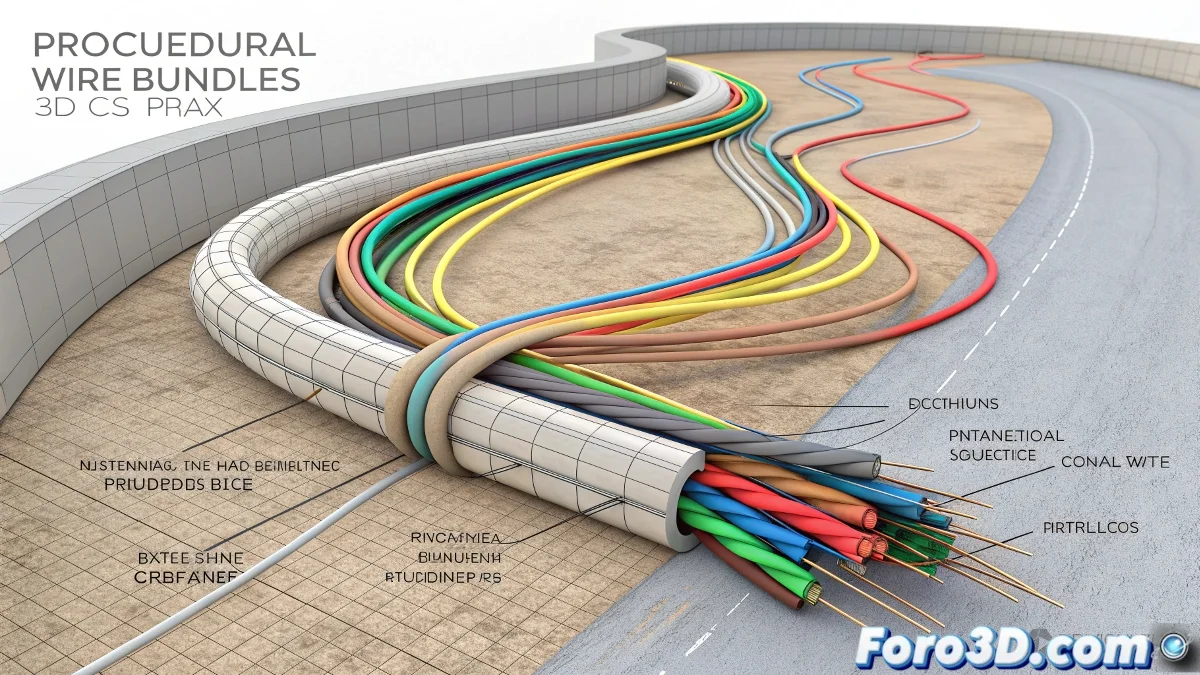
Procedural Wire Bundles: Perfect Organization in 3ds Max
Artist and trainer Paul Neale has published a new tutorial showcasing a procedural method for creating wire bundles with cable ties in Autodesk 3ds Max 🎬. The system is designed to remain fully dynamic, so any adjustment automatically updates throughout the entire assembly, facilitating iteration and creative control. This technique not only saves hours of manual modeling but also ensures consistency and realism in VFX, video game, or technical visualization projects. Because in the 3D world, even cables deserve their own smart system 💡.
Cables with Natural Variation and Realistic Deformation
The workflow uses splines, noise modifiers, and arrays to generate cables with natural variations in their placement and color 🌈. With the help of Path Deform, the cables follow a designated curve, while additional modifiers introduce twists and irregularities that provide an organic and believable look. The result is wire bundles that appear hand-crafted but are completely procedural, with the advantage of being able to adjust parameters like thickness, density, or curvature at any time without breaking the geometry. Because controlled chaos is the essence of realism.
The system uses splines, noise modifiers, and arrays to generate cables with natural variations in placement and color.
Procedurally Generated Cable Ties for Realistic Fastening
The cable ties (zip ties) are also generated procedurally, compressing the cables at set intervals using a combination of instanced arrays, volume select, push modifiers, and skin wrap 🔗. This simulates the natural bulging of cables between the ties and the tightening at each fastening point, adding that level of detail that distinguishes professionals. The ties are built from edited splines, extrusions, and conform modifiers, with thickness added through Shell to achieve volume without sacrificing flexibility. A masterful example of parametric modeling.
Advantages of the Procedural Approach for Artists
This method offers significant benefits over traditional manual modeling:
- Flexibility: Real-time adjustments that propagate automatically.
- Consistency: Controlled variation that maintains visual coherence.
- Efficiency: Drastic reduction in time for iterations and changes.
- Scalability: Easy adaptation to different complexities and scenarios.
Applications in Professional Projects
This technique is invaluable for multiple industries:
- VFX: Creation of wiring for spaceships, robots, or futuristic settings.
- Video Games: Modular assets for industrial or technological environments.
- Technical Visualization: Interactive diagrams or installation manuals.
- Architecture: Integration of realistic wiring in interior renders.
The Irony of Perfect Cables
Thanks to this tutorial, your cables will be so well-organized that even real electricians would want to hire them for their next installation... though they'd probably be surprised to discover they only exist in the digital world 😅.