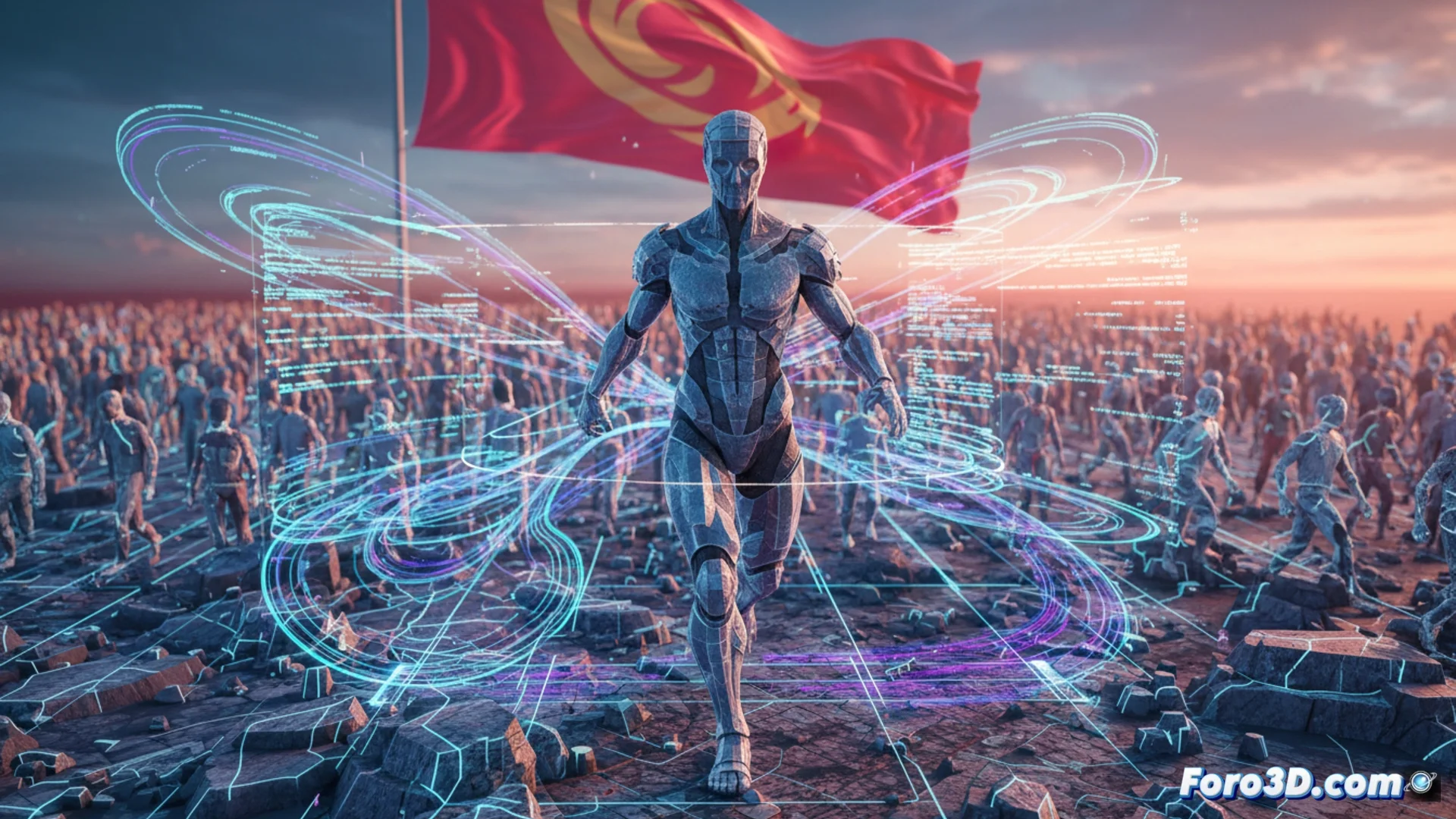
Procedural animation generates movement with rules and algorithms
This method for producing movement is based on applying predefined rules, algorithms, and mathematical systems, instead of manually drawing each keyframe. It allows creating complex and dynamic behaviors that perceive and react to their environment or parameters that change instantly. It is an essential technique in video games, visual effects, and simulations, where elements need to respond in a believable and non-repetitive way. The essence lies in the fact that the movement is automatically calculated, optimizing time and resources by avoiding animating every detail by hand 🚀.
Systems and algorithms produce movement autonomously
The process works by defining a set of equations or rules that describe how an object or character should behave. For example, a system can process how fabric moves with the wind, how a body falls, or how a group of people walks. To implement these rules, visual logic nodes, scripts in languages like Python or C#, or specialized environments within engines like Unity or Unreal Engine are used. The result is an animation that can adapt to unforeseen contexts, delivering variety and realism without linearly increasing manual work.
Key tools and environments:- Logic nodes and scripting: Allow programming behavior rules without relying solely on keyframes.
- Game engines: Environments like Unity and Unreal Engine offer specialized frameworks for developing these systems.
- Programming languages: Python, C#, and others are used to write the algorithms that govern movement.
A traditional animator might comment that it's making the computer do the heavy lifting, although they then spend hours debugging why that tree is performing a dance choreography.
Its main uses are in video games and producing visual effects
In the current industry, this methodology is key for developing particle systems, simulating clothing and hair, handling crowd behaviors (crowd simulation), and creating facial animations based on blendshapes or audio. In the video game realm, it enables characters to adapt to terrain when moving or antagonists to show unique reactions. For generating visual effects, it is applied to simulate large-scale natural phenomena. The power of modern GPUs, through vertex or compute shaders, has greatly expanded its capabilities, allowing the processing of millions of elements in real time.
Concrete applications of procedural animation:- Crowd and clothing simulation: To generate massive, realistic, and dynamic fabric movements.
- Facial animation and particles: Creates expressions and atmospheric effects that respond to stimuli like audio.
- Environmental interaction in video games: Allows characters to walk naturally over uneven surfaces.
The future and impact of the procedural approach
This paradigm transforms how digital movement is conceived, shifting the focus from intensive manual creation to the design of intelligent systems. It saves significant resources and allows scaling animation complexity non-linearly. Although it requires an initial effort to set up and debug the rules, the result is a repertoire of believable, adaptive, and efficient movements, essential for the next generation of interactive and visual experiences. Procedural animation does not replace the artist but gives them more powerful tools to express their vision 🤖.