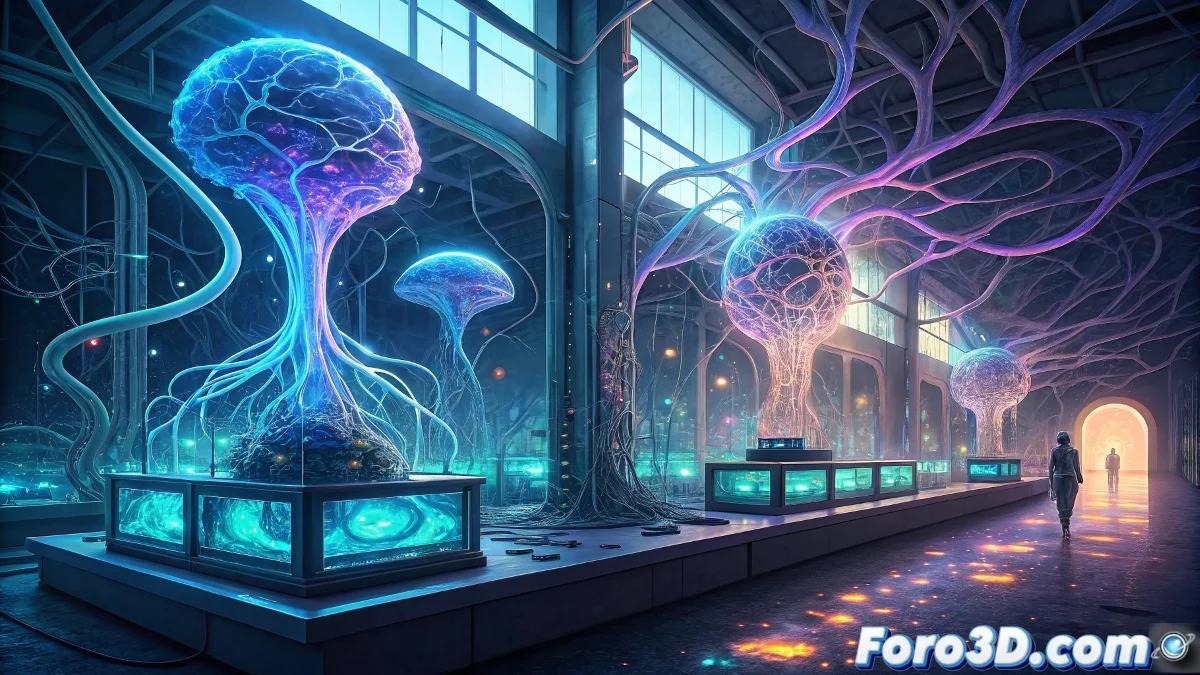
Principles of Generative AI: The Magic of Creating from Nothing
While traditional AI specializes in analyzing and classifying existing information, generative AI makes the quantum leap: it creates original content that never existed before. From poems that could rival Neruda to images that challenge human imagination, these systems don't copy; they understand patterns so deeply that they can generate infinite variations. The secret isn't magic, but sophisticated mathematics that allow machines to learn the "essence" of data and then recreate it with surprising authenticity. 🎨
Unsupervised Learning: Finding Patterns Without Instructions
The heart of generative AI beats in unsupervised learning. Unlike systems that need labels like "cat" or "dog," generative models analyze millions of examples without explicit instructions, discovering underlying patterns on their own. It's like giving someone all the novels written in Spanish without telling them the grammar rules, and they eventually learn to write like Cervantes simply by absorbing the structure of the language. This ability to find order in chaos is what enables creation, not just imitation. 📚
Fundamental Concepts of Generative AI:- probability distribution over complex data spaces
- latent spaces where essential features are encoded
- generation through sampling from learned distributions
- evaluation of quality and diversity of generated samples
Generative Adversarial Networks (GANs): The Forger and Detective Game
One of the brightest inventions in generative AI is GANs, where two neural networks play a continuous cat-and-mouse game. One network (the generator) creates fake content, while the other (the discriminator) tries to detect if it's real or generated. With each iteration, the generator improves its forgeries and the discriminator sharpens its judgment. This adversarial process continues until the generator produces content indistinguishable from the real thing. It's the principle behind faces of people who don't exist and photographs of imaginary places. 🎭
Generative AI doesn't repeat what it has seen; it expresses what it has understood
Diffusion Models: From Noise to Masterpiece
Diffusion models work through a fascinating two-phase process. First, they learn to destroy data by gradually adding noise until it looks like TV static. Then, they learn to reverse this process, reconstructing coherent data from absolute chaos. When you use tools like DALL-E or Midjourney, you're seeing this principle in action: the model starts with random noise and, step by step, "reveals" an image that matches your description. It's like watching a sculptor who sees the statue inside the marble and simply removes what's extra. 🗿
Main Generative Architectures:- GANs for image generation and synthetic data
- transformers for text and sequences (GPT, BERT)
- diffusion models for high-quality images
- variational autoencoders for controlled generation
Transformers and Attention: The Secret of Natural Language
The revolution of models like GPT is based on the attention mechanism, which allows the network to weigh the importance of each word in relation to all others in a sequence. Instead of processing text linearly, transformers analyze connections between distant words, capturing complex dependencies that give richness to human language. This explains why ChatGPT can maintain coherence in long conversations and understand subtle contexts: it's not memorizing responses, but generating language by understanding deep relationships. 💬
Latent Spaces: The Hidden Universe of AI Creativity
Perhaps the most poetic concept in generative AI is the latent space: a compressed representation where each point corresponds to a possible creation. Moving smoothly through this space, AI can generate faces that age progressively, transform a horse into a zebra, or create music that evolves from classical to jazz. This space isn't random; it's structured according to the semantics of the training data, allowing algebraic operations like "king - man + woman = queen" in the visual or musical domain. 🌌
Practical Applications of These Principles:- generation of coherent and contextually relevant text
- creation of images from textual descriptions
- synthesis of voice and music with specific characteristics
- design of molecules and materials with desired properties
The principles of generative AI represent one of the deepest developments in computing history: machines that don't just calculate, but understand and create. Far from being mere advanced statistics, these systems capture the essence of human creativity: the ability to recognize patterns and recombine them into novel forms. And this is just the beginning of a journey where machines won't just help us solve problems, but will accompany us in the act of creation itself. ✨