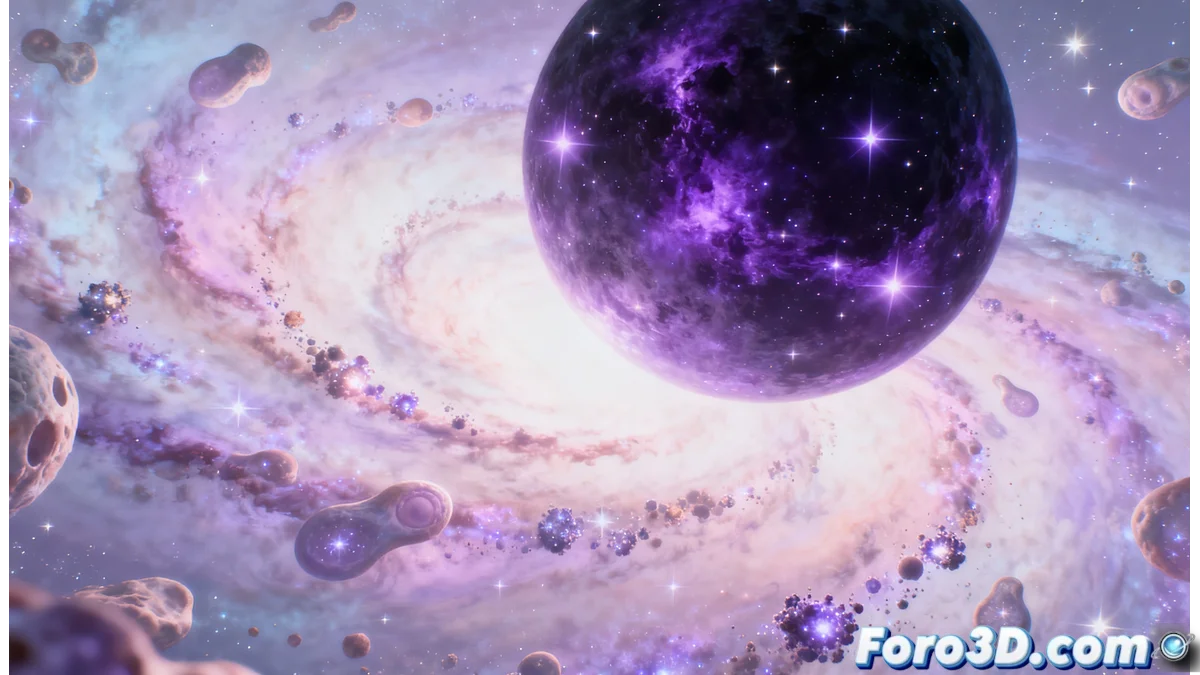
Primordial Dark Matter Stars: The Forgotten Giants of the Cosmos
Modern cosmology is completely reconsidering the nature of the first stellar objects that illuminated the universe. New theoretical models suggest that primordial stellar structures could have been radically different from the conventional stars we know today 🌌
Alternative Energy Mechanisms
Unlike normal stars that rely on nuclear fusion of hydrogen and helium, these hypothetical entities would obtain their power through completely different processes. When dense concentrations of dark matter gravitationally collapse, an extraordinary phenomenon is triggered where dark matter particles and their antiparticles annihilate each other, releasing colossal amounts of energy that could sustain objects with masses equivalent to millions of suns without requiring conventional nuclear processes.
Fundamental characteristics of these structures:- Energy source based on dark matter annihilation instead of thermonuclear fusion
- Ability to reach extraordinary masses, exceeding the solar mass by millions of times
- Predominant existence during the first hundreds of millions of years post-Big Bang
The early universe seems to have hosted supermassive versions of everything, as if the teenage cosmos experienced a kind of cosmic inferiority complex that drove it to create colossal structures.
Repercussions on Cosmological Understanding
The possible existence of these dark matter stars would resolve multiple enigmas that have puzzled astronomers for decades. Their formation and eventual collapse would provide an elegant mechanism to explain the origin of the supermassive black holes we observe in current galactic nuclei.
Observational and Technological Implications:- Natural explanation for the formation of intermediate-mass black holes that evolve into supermassive versions
- Possibility of detection using cutting-edge instruments like the James Webb Space Telescope
- Unique opportunity to obtain direct evidence about the fundamental nature of dark matter
Future of Cosmological Research
The search for these primordial structures represents one of the most exciting frontiers of contemporary astrophysics. Their potential discovery would not only transform our understanding of early cosmic evolution, but could ultimately unveil the mysteries of dark matter that constitutes approximately 85% of the universe's matter 🔭