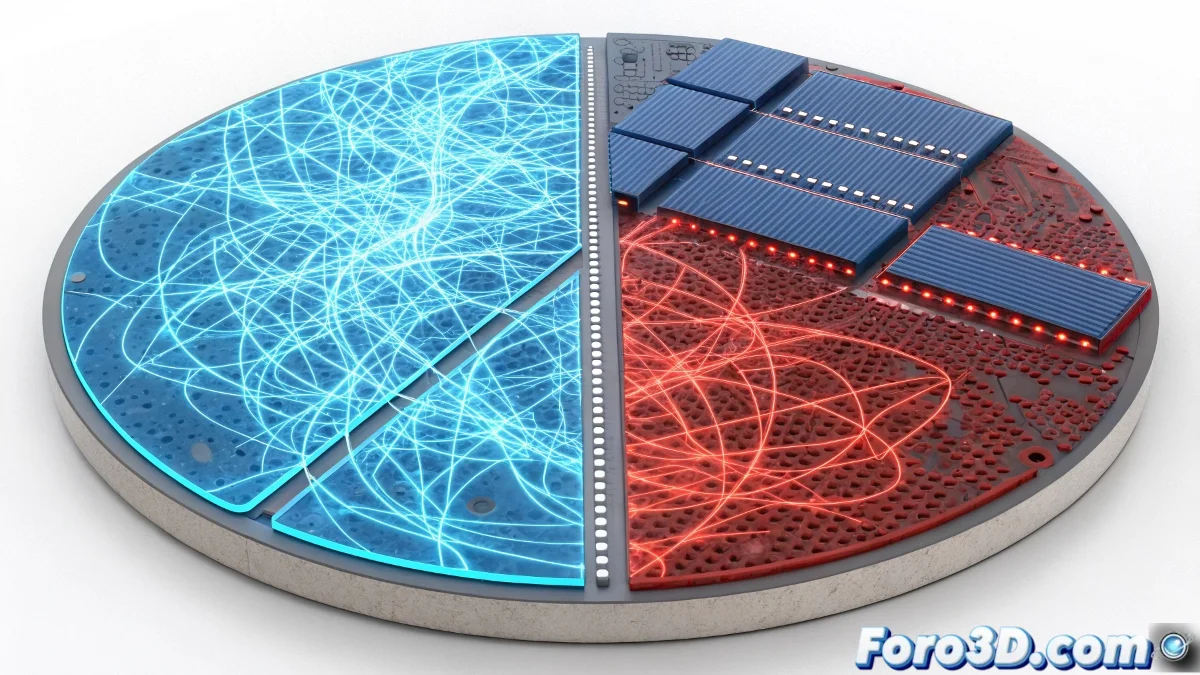
The PowerVia technology represents one of the most radical changes in processor architecture since the invention of the integrated circuit. Developed by Intel, this innovation moves the power distribution network from the front side of the chip to the back, solving fundamental problems that have limited semiconductor advancement. ⚡
What makes PowerVia unique is how it addresses the bottleneck of interference between data signals and power lines. By physically separating these networks into different planes of the wafer, it eliminates the constraints that for decades have complicated the design of increasingly dense and complex processors.
Power from behind, signals from the front: the new order of silicon
The problem PowerVia solves
In traditional architecture, power and signal interconnections compete for the same space on the front side of the chip. This forced coexistence generates multiple problems that PowerVia eliminates at the root through its revolutionary approach.
Limitations overcome with PowerVia:
- interference between power lines and signals
- voltage drops in complex distributions
- routing limitations for interconnections
- energy losses due to resistance in long traces
Technical architecture and operation
The implementation of PowerVia involves creating a three-dimensional structure where the original wafer is functionally divided. The front side is dedicated exclusively to signal interconnections, while the back side houses the complete power distribution network.
Key components of the technology:
- power distribution network on back substrate
- micro-vias connecting power to transistors
- signal-optimized interconnection layers
- low-resistance materials for power lines
Practical benefits for performance
The physical separation between power and signals allows each network to be optimized independently. Data interconnections can be denser and more efficient, while power distribution achieves lower resistance and more predictable voltage drops.
And so, while the industry celebrates each new nanometer reduction, PowerVia demonstrates that sometimes true progress is not in making things smaller, but in reorganizing them more intelligently. The irony that flipping the chip upside down may be the most sensible way to move forward. 💡