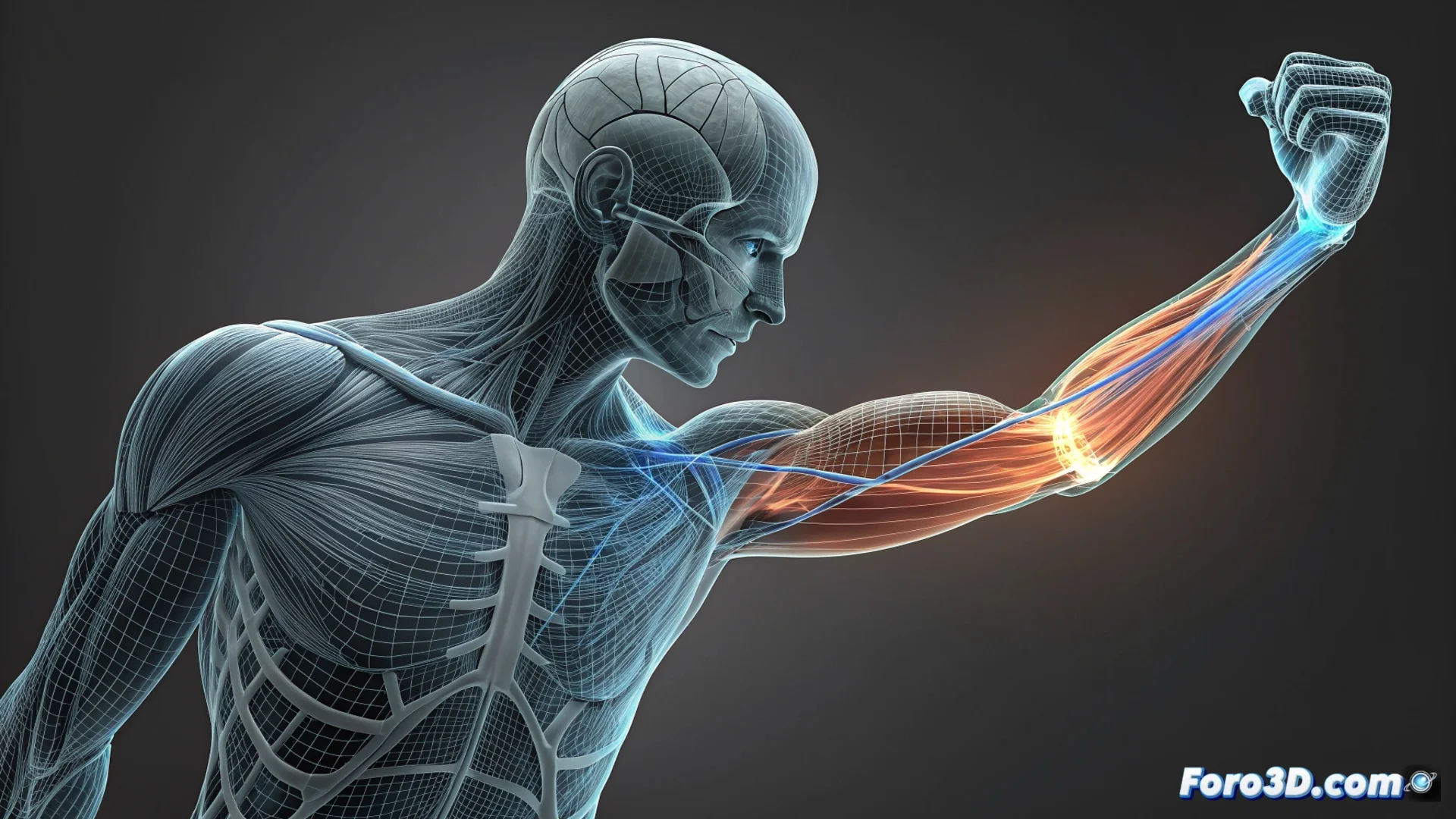
Pose Space Deformation Field: the future of correcting deformations in 3D
In digital animation, achieving believable character movement is a constant challenge. The Pose Space Deformation Field (PSD Field) emerges as a revolutionary solution, displacing the classic Corrective Shape Blending paradigm. This technique not only optimizes the workflow but redefines how we understand skin and muscle corrections in real time. 🚀
Farewell to predefined shapes, hello to the continuous field
The main limitation of traditional corrective blendshapes is their discrete nature. Artists must manually sculpt dozens, sometimes hundreds, of shapes to cover a finite range of poses. The PSD Field solves this by implementing a continuous deformation field. Instead of blending between isolated shapes, the system queries a data volume that defines how each vertex of the mesh displaces for virtually any combination of joint rotations. This generates smooth transitions and eliminates unsightly visual jumps.
Key advantages of the continuous field:- Infinite precision: It can be evaluated for any joint angle, not just precalculated ones, allowing corrections for unforeseen intermediate poses.
- Organic result: Based on a continuous model, deformations better mimic the real physical behavior of skin and muscle tissue.
- Automation: The field can be generated through physical simulation or machine learning algorithms, drastically reducing manual sculpting work.
Every rigger's dream is for the model to deform well everywhere, without having to sculpt a corrective shape for every degree of rotation.
How is this field built and used?
To implement a PSD Field, deformation information is typically encoded in a 3D volumetric texture or a signed distance field (SDF). Each voxel or texel within this volume stores displacement vectors. When the character's skeleton is animated, the engine (using a vertex or compute shader) samples this volume. It uses coordinates derived from the current pose—such as the position and orientation of the bones—as lookup coordinates (UVW) to obtain the exact displacement to apply to the affected vertices.
Common ways to store and process the field:- 3D Texture (Volumetric): Acts as a data grid where displacements are queried. It is efficient for integration into GPU-based rendering pipelines.
- Signed Distance Field (SDF): Defines the ideal deformation surface. It is very useful for representing complex shapes and allows boolean operations.
- Dynamic Sampling: The shader evaluates the field at runtime, applying corrections on the fly as the animation evolves, without needing to pre-blend geometries.
Impact on production and the future of rigging
Adopting the Pose Space Deformation Field transforms the animation pipeline. Riggers and technical artists can spend less time manually sculpting corrections for specific cases—such as preventing a shoulder from deforming strangely at 45 degrees—and more time refining the model's overall behavior. This technique brings 3D animation closer to an ideal of intelligent automation, where the system understands and applies the laws of anatomical deformation by itself. The end result is characters that move with unprecedented fidelity and naturalness. 🎬