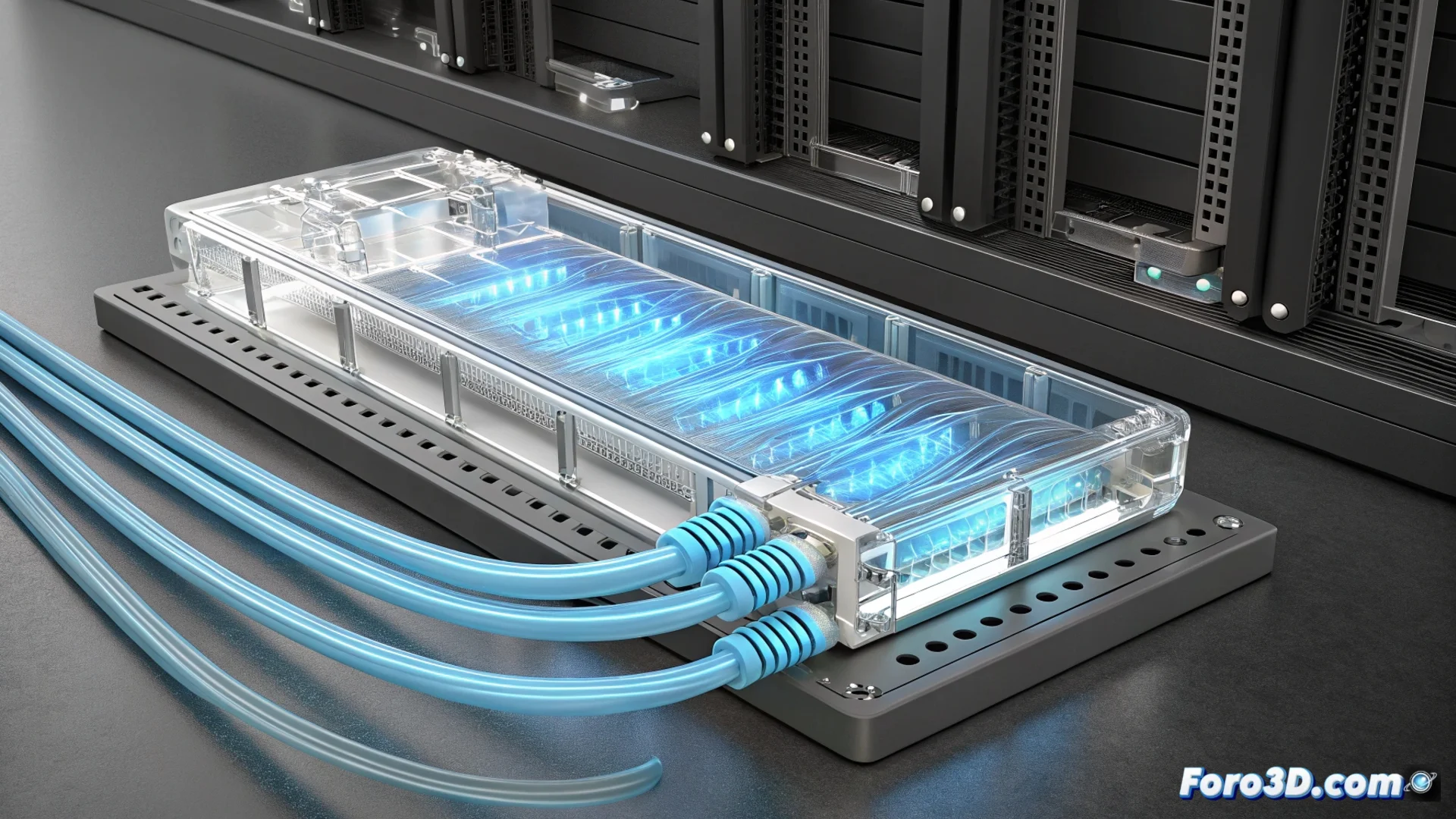
Point2 and AttoTude Develop Plastic Waveguides for AI Data Centers
The race to build more powerful data centers for artificial intelligence hits a physical limit: cables. Companies Point2 Technology and AttoTude propose a radical solution that leaves behind copper and fiber optics. Their innovation is waveguides made of plastic that operate in the terahertz range, designed to move data between accelerators like GPUs more efficiently. 🚀
A Response to Interconnection Bottlenecks
Modern AI accelerators need to communicate at extreme speeds and with minimal latency. Copper cables lose signal over short distances when speed increases, and fiber optics, although fast, require signal conversions that add complexity and cost. Point2 and AttoTude's technology seeks to offer an optimal middle ground: the high capacity of fiber with a potentially simpler and more economical format to integrate.
Key Advantages of Plastic Waveguides:- Transmit at terahertz frequencies, enabling much higher bandwidths.
- Use multiple channels within the same waveguide, multiplying the capacity to send data.
- Their plastic construction makes them cheaper to produce than traditional fiber optic links.
While some debate conventional cables, others are already thinking about how to move terabits of data through a simple plastic tube.
How the Transmission System Works
The core of this technology is a dielectric plastic waveguide that channels electromagnetic signals at extremely high frequencies. By employing multiple wave channels simultaneously within a single conduit, the system achieves transmitting large volumes of data over practical distances for a data center, ranging from 10 to 20 meters. This method not only promises more speed but also consumes less energy per bit transferred.
Impact on AI Infrastructure:- Enables connecting thousands of accelerators (GPUs, TPUs) with greater density and less signal loss.
- Facilitates scaling computing clusters for AI, eliminating a key obstacle in their design.
- Could reduce the total cost of building and operating server farms to train AI models.
The Future of Connectivity in Data Centers
This initiative underscores the critical evolution of interconnection in high-performance environments. Plastic waveguides represent a paradigm shift, where the physical medium for moving data is redesigned from scratch to meet specific demands of processing massive information. If their development and adoption succeed, they could redefine how future data centers are built, making moving terabytes within them faster, cheaper, and more efficient. 🔌