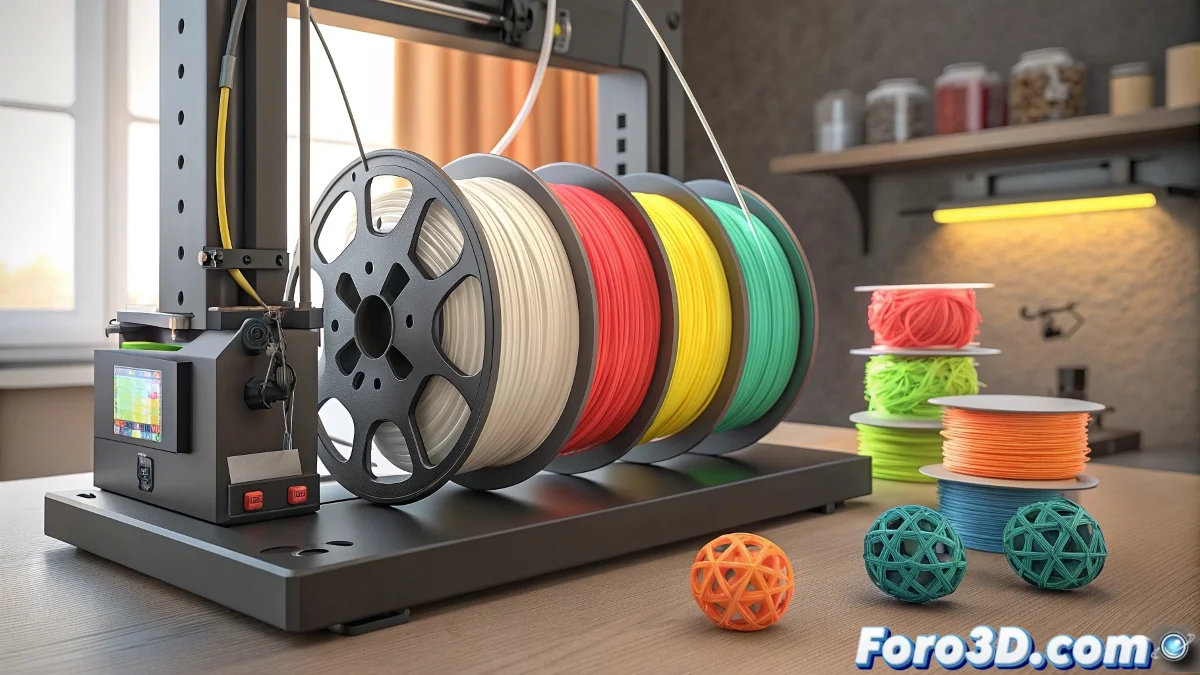
The King of 3D Printing Filaments
Polyactic acid, better known as PLA, has established itself as the most popular filament in the world of 3D printing. Its fame is no coincidence: it combines ease of use with consistent results, making it the choice for both novices and experts in their projects. This thermoplastic material of vegetable origin, generally derived from corn starch or sugarcane, represents the perfect entry point to the universe of additive manufacturing.
What really sets PLA apart is its relatively low printing temperature, which ranges between 180°C and 220°C. This feature allows it to be used in virtually any 3D printer on the market, even basic models. Additionally, it does not require a heated bed, although using one significantly improves results. Designers particularly appreciate its minimal shrinkage during cooling, which translates into dimensionally precise parts.
Technical Advantages of PLA Filament
- Excellent adhesion to the print bed without the need for high temperatures
- Minimal deformation and warping during the cooling process
- Wide range of colors and finishes available on the market
- Compatibility with different types of nozzles and hotends
Mechanical Properties and Practical Applications
In structural terms, PLA offers superior rigidity to many other filaments, although it exhibits some fragility in applications requiring flexibility. Its tensile strength is around 50 MPa, sufficient for most prototypes and decorative parts. Industrial design professionals value it for creating conceptual models where surface finish is prioritized over mechanical strength.
PLA proves that simplicity in processing is not at odds with quality in the final results
In terms of finish, PLA allows for smooth surfaces and sharp details that enhance the visual quality of prints. It responds excellently to post-processing through sanding, painting, or polishing, expanding its creative possibilities. However, its low glass transition temperature (around 60°C) limits its use in applications exposed to heat or extreme outdoor conditions.
Important Considerations for Its Use
- Storage in a dry environment to avoid moisture absorption
- Adequate ventilation during printing, although less critical than with other materials
- Limitations in mechanical applications or those exposed to constant loads
- Excellent for visual parts but not recommended for critical structural components
The versatility of PLA keeps it as the reference filament for education, rapid prototyping, and applications where visual appearance takes precedence over extreme mechanical considerations. Its biodegradable nature and renewable origin add an ecological value that meets current demands for sustainability in design and manufacturing. 🌱
And remember: PLA may be easy to use, but that doesn't mean it forgives all calibration errors... though most of them. 😉
You can see this product and similar ones in the : store