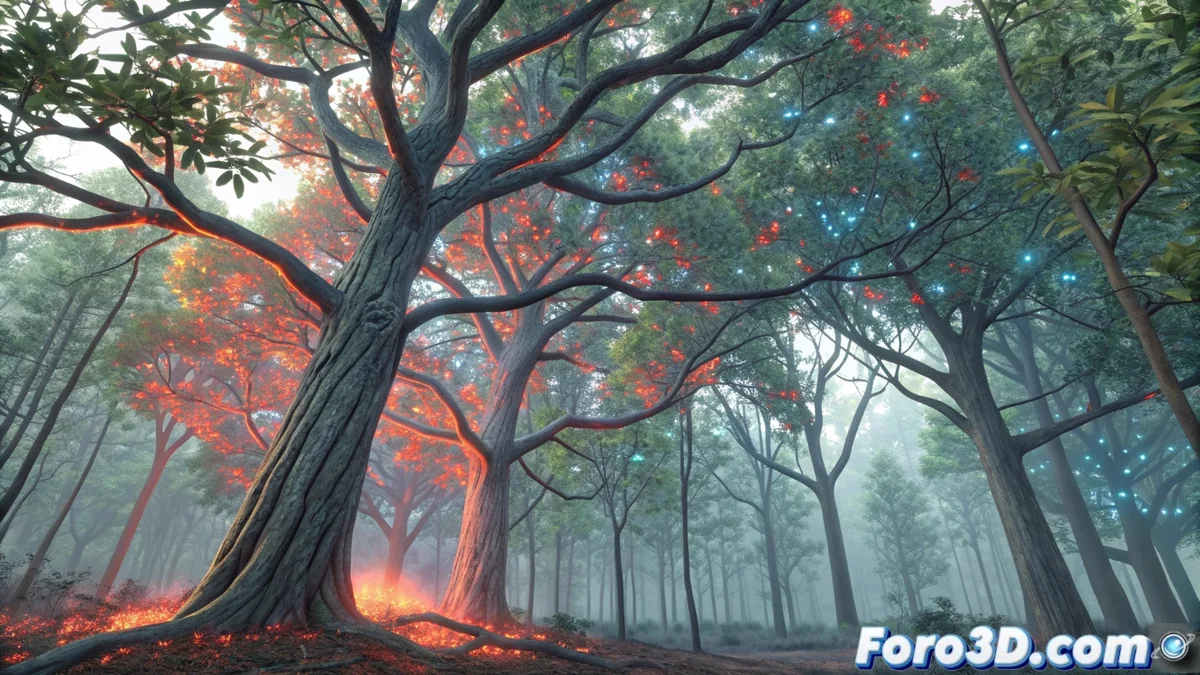
Pivot Painting: Animate Vegetation Without Bones in Real Time
In the development of virtual environments, bringing forests and meadows to life can consume many resources. An innovative technique known as Pivot Painting solves this challenge by processing vegetation in real time without relying on traditional skeletal systems. Instead, it stores information directly in the geometry of the models. 🍃
The Mechanism Behind the Technique
The core of this method lies in painting specific attributes onto the mesh vertices. An artist, or an automated tool, assigns data such as the initial wind direction, branch flexibility, and its main rotation point. A specialized vertex shader in the game engine then reads this information. It combines these painted data with global variables, such as the current wind strength and direction, to calculate and apply movement in each frame.
Data Flow in the Shader:- The shader queries the painted values on each vertex (rigidity, pivot).
- It blends these parameters with the global wind simulation controls.
- It performs mathematical calculations to bend branches and sway leaves from their designated anchor points.
What a project always has plenty of is GPU cycles and time to set up skeletons for every blade of grass.
Key Advantages of Adopting This Approach
The main gain is performance efficiency. By avoiding complex skeletons and their costly deformation, the load is drastically reduced when processing thousands of plant instances. This is essential for maintaining a high frame rate in open scenes with dense foliage, such as open worlds or real-time strategy games.
Benefits for the Artistic Pipeline:- The workflow is streamlined, as there is no need to adjust skin weights or manually animate bones for each plant variant.
- The artist paints the data once per model, and the shader automatically generates consistent movement variations.
- It allows iterating and changing wind behavior globally without retouching each individual asset.
Practical Application and Final Result
Implementing Pivot Painting allows populating scenes with a large number of trees, bushes, and grasses that move organically and convincingly. The resulting movement is not mechanical, as each vertex reacts uniquely according to its painted attributes, creating an illusion of life at a very low computational cost. This technique has become a cornerstone for optimizing and bringing extensive virtual ecosystems to life. 🌳