Physics Suggests That Time Could Be an Emergent Illusion
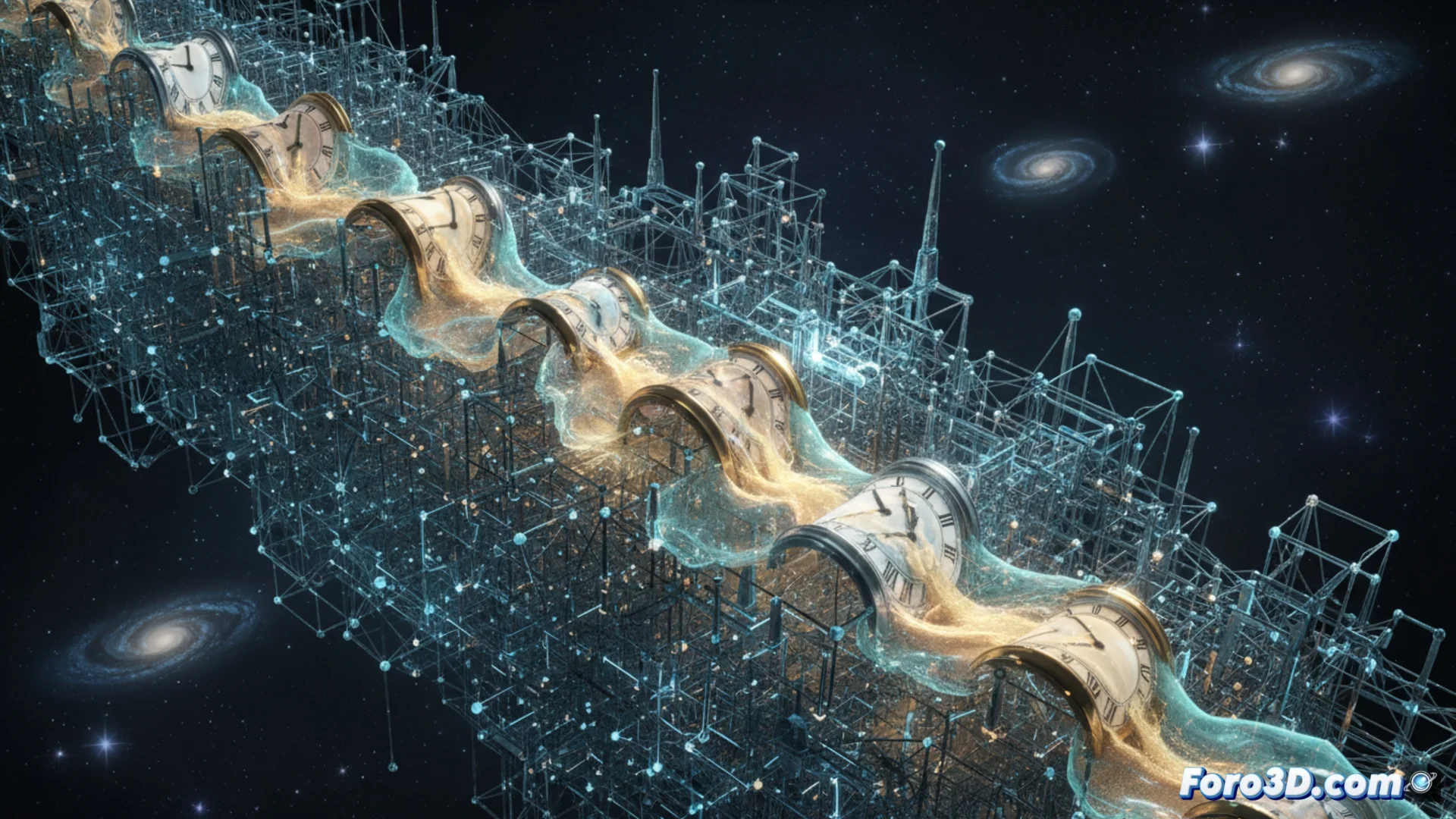
A radical perspective in theoretical physics suggests that time might not be a fundamental element of reality, but rather a property that emerges from a deeper, timeless substrate. This approach directly confronts our daily experience and is grounded in frameworks like loop quantum gravity, which conceives the cosmos as a vast network of interconnections where there is no absolute temporal flow. If this view is correct, yesterday, today, and tomorrow would coexist in a fixed structure. 🌀
Ways to Test That Time Is Not Fundamental
To verify this hypothesis, researchers seek inconsistencies in universal constants, which would be completely invariable if time were real. A crucial experimental approach involves comparing the oscillation frequency of atomic clocks with that of atomic nuclei located near massive bodies. If time emerges from a granular structure, these frequencies could drift in a way that conventional theories do not anticipate, thus revealing the discrete texture of space-time.
Key Experimental Strategies:- Search for variations in fundamental constants that should be fixed.
- Measure with extreme precision the synchronization between different types of atomic clocks in intense gravitational fields.
- Analyze any deviations that reveal the underlying granular nature of reality.
Confirming that time is an illusion would revolutionize our understanding of reality. Concepts like causality, change, and free will would need to be reinterpreted.
Consequences of a Timeless Cosmos
Demonstrating that time is an emergent construct would completely transform how we understand the universe. Core ideas like causality, change, and free will would require a new interpretation within a framework where everything "already is." This impact transcends theoretical physics, reaching cosmology and our philosophical reflection on existence. The great challenge is to harmonize this framework with the subjective and irreversible experience of time that we perceive. 🤯
Deeply Affected Areas:- Theoretical physics and cosmological models of the universe's origin.
- Philosophy of science and our notion of existence and becoming.
- The interpretation of conscious experience and the perception of change.
Reconciling Theory with Perception
The journey to validate this idea is as complex as its implications. Although our perception tells us that time flows, physics explores the possibility that it is a side effect of a more static reality. Of course, if time turns out to be an illusion, being late would cease to be a personal problem and become a cosmic perception error. Perhaps we can attribute it to quantum entanglement. The path ahead requires ingenious experiments and an open mind to rethink the most basic things. ⏳