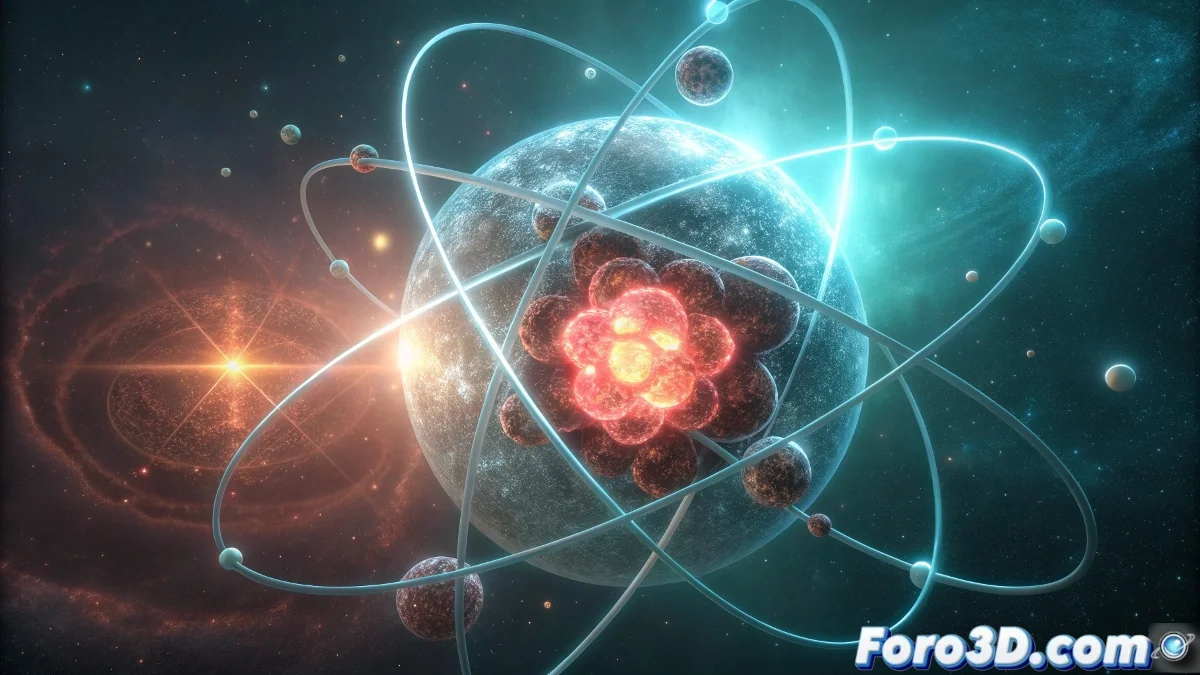
When the Invincible Shows Its Cracks
Physicists from leading institutions worldwide have experimentally documented the specific conditions under which the strong nuclear force—traditionally considered the most powerful force in nature—begins to show signs of weakness. This fundamental force, responsible for holding quarks together within protons and neutrons, and by extension for keeping atomic nuclei cohesive, had always been considered inviolable under normal conditions. Experiments in particle accelerators have revealed that at extremely high energies and critical densities, this omnipresent force can significantly attenuate.
The discovery has profound implications for our understanding of the early universe, where these extreme conditions were the norm rather than the exception. During the first microseconds after the Big Bang, when the universe was filled with quark-gluon plasma, the strong force may have behaved radically differently from how it does in our current universe. This research also provides crucial clues about the behavior of matter in neutron stars and other extreme astrophysical objects.
Even the universe's most solid foundations have their limits under extreme pressure
Nuke Project Setup
To visualize this phenomenon in Nuke, we begin by creating a 3840x2160 pixel script with linear color space, ideal for precise scientific manipulation. We set up Constant nodes for the different base layers: quantum space background, subatomic particles, and force fields. The node graph organization is crucial from the start, grouping related elements to maintain clarity while working with complex interactions between components.
We configure TimeClip nodes to handle the animation of the phenomenon over time, essential for showing the transition from full strength to weakening. We use mathematical expressions linked to sliders to control key parameters like force intensity, energy density, and influence radius, allowing quick iterative adjustments as we explore different visual representations of the phenomenon.
- 4K Script with linear color space
- Organized node graph by components
- TimeClip nodes for temporal animation
- Expressions and sliders for parametric control
Representation of the Strong Nuclear Force Field
The strong nuclear force field is created using a combination of procedural Noise nodes and custom GodRays nodes. We start with a fractal-type Noise node that generates the base texture of the field, adjusting frequency and amplitude parameters to simulate the fluctuating quantum nature of the force. We apply multiple layers of noise at different scales to create visual richness at macro and micro levels.
For the characteristic "grip" effect of the strong force, we use VectorDistort nodes that create radial attraction patterns around quark positions. The intensity of these patterns is linked to our main control sliders, allowing us to visually show how the attractive power diminishes under extreme conditions. We add Glow nodes with chromatic modulation that shift from intense blue (full strength) to pale red (weakened force).
Visualizing the invisible requires translating abstract mathematics into intuitive visual language
- Multi-scale fractal Noise for field texture
- Radial VectorDistort for attraction patterns
- Glow with chromatic modulation to indicate intensity
- Blending layers for visual complexity
Creation and Animation of Subatomic Particles
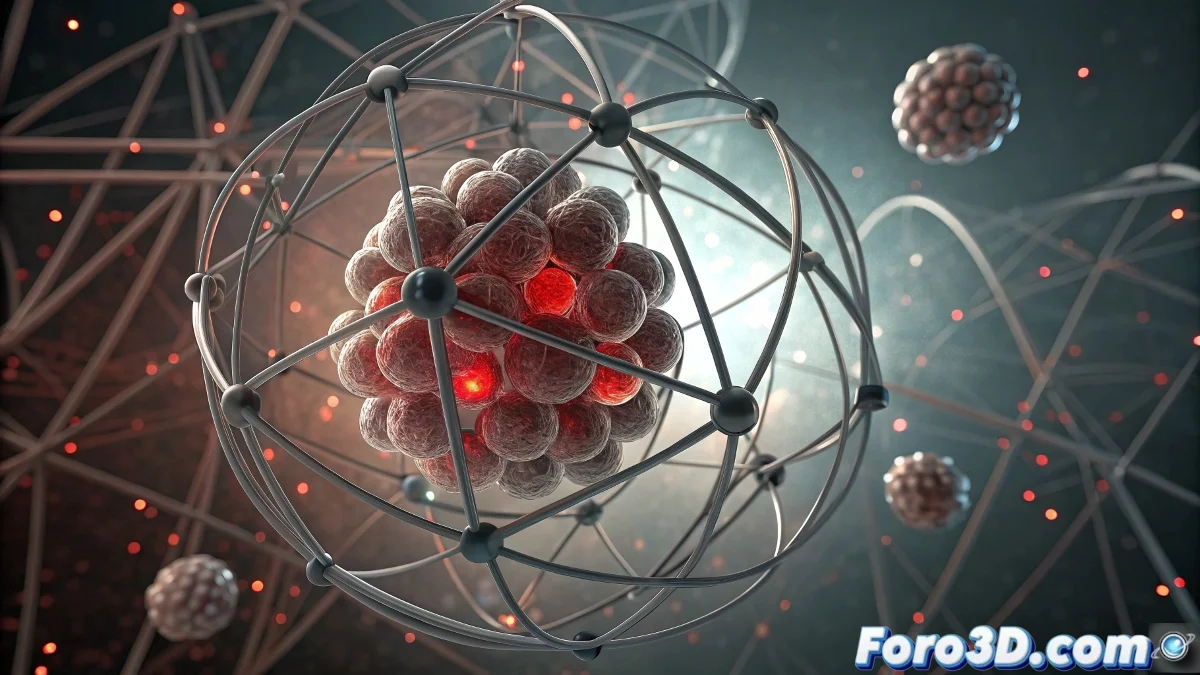
The quarks and gluons are generated using Nuke's particle system with ParticleEmitter and ParticleToImage nodes. We configure different emitters for the three quark colors (red, green, blue) and for gluons (represented as exchange particles with unique properties). Each particle type has differentiated movement and behavior properties that reflect their roles in the strong force interaction.
The particle animation is crucial for showing the transition between force states. We use CurveTool and Tracker nodes to create movements that evolve from tight, stable orbits (full strong force) to wider, erratic trajectories (weakened force). Parameters for particle speed, attraction, and lifetime are all linked to our master controls to maintain physical coherence in the visualization.
Transition Effects and Extreme Conditions
To represent the high-energy and density conditions that cause weakening, we implement a roto-based transition effects system. We create Roto nodes to define regions of interest where high-energy collisions occur, and use animated Blur and Glow nodes to show how extreme energy disrupts the force field. The intensity of these effects increases progressively during the animation.
The force weakening itself is visualized using radial DirBlur nodes that selectively blur force patterns in high-energy areas, combined with Grade nodes that reduce contrast and saturation in affected force fields. We use animated alpha channels to precisely control where and how much this weakening effect is applied.
- Animated Roto for high-energy regions
- Radial DirBlur for weakening patterns
- Selective Grade for visual intensity reduction
- Alpha channels for precise transition control
Element Integration and Final Composition
The final composition combines all elements using hierarchically organized Merge nodes. We use scientific blending modes like Add and Screen for energy effects, while maintaining more natural modes like Over for fundamental particles. The depth of field is simulated using ZDefocus nodes that keep areas of interest sharp while subtly blurring the background.
For the final render, we set up Write nodes with lossless compression and multiple channels exported separately (RGB, Alpha, Depth, MotionVectors). This allows maximum control in post-production to adjust individual elements if needed. The animated sequence clearly shows the progression from an intact nuclear force state to weakening under extreme conditions.
The true magic of composition occurs when science and art converge to reveal the invisible
Annotation Elements and Scientific Context
We incorporate animated annotation elements using Text and Axis nodes that appear at key moments to explain scientific concepts. Energy scales are visualized using Ramp nodes with dynamic labels that display values in MeV and GeV during the transition. Simplified Feynman diagrams are integrated as floating elements that illustrate interactions between quarks and gluons in different force regimes.
The timing of the entire animation is carefully choreographed to balance scientific clarity with visual impact. The most dramatic moments—such as the temporary breaking of quark bonds—are emphasized with strategic pauses and synchronized sound effects (in the final audio version).
- Animated texts for scientific explanations
- Energy scales with dynamic values
- Feynman diagrams integrated
- Choreographed timing for narrative clarity
Educational and Outreach Applications
This Nuke visualization has significant potential for education and scientific outreach. By making an abstract particle physics concept tangible, it helps bridge the gap between fundamental research and public understanding. The techniques developed can be adapted to visualize other equally challenging quantum phenomena.
For researchers and educators, the resulting Nuke script serves as a reusable template that can be modified to show different aspects of the strong nuclear force or adapted to visualize other fundamental forces under extreme conditions.
The Art of Revealing the Invisible
This project demonstrates how Nuke can go beyond entertainment to become a powerful tool for scientific exploration. By providing means to visualize phenomena that would otherwise be inaccessible to human perception, it helps better understand the fundamental forces that govern our universe.
The ability to precisely manipulate every aspect of the visualization—from the subatomic scale to cosmological-level energy effects—makes Nuke an ideal platform for translating complex scientific data into comprehensible and impactful visual experiences.
In the end, visualizing the strong nuclear force in Nuke is like translating the mathematical language of the universe into the visual language of human understanding—and in that process, we perhaps understand the fundamental rules of reality a little better 🔬