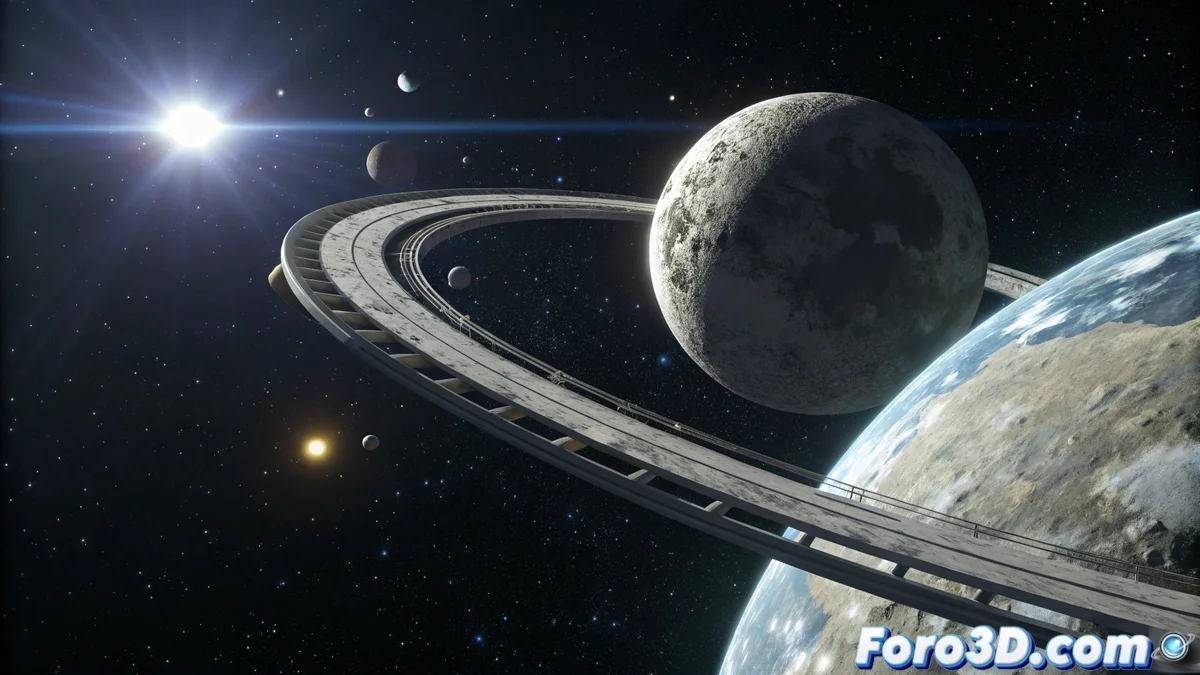
Physicists Design Experiments Without Material Limits
In a purely theoretical exercise, five researchers propose what projects they would undertake if there were no barriers of money, engineering, or the laws of physics we know. These concepts seek to expand scientific imagination, defining the maximum we can think, not what we can build today. 🚀
A Planetary-Scale Acceleration Ring
The most prominent proposal imagines building a particle collider that completely surrounds the Moon. This ring would surpass the Large Hadron Collider (LHC) in size by orders of magnitude. Its scale would allow generating collision energies never seen before, which could reveal new domains of fundamental physics.
Objectives and challenges of the lunar accelerator:- Search for direct evidence of extra dimensions or the components of dark matter, phenomena that Earth-based accelerators only investigate indirectly.
- Solve space engineering problems, such as assembling the structure in vacuum and stabilizing a planetary-scale structure.
- Reach energy levels that open a window to a completely new physics, beyond the Standard Model.
In this scenario, the annual physics budget would be measured in points of the galactic Gross Domestic Product.
A Laser Device That Redefines the Possible
Another radical idea proposes developing a laser of such extreme power that it challenges current principles of quantum electrodynamics. It would concentrate a colossal amount of light energy into a tiny point, recreating conditions similar to the moments after the Big Bang. ⚡
The power to separate the quantum vacuum:- The generated electric field would be so intense that it could separate the quantum vacuum itself, a theoretical phenomenon.
- This process would produce spontaneous pairs of particles and antiparticles directly from "nothing."
- To achieve it, a new physics of materials and optics would be needed, overcoming the dielectric breakdown limits that currently cap maximum laser power.
The Value of Thinking Without Borders
These hypothetical designs, although impossible to build today, serve to drive theoretical thinking and point out the ultimate frontiers of our knowledge. In a universe without material restrictions, scientists' main complaint might be that building the lunar accelerator delays their next space coffee. The exercise underscores that scientific curiosity always seeks to go further, even when current means cannot keep up. 🌌