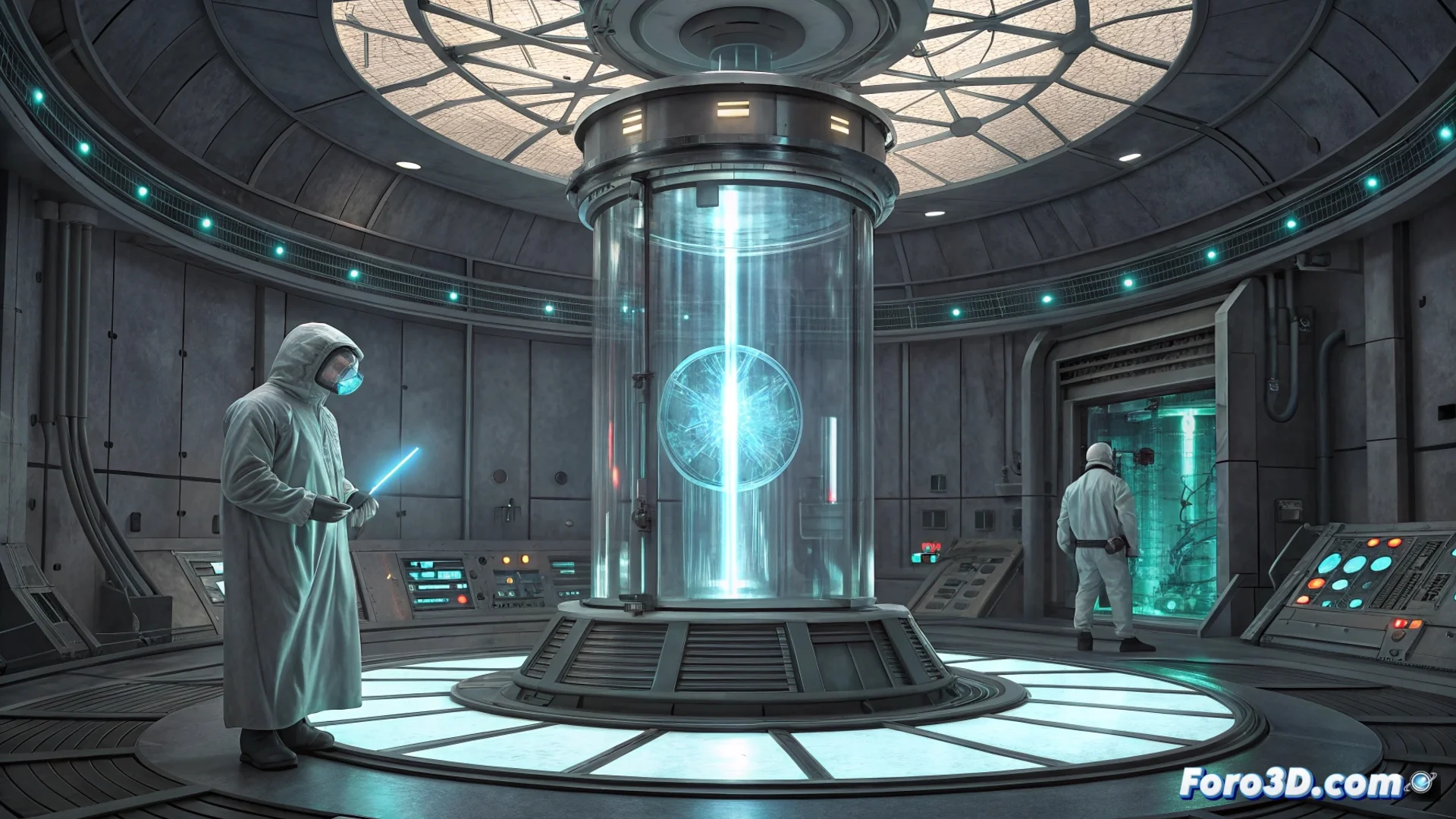
Physicists Design a Detector to Catch Gravitons
A group of physics researchers presents the first serious concept for a device that attempts to capture a graviton, the hypothetical particle that would explain gravity in the realm of quantum mechanics. This innovative apparatus integrates superfluid helium cooled to temperatures near absolute zero, a resonator, and high-precision laser systems. The fundamental premise is that a gravitational wave could deposit a quantum of energy, i.e., a graviton, within the system. This energy would transform into a phonon, a quantum vibration within the helium, which lasers could then detect. If successful, this experimental path would open the door to observing quantum effects of gravity and bring together two pillars of modern physics. 🔬
How the Proposed Mechanism Works
The proposed detector operates in a quantum regime. The superfluid helium, when cooled almost to absolute zero, behaves as a frictionless fluid where quantum phenomena manifest on a macroscopic scale. A mechanical resonator, coupled to this helium bath, possesses extreme sensitivity. If a graviton interacts with the assembly, it would transfer its energy to the resonator, thereby generating a phonon. To read this minuscule vibration, laser interferometric techniques are used, capable of detecting tiny displacements. This process would essentially convert a gravitational signal into a measurable quantum mechanical signal.
Key Components of the System:- Superfluid Helium: Acts as a frictionless quantum medium where phonons can be generated.
- Mechanical Resonator: Ultrasensitive element that receives the graviton energy and converts it into vibration.
- Laser Interferometric System: High-precision setup to detect and measure the resonator's minuscule displacements.
The graviton is so elusive that, if this experiment detects it, the first data it sends will probably be a request to work from home, claiming that the journey from the gravitational wave source has been exhausting.
The Technical Challenges to Overcome
Although the design is promising, physicists face enormous obstacles before achieving a definitive signal. The main challenge is isolating the experiment from any vibration or thermal noise that could mask the presumed graviton's signal. The required sensitivity is extreme, given that the interaction between gravity and matter is extraordinarily weak. Additionally, it must be verified that any detected phonon indeed comes from a gravitational interaction and not from another source. Overcoming these issues demands advances in cryogenics, materials, and precision metrology. 🧊
Main Challenges to Resolve:- Vibration Isolation: Protect the experiment from any external mechanical or thermal perturbation.
- Extreme Sensitivity: Achieve the detection level necessary to capture the weak gravitational interaction.
- Origin Verification: Confirm that the measured signal unequivocally comes from a graviton and not from another phenomenon.
The Potential Impact of the Discovery
Succeeding in detecting a graviton would represent a monumental milestone in physics. It would not only confirm the existence of this fundamental particle but also provide the first direct experimental evidence that gravity operates under the rules of quantum mechanics. This would unprecedentedly bring together the theory of general relativity and quantum physics, two frameworks that have so far resisted complete unification. The path is arduous and full of technical uncertainties, but the presented design marks a solid first conceptual step toward one of modern science's most ambitious goals. 🌌