Physics Builds the First Detector to Catch Gravitons
Experimental physics takes a historic leap by beginning the construction of the first device designed to capture gravitons. These still hypothetical particles represent the quanta of the gravitational interaction and are the missing link to unify quantum theory with Einstein's general relativity. The project, named Graviton, aims to verify their existence directly, a goal that until now belonged solely to the theoretical domain. 🔬
The Challenge of Capturing an Almost Imperceptible Particle
The graviton is notoriously difficult to detect due to its infinitesimal interaction with matter. To attempt to detect it, the team employs a laser interferometer several kilometers long, inspired by instruments like LIGO, but with much greater precision and operating at extremely low temperatures, close to absolute zero. The goal is to measure the tiny perturbations in space-time that a single graviton could generate, an enormous technological challenge.
Key Features of the Detector:- Long laser interferometer with unprecedented sensitivity.
- Cryogenic cooling systems to reduce thermal noise to a minimum.
- Technology to isolate infinitesimal vibrations in the space-time fabric.
Attempting to detect a graviton is like trying to hear the whisper of a single grain of sand in the middle of a cosmic hurricane.
Mechanism of the Quantum Trap for Gravity
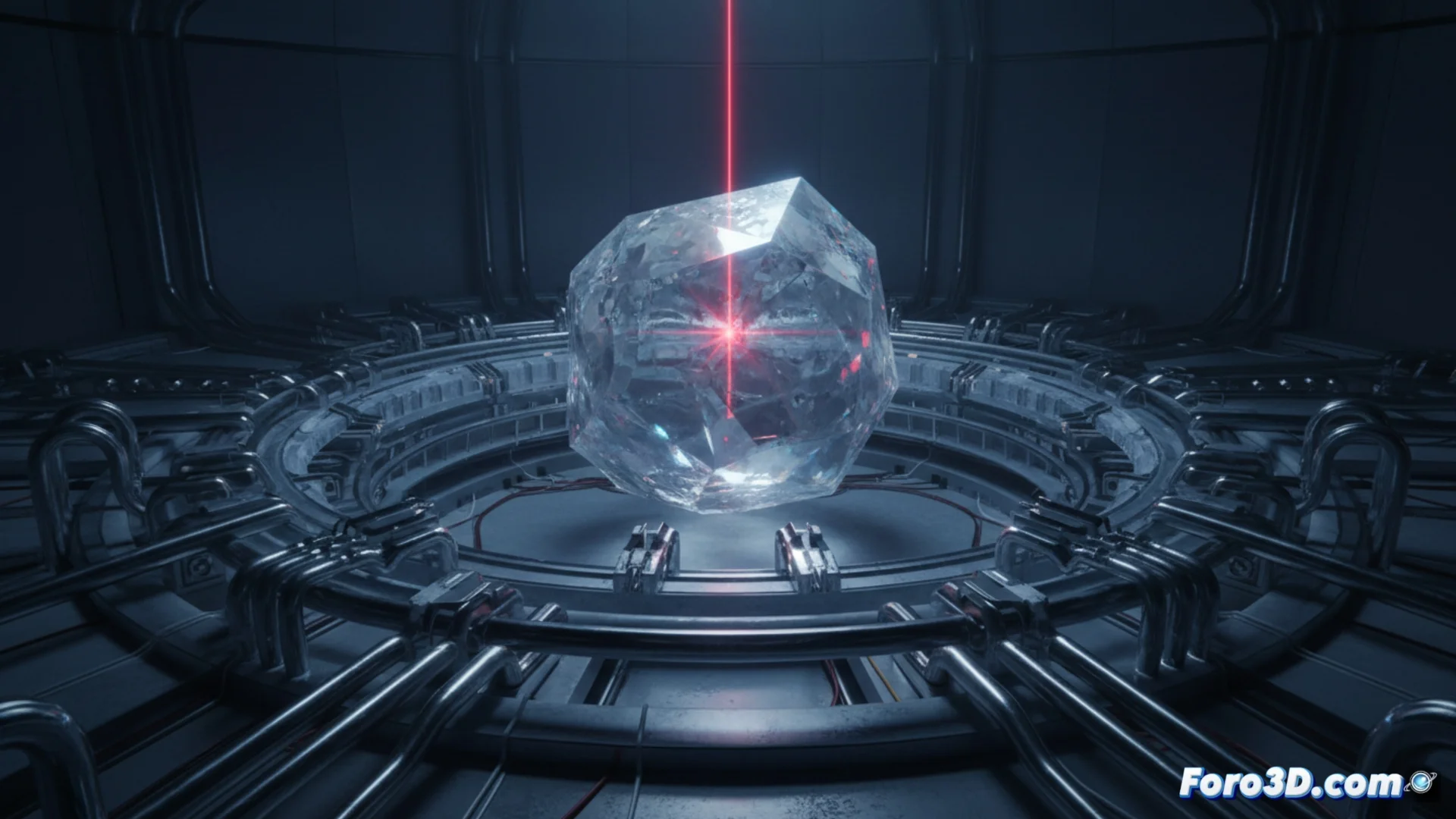
The heart of the experiment is a massive crystal kept in an ultra-refrigerated state. Theoretical models suggest that if a graviton passes through this crystal, it could transfer angular momentum to it, inducing a characteristic vibration. A set of superconducting quantum sensors constantly monitors this crystal to identify a specific signal that stands out from the thermal and quantum background noise. Isolating this signature would confirm the quantum nature of the gravitational force.
Core Experimental Components:- Massive and ultra-refrigerated crystal acting as a sensitive target.
- Network of superconducting quantum sensors to monitor vibrations.
- Advanced algorithms to filter noise and search for the graviton signature.
The Hunt for the Quantum Ghost
This project embodies the fundamental longing of physics: catching what is as elusive as a ghost. The hunt for the graviton is not just a technical exercise; it is a profound quest to listen to the faintest music of the universe and, ultimately, weave a single theory that explains all the forces of nature. Success would change our understanding of reality forever. 🌌