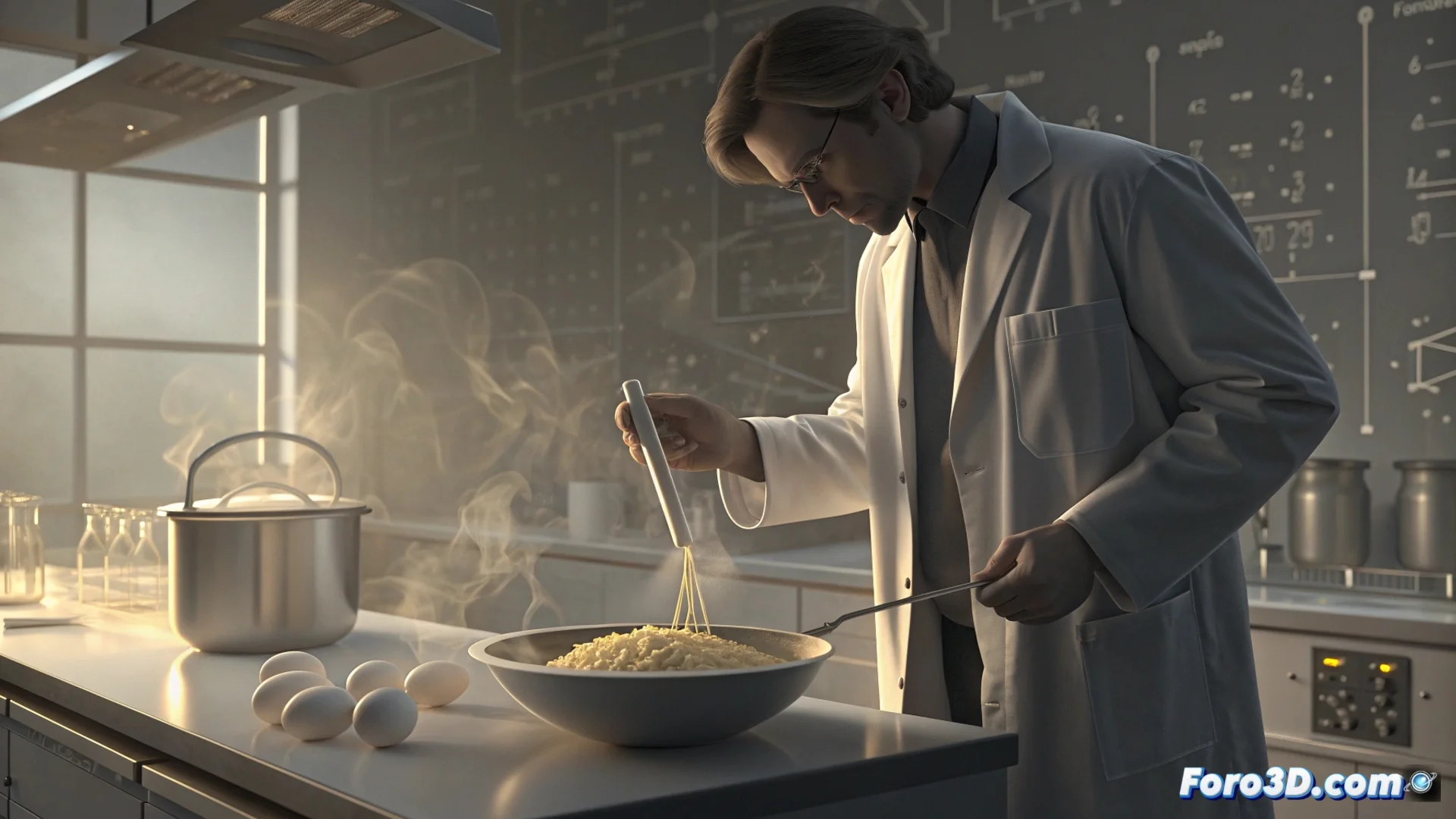
Physicists Apply the Scientific Method to Traditional Cooking Recipes
A team of physicists has decided to bring the rigor of their discipline to an unexpected territory: home cooking. Their project, started in 2025, consists of analyzing seemingly simple dishes with scientific tools, such as cacio e pepe pasta and boiled eggs, to establish exact parameters that guarantee a perfect result every time. They publish their conclusions in specialized journals, sparking mixed reactions among academics and gastronomy professionals. 🧪🍝
Breaking Down the Art of Cacio e Pepe
The researchers focus their work on the emulsion that defines the cacio e pepe sauce, composed of pecorino cheese, black pepper, and pasta cooking water. Their analysis determines that variables like the fork spinning speed and the precise angle when mixing are critical, along with the exact temperature of the starchy water. They propose a protocol that eliminates any element of intuition, replacing it with calculable formulas.
Key Points from the Pasta Study:- They model the emulsion as a fluid dynamics and surface tension problem.
- They define an equation to calculate the optimal movement when integrating the ingredients.
- They conclude that ignoring factors like the variable quality of the cheese or the pepper grind simplifies the model but ensures repeatability.
Turning a cultural gesture passed down through generations into a series of measurable physical variables is, to say the least, controversial.
The Physics Behind the Ideal Boiled Egg
The second line of research focuses on achieving a boiled egg with a creamy yolk and fully solid white. The scientists approach the process as a challenge of heat transfer and thermal diffusion. They create a model that considers the egg's diameter and its temperature when taken out of the refrigerator to calculate an exact cooking time, discouraging empirical methods like counting minutes from boiling.
Technical Aspects of Egg Cooking:- They develop a mathematical model that predicts the temperature gradient inside the egg.
- They establish that size is the most determining factor, above altitude or fire power.
- They offer a time table adjusted to the gram and degree Celsius.
A Clash Between Two Worlds
While the scientific community values the exercise as legitimate and elegant applied physics, the traditional culinary sector shows skepticism. Italian chefs argue that this approach dehumanizes an act loaded with tradition, overlooking the importance of raw materials and the cook's touch. In homes, some enthusiasts adopt precision thermometers, but many wonder if a graduate degree is needed to prepare dinner, joking about the excessive complexity. The debate highlights the eternal tension between intuitive art and reproducible precision. ⚖️🔬