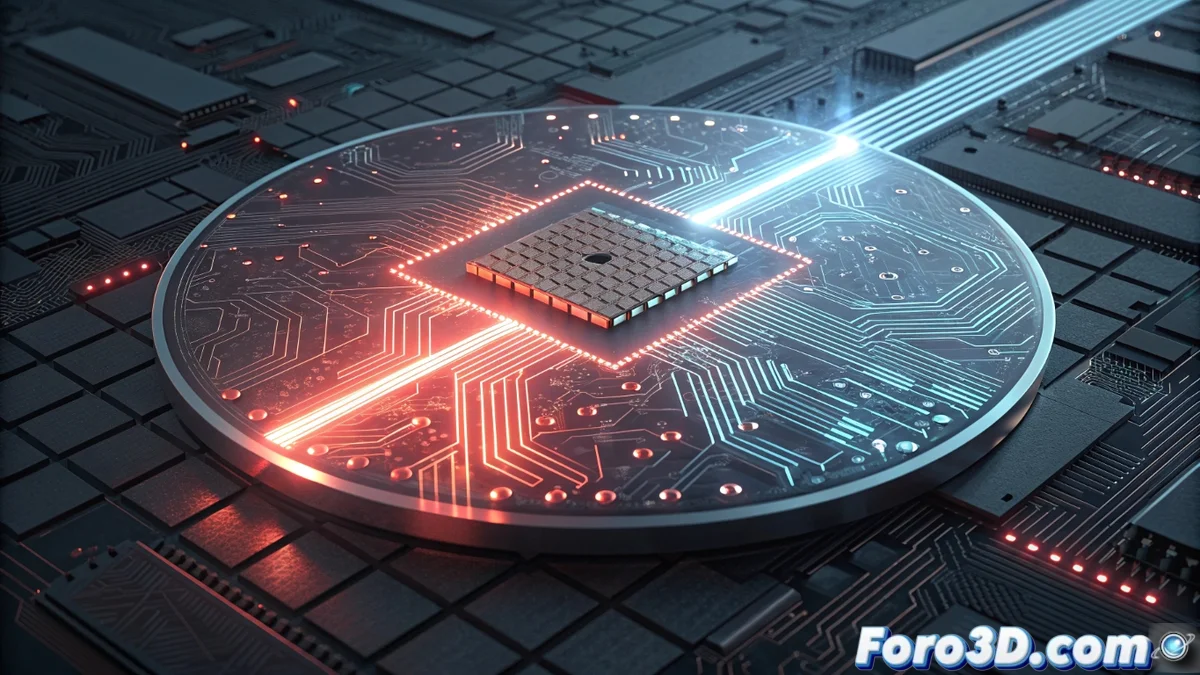
Photonic Integrated Circuits: Light as the Basis for Data Processing
Technology constantly seeks faster and more efficient ways to handle information. A photonic integrated circuit (PIC) represents a leap forward by replacing electrons with photons, light particles, to process and transmit data. This specialized chip integrates optical components into a substrate, typically silicon, laying the foundation for a new era where light governs the flow of information. 🚀
How Does a Chip That Manipulates Light Operate?
The fundamental principle lies in miniaturizing and connecting essential optical elements within a silicon wafer. A laser emits a beam of light that is conducted through waveguides, which act as the system's "wires." Modulators encode data by altering light properties, such as its intensity. Finally, photodetectors convert the optical signal back to electrical for interpretation by other systems. This process leverages microelectronics fabrication techniques but with materials adapted to guide and control light efficiently.
Key Components in a PIC:- Integrated Laser: Generates the light source directly on the chip.
- Waveguides: Channel and direct photons through defined paths.
- Modulators: Imprint information onto the light beam by modifying its state.
- Photodetectors: Transform the optical signal into a usable electrical signal.
Manipulating photons instead of electrons drastically reduces energy loss and heat generation, two major limitations of traditional electronics.
Areas Where This Technology Shines
PIC applications go beyond theoretical optical computing. Their most immediate and powerful use is in data centers and telecommunications networks, where they can manage massive internet data traffic with much higher bandwidth and speed. Their potential is also being actively researched to build faster processors with lower power consumption for artificial intelligence tasks, as well as high-precision sensors in fields like medical and scientific instrumentation.
Main Fields of Application:- Communications and Networks: To transmit large volumes of data with maximum efficiency.
- High-Performance Computing: To enhance AI systems and specialized processing.
- Advanced Sensing: To create extremely precise measurement devices.
The Future of Processing Information with Light
On-chip photonics promises to revolutionize how we move and process information. Although fully integrating this technology into a general-purpose computer remains a long-term challenge, its path is illuminated. The next time you think about network latency, remember that the solution might be in a chip that has literally swapped electrons for photons to see information in a new light. 💡