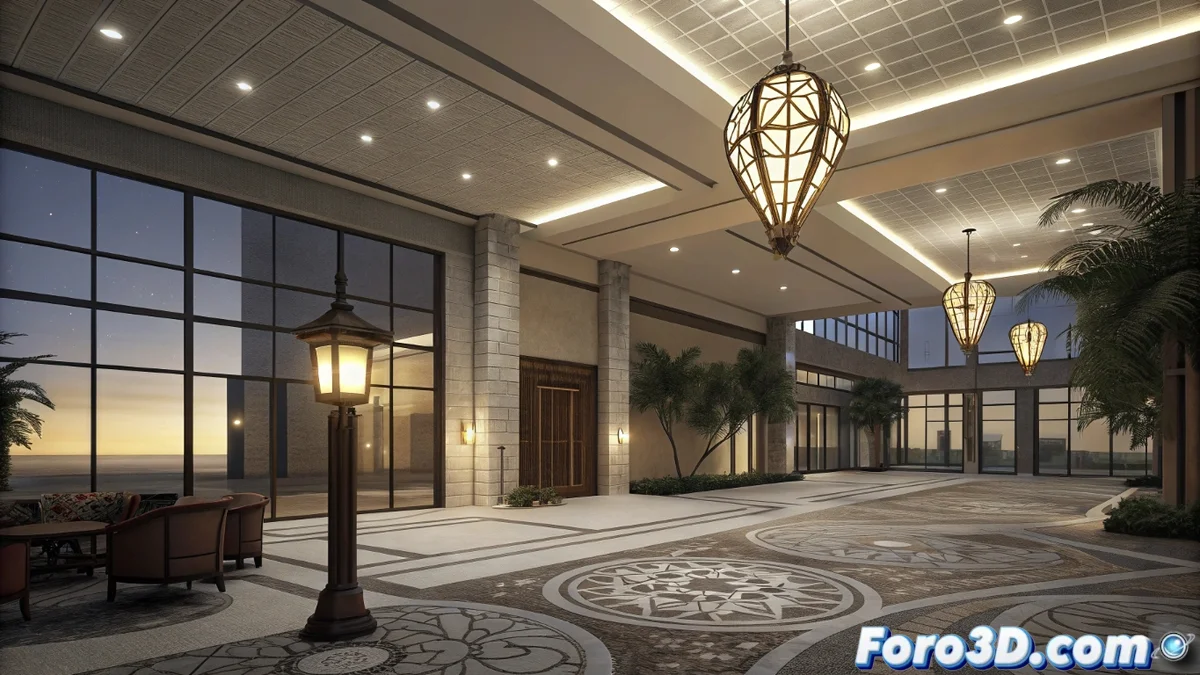
Photometric Lighting and IES Files for Realistic 3D Visualization
In the field of architectural rendering and interiors, achieving convincing realism in lighting is a constant challenge. Photometric lighting emerges as the technical solution par excellence, moving away from artistic approximations to base itself on measurable physical data from real luminaires. This methodology transforms visualization into a reliable prediction tool 🎯.
The IES Standard: The DNA of Real Light
The precision of this technique lies in IES files (Illuminating Engineering Society). These files, generated by manufacturers after rigorous laboratory measurements, contain the luminescent fingerprint of each lamp, downlight, or projector model. By linking an IES file to a light source within a 3D engine, not only is its brightness adjusted, but its dispersion pattern, opening angles, relative intensities, and even imperfections or complex beam designs are replicated with exactness. This allows distinguishing, for example, the soft and diffuse light of an LED panel from the sharp and directional beam of a spot.
Key advantages of using IES profiles:- Technical authenticity: The visual representation matches the expected performance of the physical luminaire, crucial for client presentations and regulatory compliance.
- Design efficiency: Allows evaluating and adjusting the lighting scheme before construction or material purchase.
- Superior visual quality: Generates shadows, reflections, and light falloffs impossible to match with standard manual lights.
Attempting to manually simulate the complex pattern of a spotlight without IES data usually results in a representation that an expert would identify as incorrect in seconds.
Implementation in the 3D Workflow
Integrating photometric lighting requires a structured process. First, it is necessary to select the specific IES files for the proposed luminaires in the project. Then, in applications like 3ds Max with V-Ray, Blender with Cycles, or Unreal Engine, a photometric light (Photometric Light, IES Light) is created and the corresponding file is associated. The rendering engine then handles calculating the light interaction based on that scientific data, not estimated values.
Main applications:- Architecture studios and lighting design: To create visualizations that predict the final lighting environment with great fidelity.
- Product development: Manufacturers can visualize their own luminaires in virtual environments before producing them.
- Compliance analysis: Verify that a design meets the lighting levels required by regulations.
Considerations and Technical-Artistic Balance
This level of precision comes with certain trade-offs. Render times are usually longer due to the complexity of the calculations, and it is necessary to organize and manage an IES file library. However, the trade-off is worth it for projects where technical accuracy is paramount. For more conceptual or artistic work, artists sometimes opt for a combination, using photometric lights as a base and adjusting generic lights to enhance specific aesthetic aspects. Mastery of this tool significantly expands the capabilities of any 3D visualizer, bringing digital simulation closer to physical reality 💡.