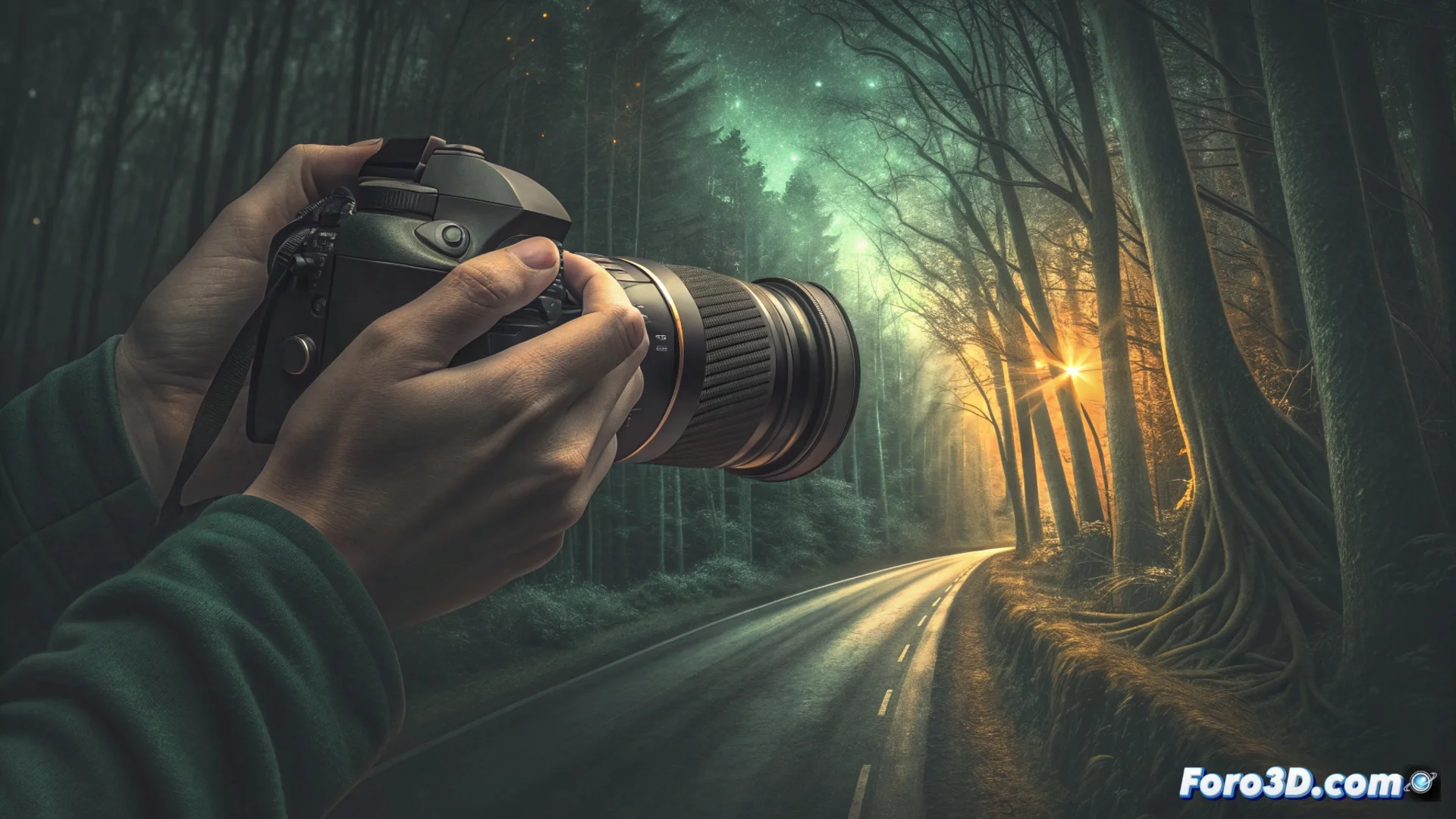
Photographing with Intentional Camera Movement (ICM)
The technique known as intentional camera movement or ICM breaks with the norm of freezing the scene. Instead, the photographer deliberately moves the camera while the shutter is open, thus recording the motion trail to generate visual abstractions. This method reinterprets landscapes and urban environments, giving them a quality that evokes impressionist painting. 🎨
Preparing the Camera for the ICM Effect
To achieve this effect, it is essential to operate in manual mode and precisely control the parameters. A slow shutter speed is needed, which can range from 1/15 of a second to several seconds. To allow this time without the image burning out, a low ISO (such as 100) and a closed aperture (for example, f/16) are adjusted. Any stabilization system is disabled, and manual focus is set on a specific point. A tripod is not used, as the body itself acts as a flexible support to direct the movement. 📸
Key Configuration Step by Step:- Adjust speed: Select a long exposure time, between 1/15s and several seconds.
- Control the light: Use ISO 100 and a closed aperture (f/16 or higher) to compensate.
- Prepare the camera: Disable stabilization and manually focus on the desired point.
ICM is not about freezing a moment, but about painting with light and time using the camera as a brush.
Executing Movements During Exposure
The final result depends entirely on the type of movement executed. Each gesture produces a different pattern of light and form, transforming reality into a unique composition.
Types of Movement and Their Effects:- Rotary swivel: Rotating the camera on its axis creates swirls and color spirals.
- Linear sweep: Moving the camera vertically or horizontally generates defined stripes and straight strokes.
- Zoom movement: If the lens allows, activating the zoom during exposure creates a light explosion that seems to emerge from the center.
The Trial and Learning Process
Mastering this technique requires patience, as the results are inherently unpredictable. It is a constant cycle of testing, reviewing on screen, and adjusting. Rather than planning a rigid composition, the photographer learns to perceive the rhythm of the movement and react to the scene. Experimentation by combining gestures and varying their speed is key to discovering new textures and visual sensations. It is an active dialogue between the author, the camera, and the movement. ✨