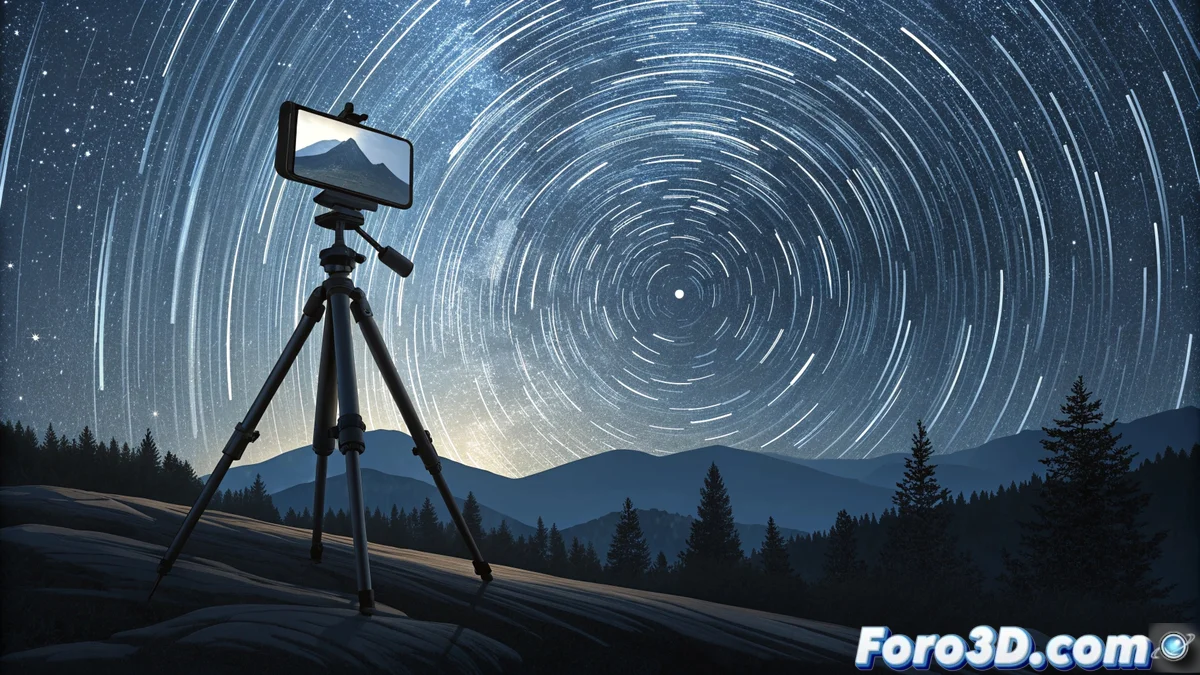
Photographing Star Trails with a Mobile Phone
Capturing the apparent rotation of the stars no longer requires professional equipment. With a smartphone and the right technique, you can achieve impressive star trails or stellar trails. This method is based on taking many long-exposure photos and combining them afterward. 🌌
Prepare the Equipment and Set Up the Phone
The first thing is to completely stabilize the device. A sturdy tripod is essential to avoid any vibration during hours. You'll need a camera app that allows you to adjust parameters manually; apps like NightCap Camera or ProCam are ideal for this. Set up manual mode and disable all automatic settings, especially white balance.
Key Steps for Capture:- Exposure: Program the app to take consecutive photos with an exposure time between 15 and 30 seconds each.
- Sequence: You will need to capture hundreds of these images, a process that can last from one to several hours.
- Power: Connect the phone to a power bank or external source so the battery doesn't fail.
Patience is your best ally. An untimely cloud or incorrect setting can make you have to repeat the entire session, but it's part of the learning process.
Combine the Photos and Reveal the Trails
The individual photos only show points of light. To make the circular trajectories visible, you must stack all the images. Use specialized software like Star Trails (for computer) or StarStaX (also for mobile). This process digitally combines the shots, superimposing the position of each star in each photo. The result is a single image where the light lines show the movement of the celestial sphere.
Processing Options:- On the mobile: Some apps allow stacking the photos directly on the device, although it can consume a lot of resources.
- On the computer: Transferring the files to a PC gives more control over the final process and the quality of the resulting image.
Plan Your Night Session Successfully
The location determines the result. Choose a site with dark skies, far from light pollution from towns or cities. To capture the most defined concentric circles, point the camera toward the celestial pole (north in the northern hemisphere, south in the southern hemisphere). Check the weather forecast and choose a clear night without a full moon. With these preparations, you'll be ready to capture the Earth's rotation in a single photograph. ✨