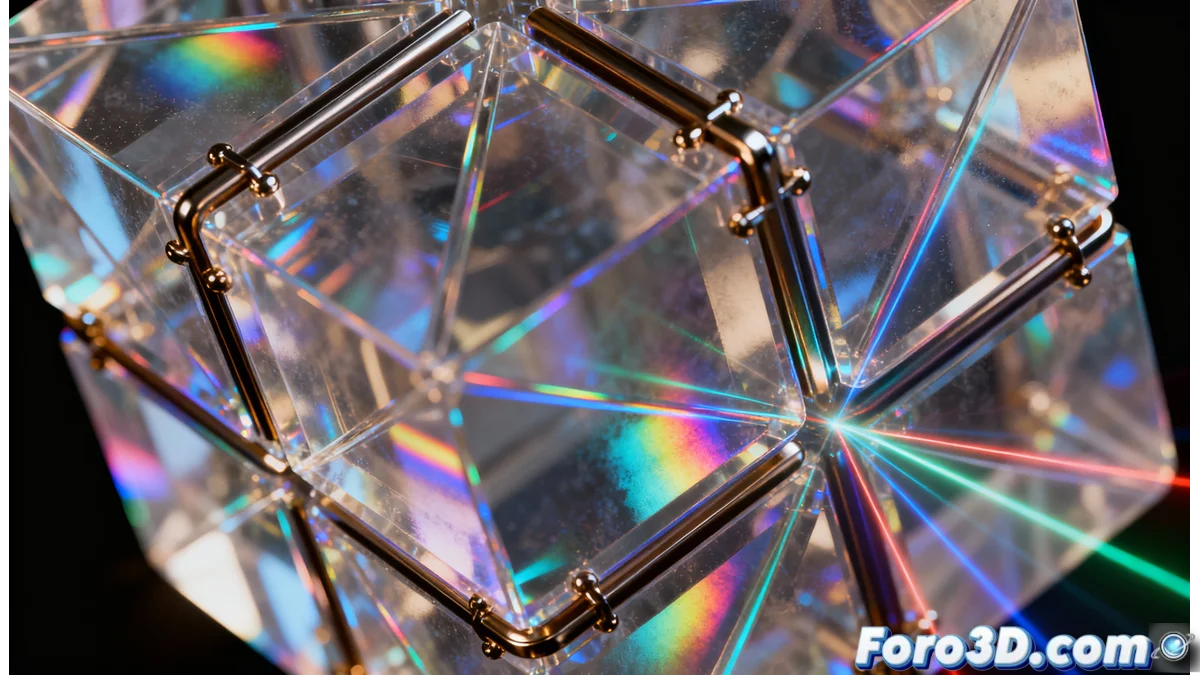
Photochromic Materials in 3D Printing: The Optical Revolution Without Electronics
Additive manufacturing has reached an extraordinary milestone with the development of specialized photochromic materials that respond dynamically to light stimuli. These innovative compounds modify their optical properties in a completely reversible manner, opening unsuspected horizons in the field of advanced integrated optics. The ability to produce complex three-dimensional structures that modulate light without relying on electronic components represents a fundamental technological paradigm shift 🚀.
Molecular Mechanisms and Transformative Applications
The essential functioning of these materials is based on photon-induced molecular transitions between two different stable states. This controlled transformation significantly alters their light absorption and transmission capabilities. When printed with precise three-dimensional configurations, these architectures can direct, filter, and modulate light beams in a completely programmable manner. Immediate practical implementations include fundamental components for optical computing systems, where they perform basic logic operations using photons exclusively as the processing medium.
Main applications in different sectors:- Optical computing: Performing fundamental logic operations using only light as the processing medium, eliminating unnecessary energy conversions
- Reconfigurable optical data storage: Memory systems that can be dynamically rewritten using controlled light stimuli
- Telecommunications infrastructure: Development of fully optical switches and routers that dramatically improve energy efficiency and available bandwidth
Direct integration of optical functionality into three-dimensionally printed structures eliminates complex assembly processes and reduces potential critical failure points
Competitive Advantages Over Established Technologies
The direct incorporation of photochromic properties within additively manufactured structures presents distinctive benefits over conventional technological approaches. This methodology eliminates the need to assemble optical components separately, significantly reducing manufacturing costs and minimizing potentially problematic interfaces. The additive nature allows the creation of intricate internal geometries that would be impossible to manufacture using traditional subtractive techniques, generating optimized three-dimensional optical paths for specific applications.
Fundamental operational benefits:- Energy autonomy: Maintain full functionality without requiring constant electrical power, operating exclusively with control light signals
- Electromagnetic immunity: Ideal for environments where electromagnetic interference poses a critical challenge for conventional systems
- Superior energy efficiency: Minimize overall energy consumption by eliminating conversions between optical and electronic domains
Historical Perspective and Future Projection
It is fascinating to consider how we would explain to researchers from decades past that we have polymeric materials that process information with light while fabricating them using desktop 3D printers. They would probably consider these capabilities as science fiction speculation rather than tangible technological reality. This evolution underscores the accelerated pace of innovation in digital manufacturing technologies and advanced functional materials, where the boundary between the imaginable and the practicable is continuously redefined 🌈.