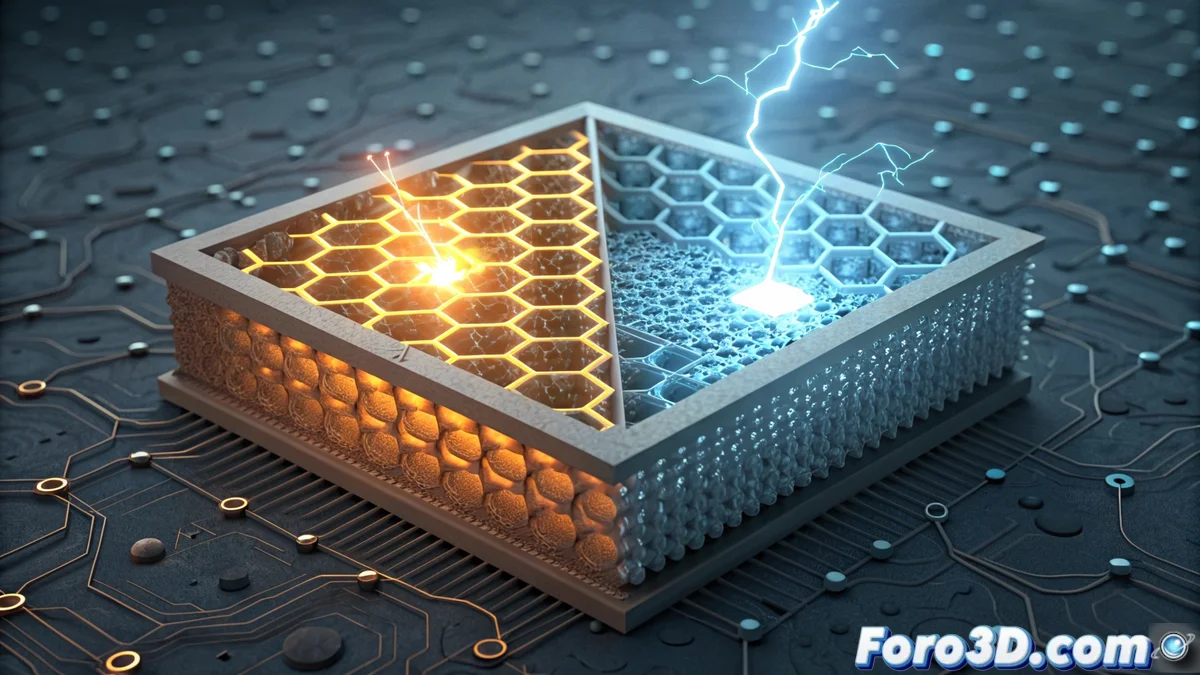
Phase-Change Memory and Its Future in Storage
Phase-change memory (PCM) represents an evolution in how we store digital information. It works on a principle similar to that of rewritable DVD discs, but on a microscopic scale and with the potential to revolutionize electronics. Its essence lies in manipulating the physical structure of a special material to store bits permanently. 🔥
How Does PCM Work?
The core of this technology is a chalcogenide alloy. This material can exist in two states with very different electrical properties. By applying precise heat pulses, a change is induced between an amorphous state (disordered, with high resistance) and a crystalline state (ordered, with low resistance). The system interprets this resistance difference as a logical 0 or a logical 1, creating non-volatile memory that does not lose data when the device is turned off.
The cycle of writing and reading data:- Write a '0' (amorphous state): A short but intense electrical pulse is sent. This heats the material until it melts and then cools it rapidly, "freezing" it into the high-resistance amorphous structure.
- Write a '1' (crystalline state): A longer and less powerful pulse is applied. It heats the material just above its crystallization temperature, allowing the atoms to organize into an ordered, low-resistance structure.
- Read the data: This is a non-destructive process. A very low voltage is used to measure the cell's resistance without generating enough heat to alter its state. This cycle can be repeated millions of times.
PCM combines the best of two worlds: the persistence of flash memory and the speed of RAM.
Key Advantages and Future Applications
This technology is not just a laboratory concept; its characteristics position it as a strong candidate to replace or complement current memories. It offers significantly faster write speeds than NAND flash memory, consumes less energy, and is much more resistant to wear from write and erase cycles.
Potential beyond storage:- Next-generation storage: It could be used in ultra-fast solid-state drives (SSDs) and persistent working memories, reducing system boot and load times.
- In-Memory Computing: Its resistance-changing nature makes it ideal for this paradigm. Instead of constantly moving data between memory and processor, calculations can be processed directly where the data is stored, eliminating a fundamental bottleneck. 🧠
- Neuromorphic architectures: The analog behavior of resistance in PCM can mimic the function of synapses in the brain, opening the door to specialized hardware for artificial intelligence.
Conclusion: A Hot Future
Phase-change memory demonstrates that sometimes, to advance, you have to heat things up until they change shape. This strategy, both literal in the material and metaphorical in the industry, promises to drive a new era of faster, more efficient, and capable devices. Its continued development will be crucial to shape the electronics of the coming years. ⚡