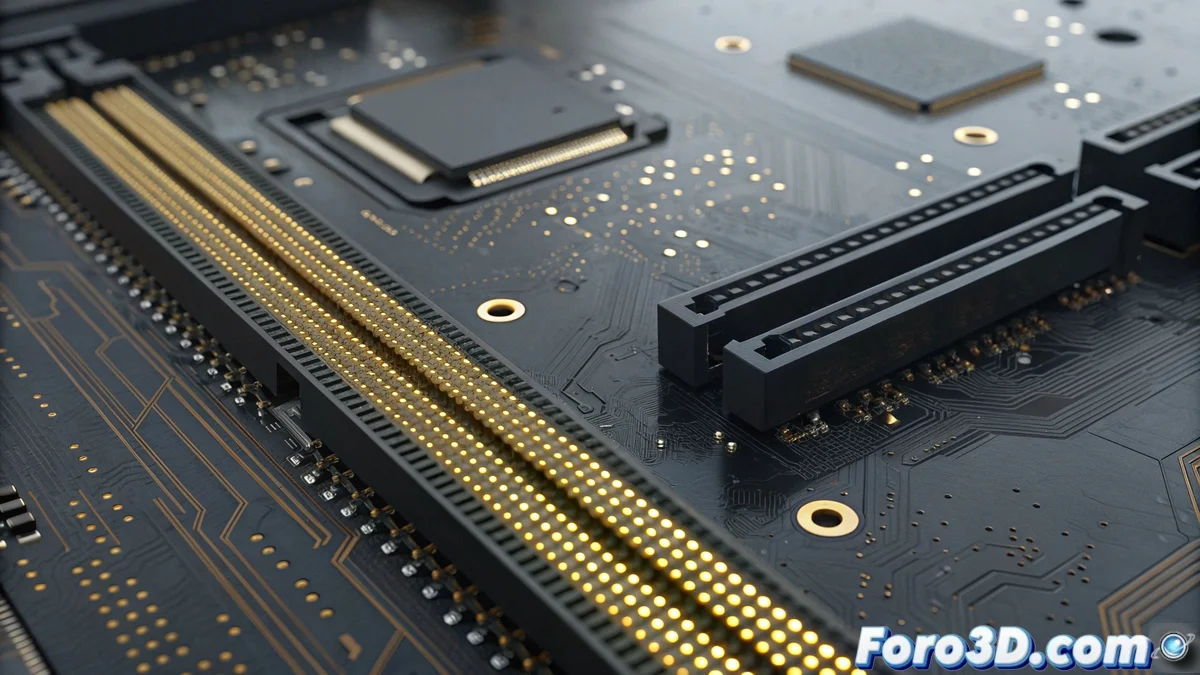
PCIe: The Data Highway in Your Computer
PCIe (Peripheral Component Interconnect Express) constitutes the fundamental standard for interconnection in contemporary computers. It functions as an ultra-high-speed highway that enables direct communication between various components and the main processor, providing significantly greater bandwidth than previous technologies such as conventional PCI or AGP. This point-to-point serial interface overcomes the performance limitations of older systems, allowing simultaneous data transfers between multiple peripherals without mutual interference. 🚀
Modular Lane Architecture
The essence of PCIe lies in its scalable design based on independent lanes, which act as dedicated paths for information transmission. These routes are combined in standard configurations such as x1, x4, x8, or x16, where the numeral indicates the number of available lanes. Each lane provides bidirectional capacity, transmitting and receiving data simultaneously. This versatility allows allocating more lanes to demanding components like graphics cards, while less demanding devices such as sound cards or capture cards operate efficiently with fewer lanes.
Practical Lane Configurations:- x1 - Ideal for basic devices like USB or Wi-Fi expansion cards
- x4 - Perfect for high-performance NVMe SSD drives
- x8 - Used by some secondary or professional graphics cards
- x16 - Reserved for main gaming graphics cards and workstations
PCIe's flexibility allows optimizing resources according to the specific needs of each component, maximizing system performance.
Generational Evolution and Use Cases
Each new generation of PCIe practically doubles the transfer speed per lane, maintaining backward compatibility with previous versions. Professional gaming graphics cards heavily leverage this standard, requiring x16 configurations to render games in 4K with high refresh rates. NVMe SSDs also benefit extraordinarily, connecting directly via PCIe x4 slots to offer read/write speeds that far surpass traditional SATA drives. Even high-speed network cards and expansion boards for additional USB ports use this interface to ensure optimal performance.
Highlighted Applications:- Professional Gaming - Graphics cards using x16 for maximum power
- Ultrafast Storage - NVMe SSDs connected via PCIe x4
- High-Speed Networks - 10GbE adapters using PCIe slots
- Connectivity Expansion - USB 3.2/Thunderbolt controllers
Practical Compatibility Considerations
Although technically possible to connect your premium graphics card to a PCIe x1 slot, the result would be comparable to trying to empty an Olympic swimming pool with a teaspoon: theoretically conceivable, but extremely inefficient and frustrating in real-world scenarios. This analogy perfectly illustrates the importance of properly matching devices with the appropriate lane configuration to achieve the expected performance. The correct implementation of the PCIe standard remains crucial to fully leverage the capabilities of modern hardware. 💻