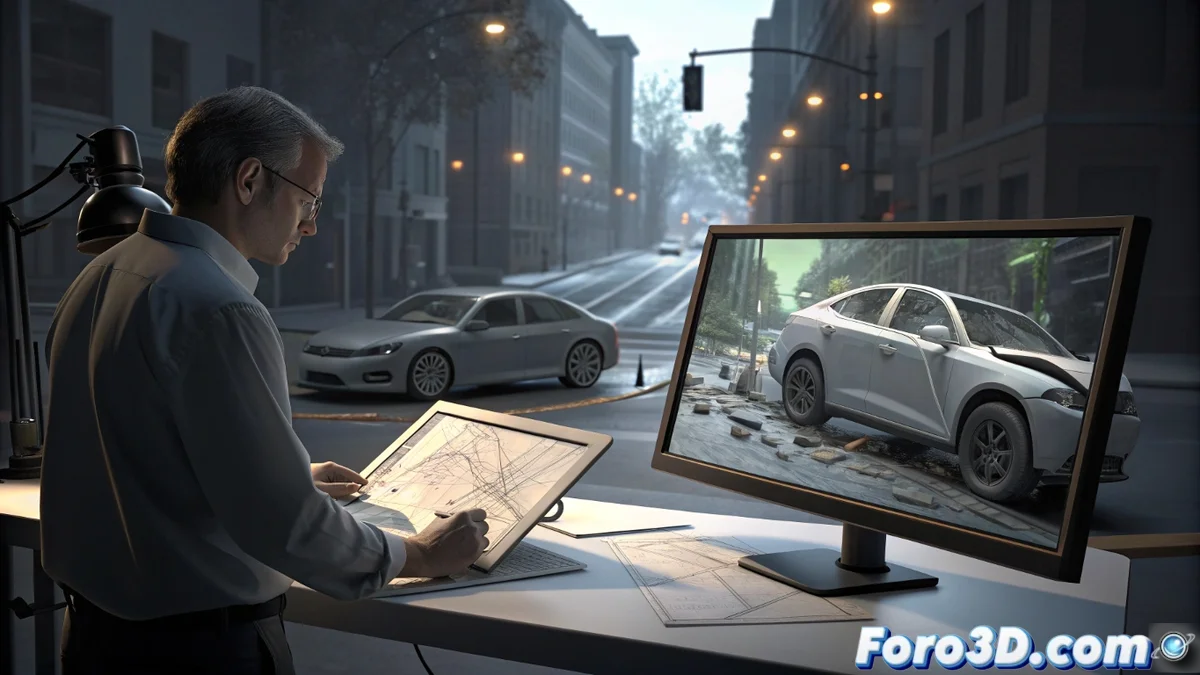
Pc-Crash: forensic simulation software for traffic accidents
In the field of technical investigation and judicial expertise, precision is fundamental. Pc-Crash stands out as a reference computational tool, specifically designed for the reconstruction and simulation of road accidents. This program allows experts to virtually recreate the complete sequence of an accident, transforming cold data into a visual and scientific narrative that is easy to understand 🚗💥.
Key applications in real investigations
The utility of this simulation software goes beyond mere academic analysis. It has become a pillar for traffic experts, police investigators, and insurance companies. Its main value lies in its ability to validate hypotheses with scientific rigor, determining critical variables such as pre-collision speed or the exact angle of impact. The animations and reports it generates are frequently presented in court, where they help unravel responsibilities before judges and tribunals.
Users and sectors that employ it:- Forensic experts: To prepare conclusive technical reports and defend them against counter-expertise.
- Law enforcement agencies: In the police investigation phase of complex accidents or those with victims.
- Insurance companies: To objectively assess the dynamics of the accident and determine degrees of fault.
- Automobile manufacturers: In the development and validation of new passive and active safety systems.
"With Pc-Crash you can model multiple scenarios, but only the reconstruction based on reliable data will withstand the scrutiny of another expert." - Common saying in the expert community.
Work methodology and technical power
The core of Pc-Crash is a calculation engine that solves equations of vehicle mechanics and dynamics. It is not limited to a simple graph; it integrates a multitude of real parameters to achieve a high degree of realism. The process begins with the meticulous input of data collected from the on-site inspection.
Variables and data that the software processes:- Brake and skid marks: Length, type, and consistency to calculate decelerations.
- Vehicle deformations: Depth and location of damages to estimate impact energies.
- Environmental conditions: Pavement type, slope, visibility, and weather factors.
- Testimonies and evidence: Final positions, scene photographs, and statements that serve as reference points.
Visualization and the human factor in simulation
From this data, the software generates computational simulations that can be viewed in 2D plan views or in complete 3D environments. This ability to create animations showing the before, during, and after of the collision is perhaps its most pedagogical feature. However, it is crucial to understand that its accuracy is directly proportional to the quality and exhaustiveness of the information entered. The tool is powerful, but it requires an expert operator who asks the right questions and interprets the results within the framework of applied physics, not assumption ⚙️🔍.