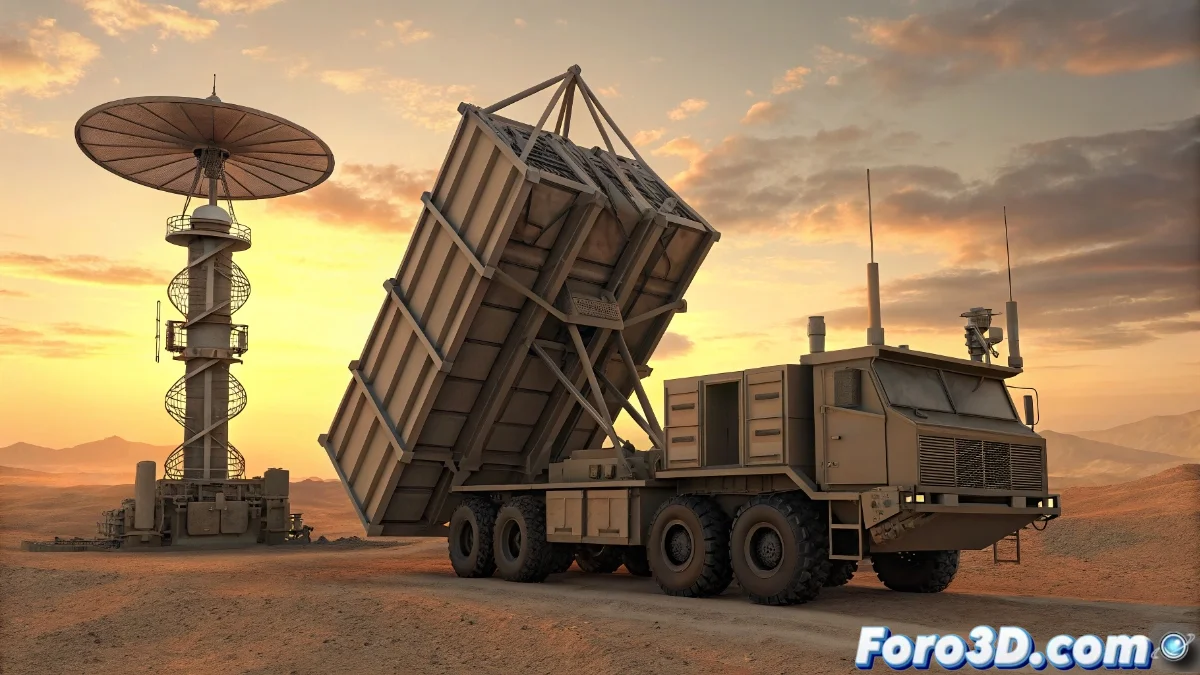
Patriot MIM-104 System: Complete Guide to 3D Modeling
The Patriot MIM-104 constitutes an advanced mobile air and missile defense platform, operating with the modern PAC-3/MSE variant. This complex system combines multiple subsystems that cooperate to detect, track, and eliminate aerial threats with lethal precision. Its modular design includes specialized radars, command centers, power units, and launchers mounted on tactical vehicles, forming an integrated and reactive defensive network. 🎯
Physical configuration and detailed dimensions
The launcher vehicles feature approximate measurements of 8-9 meters in length by 3 meters in width, adapting to various operational chassis. The PAC-3/MSE missiles reach lengths of 5 to 5.2 meters, stored in vertically oriented rectangular containers. The AN/MPQ-53/65 radar stands out for its large antenna, operating autonomously but synchronized with the entire battery. For precise 3D modeling, it is crucial to reproduce elements such as external wiring, guide rails, and access panels that define these military equipment.
Key components to replicate:- Launcher vehicle with missile containers and hydraulic system
- Radar with rotating antenna and support structures
- Control station with consoles and communication equipment
Precision in 3D modeling of the Patriot is not just aesthetic; every cable and panel must reflect the real engineering that enables intercepting threats at supersonic speeds.
Operational performance and technical capabilities
The system offers an interception range from tens of kilometers up to about 160 km with the MSE version, while the maximum operational altitude is around 24 km in updated configurations. This versatility allows neutralizing targets across a wide range of distances and elevations, adapting to dynamic tactical scenarios. The inherent mobility of the ensemble facilitates rapid deployments in varied terrains, maintaining high defensive effectiveness in critical missions.
Essential operational aspects:- Multiple engagement capability against aircraft and ballistic missiles
- Integration with broader air defense networks
- Reduced reaction times thanks to automation
Considerations for realistic 3D modeling
Recreating this system in 3D environments requires meticulous attention to the ironic details of its design, where the complexity of equipment designed to destroy targets at extreme speeds contrasts with the need to digitally align every component. The challenge lies in capturing the technical essence while ensuring that every pixel and polygon faithfully reflects advanced military engineering, almost as if the final result were to face real operational scrutiny. 💻