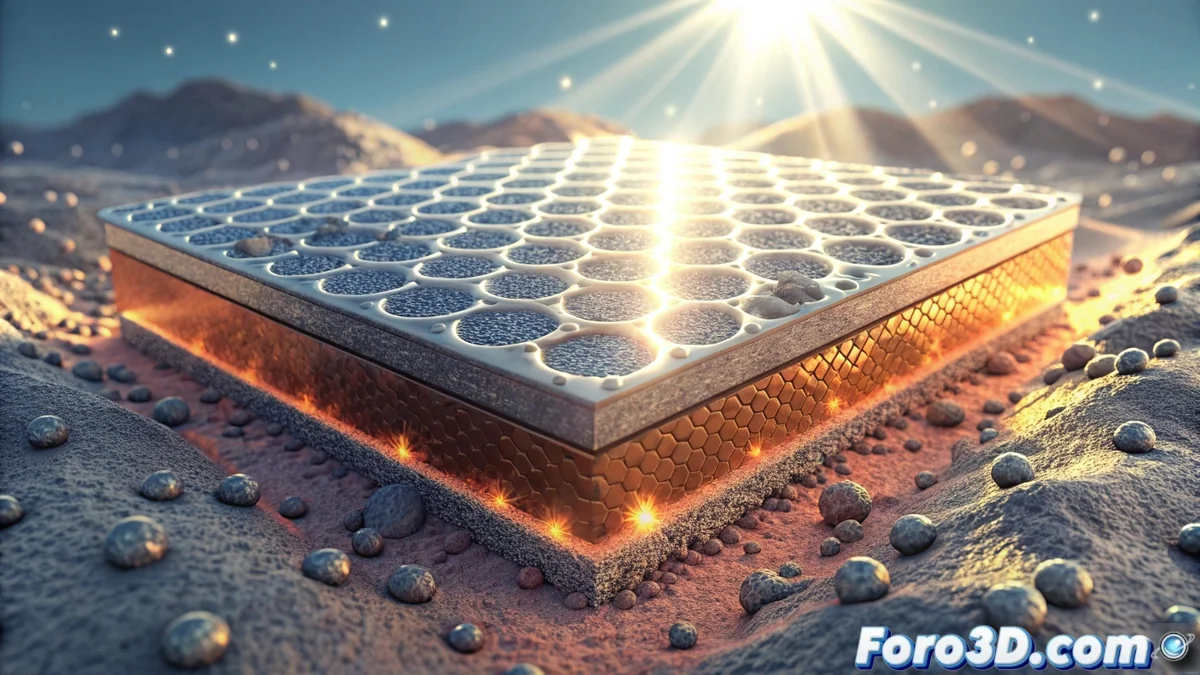
Passive Radiative Cooling: The Revolution of Cold Without Energy
Imagine being able to cool any object without plugs, without fans, and without energy costs. This is not science fiction, but the principle of passive radiative cooling, a phenomenon where all bodies emit heat to the universe in the form of infrared radiation 🌌. The great current innovation lies in state-of-the-art materials that achieve this effect under direct sunlight, something that was previously considered impossible. These advanced coatings act as a mirror for the sun and as an open window to the cold of space, achieving temperatures lower than the ambient ones.
The Science Behind Daytime Cooling
The success of this technology is based on precision optical engineering. To work during the day, a material must meet two extreme optical requirements. First, it needs a very high solar reflectance, above 95%, to reject almost all the sun's thermal energy. Second, it must exhibit equally high thermal emissivity, but in a specific infrared band between 8 and 13 micrometers. This is the famous infrared atmospheric window, where our atmosphere is almost transparent, allowing heat to escape directly into outer space 🚀.
Key Material Architectures:- Multilayer Structures: Stack thin layers of different compounds like silicon dioxide and aluminum oxide to precisely manipulate light reflection and emission.
- Metamaterials: Designed at the microscale to possess optical properties not found in nature, optimizing cooling performance.
- Porous Coatings: Incorporate particles of silicon nitride or magnesium fluoride on an ultra-reflective substrate like silver, creating an ideal surface for thermal emission.
The challenge is no longer to prove the physics, which is solid, but to manufacture these materials in a durable, cheap, and adaptable way to any climate.
Transforming Industries and Facing Obstacles
The potential applications of this passive cooling are enormously versatile and could change our way of managing temperature. Its most immediate impact would be seen in the energy efficiency of buildings, where treated facades and roofs would drastically reduce dependence on air conditioning. But the reach goes much further, touching sectors critical to technology and society 🌍.
Promising Fields of Application:- High-Performance Electronics: Passive cooling of servers, overclocked PC components, and data centers, reducing thermal throttling and fan noise.
- Renewable Energies: Increase the efficiency of solar panels by keeping them cool, as their performance drops with heat.
- Passive Cold Chain: Preservation of food, medicines, and vaccines in remote areas without access to electricity, a crucial advance for global health.
A Paradoxical Future and the Challenges Ahead
Let's think of a curious scenario for hardware enthusiasts: a radiative heatsink on a PC so efficient that it cools the surface below the ambient dew point, condensing moisture and creating a risk of corrosion or short circuit 💧. It is the irony of going from a heat problem to an unwanted "water cooling" one. This example illustrates that, although the scientific principle is mastered, the practical challenges are considerable. Industrial scalability, mass production cost, and durability against weathering are the main hurdles. The future of this technology does not depend on new discoveries, but on our engineering capacity to bring these extraordinary materials from the laboratory to the real world, adapting them to the diverse climatic conditions of the planet.