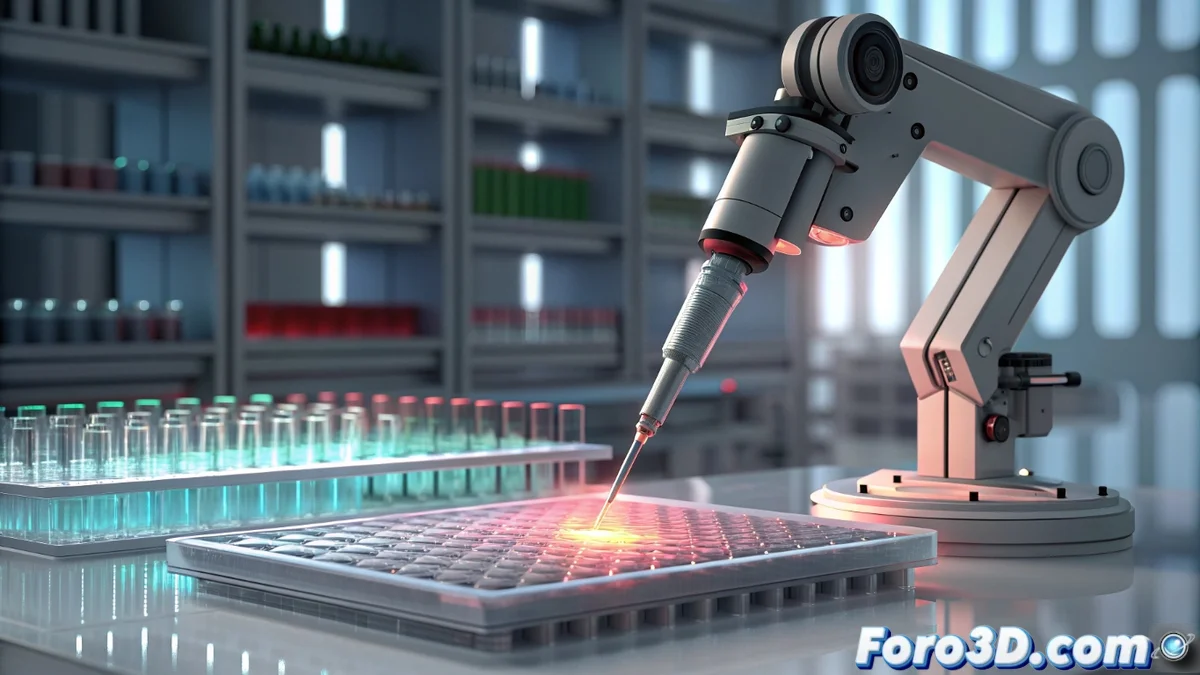
Overcoming Data Scarcity: Real-Virtual Fusion for Training Anomaly Detectors in Laboratories
The promise of autonomous laboratories to revolutionize biological research clashes with a stubborn reality: the need for immense amounts of labeled visual data. This requirement is particularly critical for training systems that detect infrequent events, such as pipetting errors, for which examples are scarce. An innovative study proposes a dual method that bypasses this bottleneck, combining intelligent real data acquisition with virtual data generation, achieving exceptional precision in fault identification. 🧪➡️🤖
A Dual Strategy: The Best of Both Worlds
The solution does not choose between real or synthetic data, but integrates them into a complementary workflow. On one hand, an optimized real acquisition pathway is established. An automated system continuously captures images, but instead of requiring human annotation for each one, it implements a "human-in-the-loop" scheme. This system presents only the images where its uncertainty is highest for verification, thus maximizing labeling quality while drastically minimizing manual workload. On the other hand, a virtual pathway generates high-fidelity synthetic images. Using generation models conditioned by reference real images and specific prompts, visual examples of anomalies are created, which are then filtered and validated to ensure realism and utility.
Fundamental Pillars of the Hybrid Approach:- Selective Real Acquisition: Automation in capture with strategic human intervention only for the most doubtful cases, optimizing resources.
- Guided Virtual Generation: Creation of synthetic data using advanced models, conditioned to ensure relevance and realism in error scenarios.
- Fusion and Balancing: Combination of both flows to build a balanced dataset, overcoming the critical scarcity of negative examples (anomalies).
The fusion of verified real data and validated virtual data enables the creation of robust and balanced training sets, something impossible to achieve with either approach alone.
Compelling Results: Near 100% Precision with Less Effort
Validation of the method in independent test environments yields extraordinary results. A detection model trained solely on automatically acquired real data achieved 99.6% precision in identifying bubbles in pipette tips, a common and problematic error. The most revealing finding comes from training another model with a mix of real and generated data. This model maintained 99.4% precision, conclusively demonstrating that synthetic data are of sufficient quality to replace a significant portion of real data without impairing system performance.
Practical Impact of the Results:- Drastic Reduction in Manual Load: Decreases the need for exhaustive data collection and review by technicians or scientists.
- Scalable Strategy: Offers a viable and cost-effective path to feed visual feedback systems in large-scale automation platforms.
- Sustained Precision: Ensures a high level of reliable detection, essential for the autonomous and safe operation of laboratories.
The Future of Autonomous Supervision in the Laboratory
This hybrid approach not only solves a specific technical problem but charts a methodological path for intelligent automation in science. By freeing researchers from the tedious task of manually supervising every operation, it allows reliance on an "artificial eye" trained on a diet of half real and half synthetic data. Thus, while the system meticulously monitors for unwanted bubbles or deceptive reflections in the plastic, the scientist can dedicate time to higher-value tasks, perhaps enjoying a coffee, secure in the knowledge that the experiment's precision is in good hands (or rather, good algorithms). ☕🔬