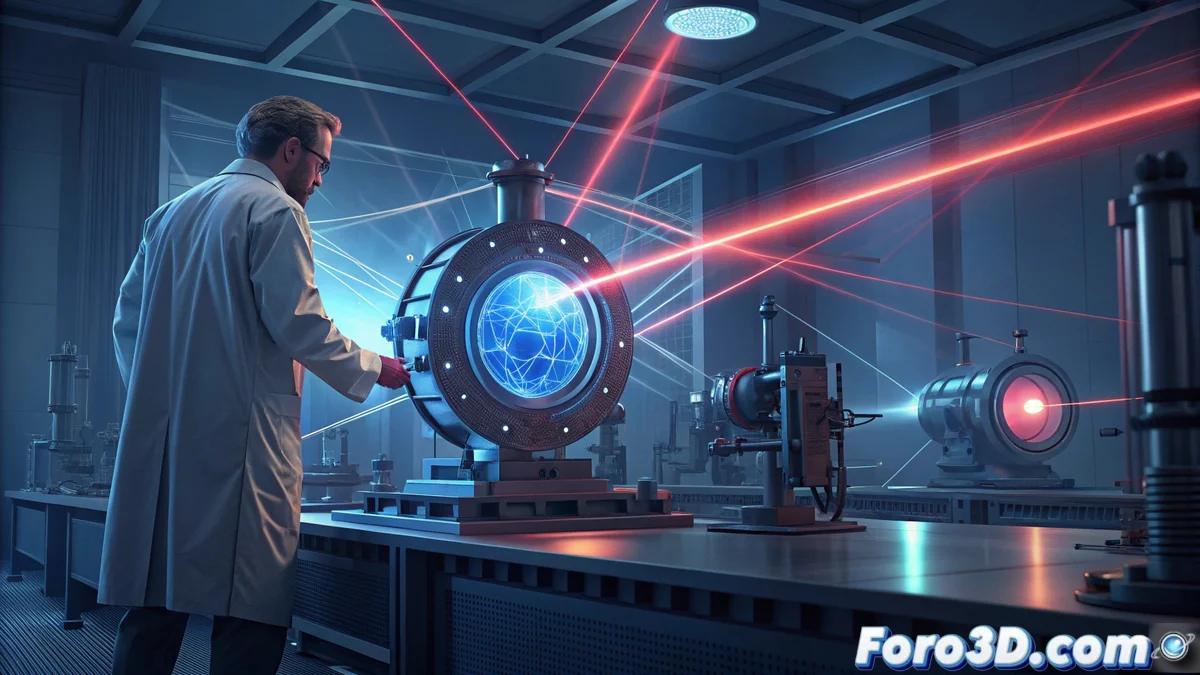
Optical Atomic Clocks Prepare a New Definition of the Second
Global metrology is at a turning point. Scientists are close to changing the official definition of the second, the base unit of time. This advance does not rely on traditional mechanisms, but on the extraordinary optical atomic clocks. These devices measure with such high fidelity that their margin of error is less than a second on timescales exceeding the age of the universe. 🕰️⚛️
Why Optical Technology Makes the Difference
Current standards use cesium atoms and microwave frequencies. The new optical clocks operate in a different regime. They use visible or infrared light to interact with atoms like ytterbium or strontium. The process involves trapping and cooling these atoms nearly to absolute zero using lasers in optical lattices. An extremely stable probe laser then measures the oscillation between two atomic energy levels. Since the frequency of this light is much higher, it allows dividing time into smaller intervals, which translates directly into superior measurement resolution and unparalleled long-term stability.
Key Advantages of Optical Clocks:- Extreme Stability: They would not drift by a second in more than 30 billion years, far surpassing cesium clocks.
- Lower Uncertainty: The high frequency of optical light reduces error in each measurement.
- New Reference Elements: Experiments are conducted with atoms like ytterbium and strontium, which offer sharper transitions for measurement.
If an optical clock had started measuring at the Big Bang, its error today would be less than a second. Missing the bus by a few seconds is, in comparison, a monumental failure.
Practical Applications That Are Already a Reality
This precision is not just theoretical. It has a direct impact on technologies we use daily and on the frontier of science. In the field of satellite navigation, such as GPS or Galileo, synchronizing onboard clocks with this accuracy allows determining positions with centimeter, even millimeter precision. For fundamental physics, these instruments are sensitive tools to detect tiny variations in gravitational fields or to test whether universal constants change over time, challenging the pillars of relativity and quantum physics.
Areas Where Their Influence Is Crucial:- Geolocation: Radical improvement in the accuracy of global positioning systems.
- General Relativity: They enable measuring the effect of gravity on time with unprecedented precision.
- Metrology: They form the basis for redefining the second in the International System of Units.
The Path to the New Global Standard
Adopting this technology as the official standard requires an international consensus among metrologists. The community must decide which specific optical clock design and, above all, which chemical element (ytterbium, strontium, or another) will serve as the universal reference. This process of comparing and validating clocks in laboratories around the world still takes time, but the course is clear. The era of optical atomic clocks will not only redefine how we measure the second, but also redefine the limits of what we can measure. 🔬🌍