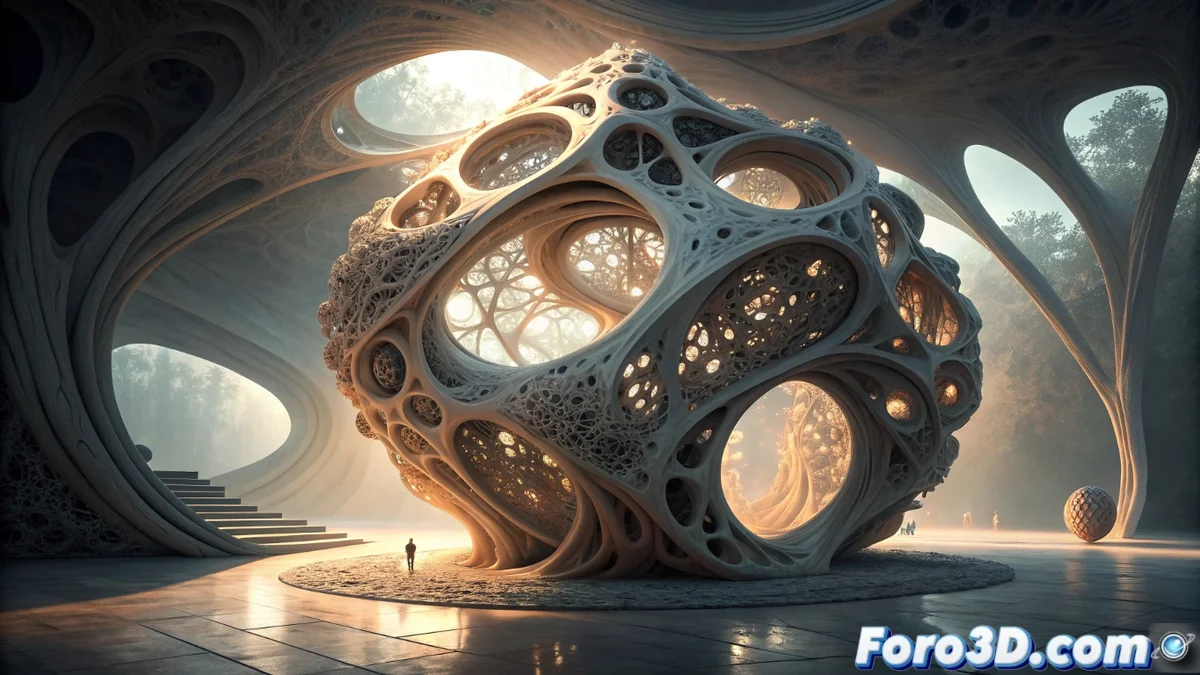
OpenSCAD as a Canvas for Parametric and Generative Art
Generally associated with engineering and technical prototyping, OpenSCAD emerges as a surprisingly fertile environment for artistic expression. Its scripting-based modeling paradigm frees the creator from the limitations of traditional graphical interfaces, allowing the definition of complex shapes through the pure logic of code. This method transforms the artist into an architect of rules, where beauty arises from the execution of algorithms and the controlled variation of parameters. 🎨
Mathematics as Sculptural Material
The core of this approach lies in the ability to translate abstract concepts into tangible geometry. Equations describing chaotic systems, such as the famous Lorenz attractor, can be numerically integrated to generate trajectories that become elegant three-dimensional scrolls. Similarly, recursive algorithms allow materializing fractals like the Mandelbrot set or the Koch snowflake, creating structures of infinite complexity and self-similarity. These primary forms are then manipulated with OpenSCAD's robust boolean operations and transformation functions, evolving from mere abstractions to digital sculptures ready for visualization or additive manufacturing.
Key Advantages of Generative Art with Code:- Precision and Reproducibility: Each piece is the exact result of a script, ensuring that any variation is deliberate and documented.
- Design Space Exploration: A single .scad file can generate an infinite family of works by adjusting its input parameters.
- Direct Bridge to Manufacturing: The native output is a 3D mesh ready to be sent to a 3D printer or advanced rendering software.
Generative art is not drawn, it is programmed; the computer is not just a tool, it is a collaborator that executes the mathematical score written by the artist.
Artistic Series and the Seed of Randomness
The true creative power unfolds when introducing elements of controlled randomness. By using functions that generate pseudo-random numbers from a seed, or by defining ranges for key variables, a single script becomes a source of unique variations. Series can be created where each piece shares a common algorithmic essence, but presents subtle or radical differences in its morphology. This process challenges traditional concepts like "original" and "copy," as each result is a legitimate and unique instance of a master set of rules.
Examples of Generative Parameters:- Random Seed: A numerical value that initiates a sequence of random numbers, defining the unique "personality" of an iteration.
- Number of Iterations: Controls the recursive depth of a fractal, determining its level of detail and complexity.
- Scale and Rotation Factors: Variables that distort and transform the base geometry, creating unexpected compositions.
Practical Considerations and the Spell of Complexity
Delving into this universe involves technical challenges. Generating extremely complex shapes, such as fractals with millions of polygons, can demand a lot from the hardware, leading to prolonged rendering times and high resource consumption. The artist must find a balance between mathematical ambition and computational viability. However, it is precisely at this limit where magic often occurs, discovering that the computer's patience can be rewarded with objects of unexpected beauty. The final warning is not to get so lost in the elegance of the code that you forget the CPU fan working at full speed. ⚙️