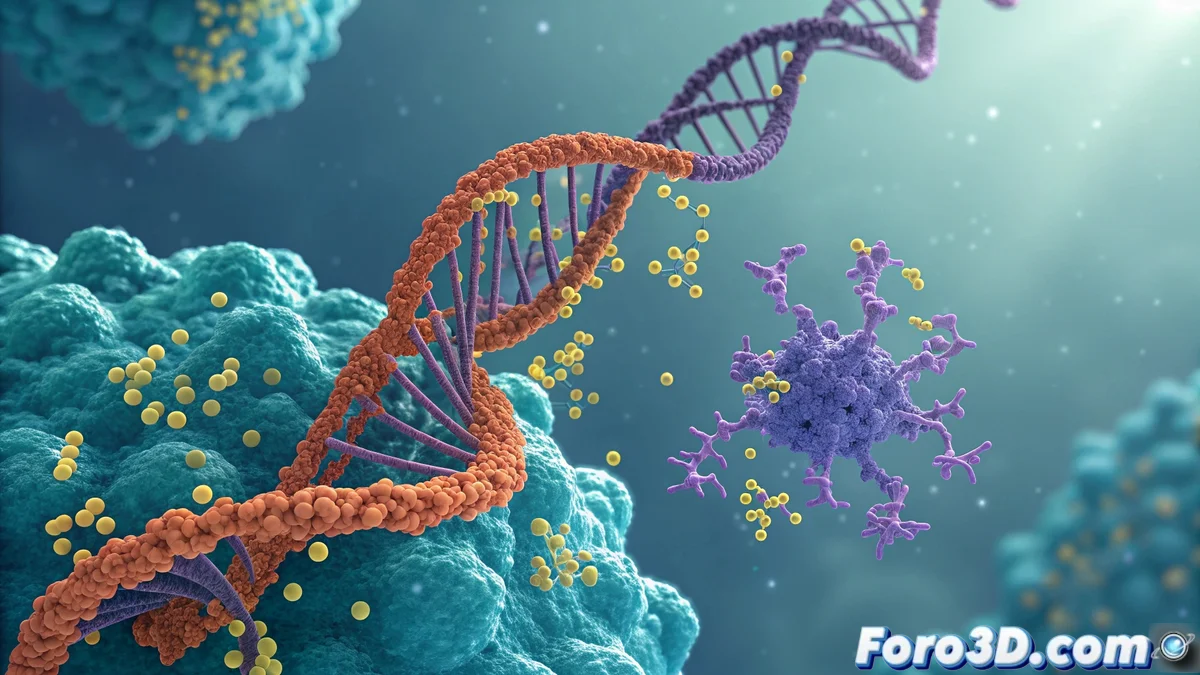
OpenFold3: Revolutionizing Biomolecular Structure Prediction
The OpenFold3 model, resulting from the collaboration between the OpenFold Consortium and the AlQuraishi Lab at Columbia University, represents a transcendental advance by emulating the functionalities of AlphaFold3 using the PyTorch framework. This innovation enables the precise determination of complete atomic configurations for biomolecular complexes that incorporate proteins, nucleic acids, and molecular ligands, opening new frontiers in scientific research 🧬.
Academic-Industrial Synergy for Continuous Improvement
The development of OpenFold3 is based on a strategic collaboration that integrates academic institutions and pharmaceutical companies, employing federated learning with industrial datasets to continuously optimize the model. This cooperative approach ensures that the solutions generated address real-world challenges, increasing both predictive accuracy and practical applicability in complex scenarios.
Key advantages of the collaborative model:- Continuous adaptation through updated industrial data
- Cross-validation among multiple specialized institutions
- Optimization for pharmaceutical and materials science applications
"The integration of academic knowledge and industrial expertise exponentially accelerates scientific discovery" - OpenFold Consortium
Transformation in Pharmaceutical Discovery and Materials Design
The extended capability of OpenFold3 to model complex biomolecular interactions allows exploring previously inaccessible structural configurations, facilitating the rational design of advanced therapies and innovative materials. This technology not only significantly reduces the time and costs associated with laboratory experimentation but also generates fundamental knowledge about the assembly and functioning mechanisms of biological systems.
Transformative applications:- Computational drug design with enhanced molecular specificity
- Development of biomaterials with customized structural properties
- Predictive analysis of protein-ligand interactions with atomic resolution
Methodological Evolution in Structural Research
OpenFold3 marks a turning point in research methodologies, allowing scientists to dedicate more time to analyzing complex hypotheses and less to basic structural determination. Although some researchers still value traditional molecular representation methods, the predictive capabilities of this system establish new paradigms in computational biology that will redefine our approach to diseases and technological development 🔍.