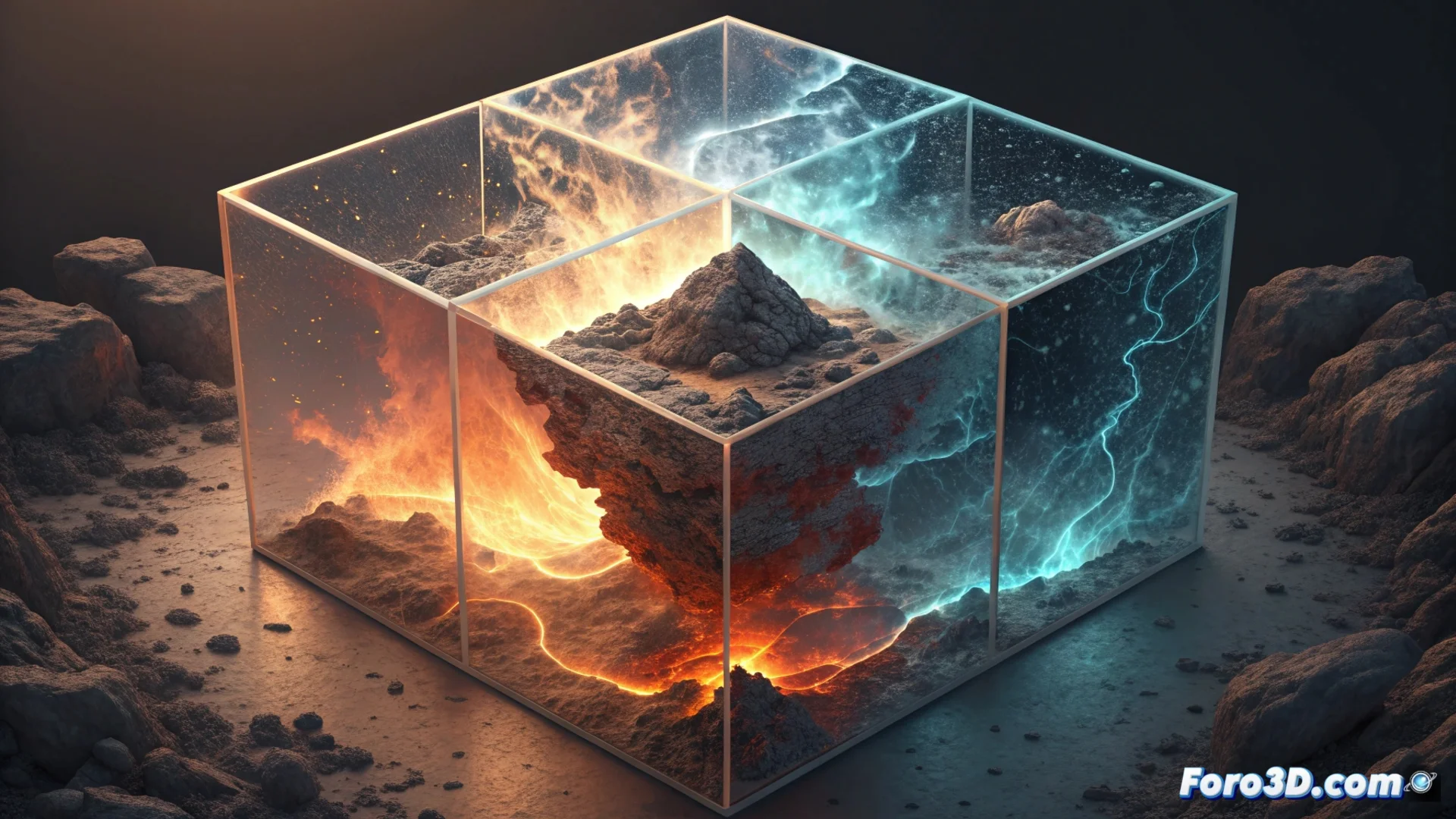
Octree texture splicing combines volumetric textures
In computer graphics and visual effects, merging complex volumetric data is a constant challenge. The octree texture splicing technique offers an elegant solution by splicing multiple VDB textures within a hierarchical data structure. This method focuses on handling transitions between the different levels of detail defined by the octree itself, allowing high-resolution information to be integrated only in critical areas. The result is a coherent and resource-efficient volumetric representation. 🧩
The octree structure organizes 3D space
An octree works by recursively subdividing three-dimensional space into eight octants. Each node in this hierarchy can directly store a block of texture data or reference eight child nodes that contain a higher level of detail. This organization is fundamental to the splicing process, as the system must locate and process only the nodes relevant to the merge. When combining textures, this structure is consulted to decide what level of detail to apply in each region, ensuring that changes between one texture and another are progressive.
Key features of the octree for splicing:- Recursive subdivision: Repeatedly divides 3D space into octants, allowing adaptive detail.
- Node hierarchy: Parent nodes point to children with more detail, optimizing VDB data storage.
- Efficient access: Allows quick querying of which areas of space need to be processed for merging, avoiding loading unnecessary data.
Splicing or stitching ensures that edges between different textures or levels are coherent, avoiding visual discontinuities in the final volume representation.
The core of the process: blending data at boundaries
The true power of this technique lies in how it blends information at the boundaries of octree nodes. To achieve this, interpolation and filtering algorithms are used to fuse values such as density, color, or other attributes stored in VDB files. This step is crucial where nodes of different detail levels meet, preventing visual artifacts like sharp edges or abrupt jumps in the volume cloud. Graphics and simulation engines calculate these transitions at runtime, often using compute shaders that optimally access the octree data structure. ⚙️
Elements of the splicing process:- Attribute interpolation: Smooths density and color values between different VDB textures and octree levels.
- Edge filtering: Applies techniques to avoid discontinuities where nodes of different resolutions meet.
- Real-time computation: Specialized shaders process the merge by efficiently accessing the octree hierarchy.
Practical considerations and a warning
Implementing octree texture splicing allows for a drastic optimization of memory usage and processing power, as high-resolution data only exists where it is strictly necessary. However, it is vital to consider the nature of the textures being combined. For example, if attempting to merge textures representing chaotic elements with very different patterns, such as clouds and fire, the ordered structure of the octree might not handle the resulting "chaos" well, potentially generating confusing visual artifacts in the final output. The key is to plan how the different volumetric datasets will interact within the imposed hierarchy. 🔍