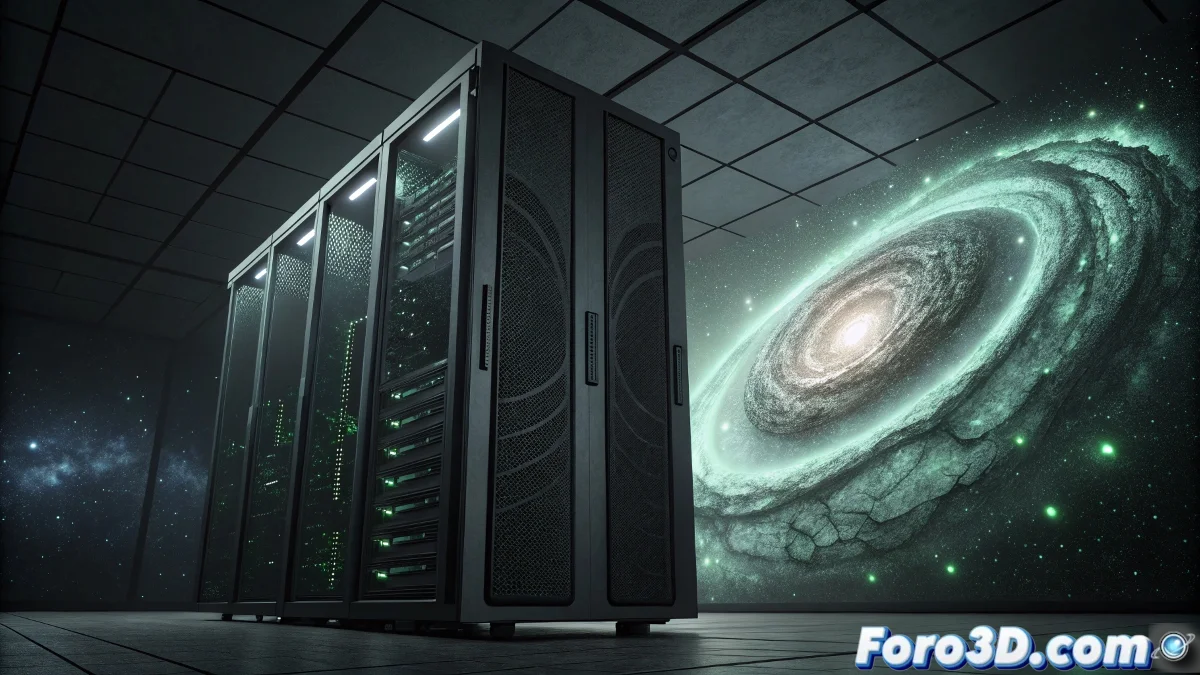
DGX Spark: When a Supercomputer Fits in a Rack and Changes Everything
NVIDIA has officially announced the commercial availability of its DGX Spark supercomputer, based on the Grace Blackwell GB10 architecture, marking a turning point in training massive-scale artificial intelligence models. This system, which occupies a single rack but delivers the performance previously requiring an entire server room, is specifically designed for training next-generation models exceeding one trillion parameters. The combination of the Grace CPU, Blackwell GPU, and fourth-generation NVLink interconnections creates a platform that redefines what's possible in AI research and development. 🚀
Grace Blackwell Architecture: Synergy Between CPU and GPU
What makes the DGX Spark exceptional is not just the sum of its parts, but how these parts are integrated. The Grace Blackwell architecture connects the Grace CPU (specialized in handling massive datasets and preprocessing operations) with Blackwell GPUs (optimized for massive matrix computation) through 900 GB/s NVLink interconnections, eliminating bottlenecks that limited previous systems. This unified memory coherence allows both processors to access a 1.5TB memory pool as if it were local, dramatically simplifying the programming of complex workloads.
Impressive Technical Specifications
The DGX Spark represents the culmination of years of development in AI-specialized hardware, combining lessons learned from previous generations of DGX systems with entirely new technologies designed from scratch for training extremely large models.
Processing Cores and Memory
Each DGX Spark node includes eight interconnected GB10 Blackwell GPUs, each with 192GB of HBM3e memory and 20 petaFLOPS capability in FP8. The Grace CPU features 144 custom ARM cores and 960GB of LPDDR5X memory. The complete rack system offers 64 interconnected GPUs, providing 12.3TB of unified HBM3e memory and 160 petaFLOPS of aggregate performance. These figures make it possible to train models that were theoretically possible but practically unattainable just a year ago.
Key specifications per rack:- 64 GB10 Blackwell GPUs with 192GB HBM3e each
- 8 Grace CPUs with 144 ARM cores each
- 12.3TB unified HBM3e memory
- 160 petaFLOPS in FP8 precision
Interconnections and Bandwidth
The system employs fourth-generation NVLink Switch providing 7.2TB/s bisectional bandwidth between the 64 GPUs, effectively creating a super-GPU of 12.3TB. NVLink-NVLink interconnections enable direct GPU-to-GPU communication without passing through the CPU, critical for distributed training algorithms. For external connectivity, it includes NVIDIA ConnectX-7 400Gb/s InfiniBand and Ethernet interfaces, allowing scaling to multi-rack clusters for the most ambitious projects.
The DGX Spark is not an evolution, but a redefinition of what it means to train AI at scale.
Energy Efficiency and Cooling
With a power consumption of 120kW per full rack, NVIDIA has prioritized efficiency through the use of custom 4nm silicon and low-power memory architectures. The system employs direct-to-chip liquid cooling for the GPUs, enabling higher sustained clock speeds while maintaining optimal temperatures. Energy efficiency improves 4x compared to the previous generation, a critical factor given the operational cost of running these systems continuously for weeks of training.
Innovations in efficiency:- direct-to-chip liquid cooling
- custom 4nm silicon
- low-power memory architecture
- 4x improvement in efficiency versus previous generation
Impact on Research and Practical Applications
The DGX Spark is designed to tackle the most complex challenges in AI: from multi-trillion parameter language models to planetary-scale scientific simulations. In medical research, it will enable modeling complete protein interactions rather than fragments. In climate modeling, it will make high-resolution simulations possible that predict extreme events with greater advance notice. For tech companies, it will accelerate the development of more capable AI assistants and more precise recommendation systems. Access to this computational power could accelerate scientific discoveries that would otherwise take decades. 🔬
Transformative applications:- multi-trillion parameter language models
- drug discovery through molecular simulation
- high-resolution climate modeling
- research in nuclear fusion and clean energy
In the end, the DGX Spark demonstrates that some problems require supercomputing-scale solutions, though it will probably make your development workstation feel a bit... adequate. 💻