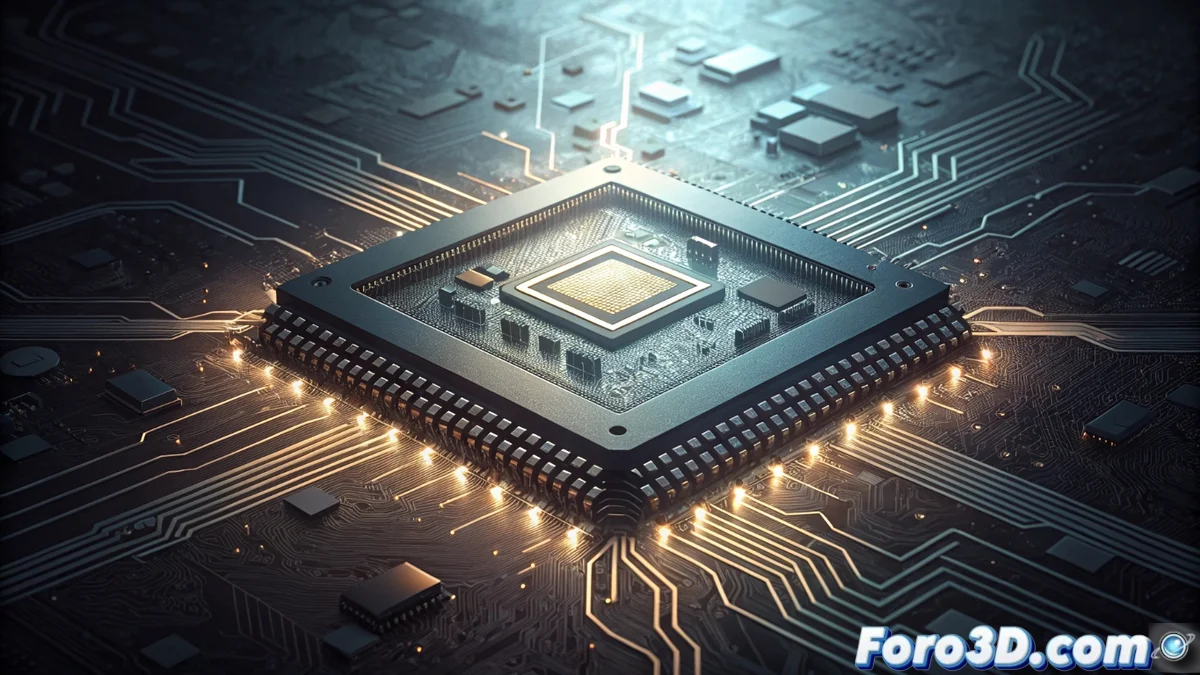
Nvidia Designs the Blackwell Architecture and its GB202 Chip for the RTX 50
The next generation of Nvidia's GPU architecture, codenamed Blackwell, is beginning to take shape through leaks. Its main chip, the GB202, is positioned as the heart of the future GeForce RTX 50 graphics cards, promising notable advances in power and energy efficiency. 🚀
The GB202 Core Doubles Graphics Processing Capacity
According to circulating data, the GB202 would integrate a much denser configuration than its predecessor, the AD102 from Ada Lovelace. The internal structure is organized into 12 GPC (Graphics Processing Clusters), each containing 8 TPC (Texture Processing Clusters). This design culminates in a total of 192 Streaming Multiprocessors (SM), meaning double the processing units of the current chip.
Key design features:- Core configuration: 12 GPC with 8 TPC each, totaling 192 SM.
- Comparison: Doubles the number of SM from the AD102 (Ada Lovelace).
- Objective: Handle extreme workloads in games and professional rendering and AI applications.
A 512-bit bus for GDDR7 memory hasn't been seen in consumer GPUs since the Pascal era, marking a return to massive bandwidths.
Massive Bandwidth and New Interconnection
To power such core density, the memory system must be exceptionally fast. Reports indicate that Nvidia would expand the memory bus of the GB202 to 512 bits. Combined with the next generation of GDDR7 memory, this width would allow surpassing bandwidths of 1.5 TB/s. In parallel, the internal NVLink interconnection is expected to be redesigned to offer more bandwidth and less latency, a critical factor for high-performance computing.
Advances in data transfer:- Memory bus: Speculated increase to 512 bits.
- Memory technology: Implementation of GDDR7 for unprecedented speeds.
- NVLink interconnection: Redesigned to be faster and more efficient in AI and simulation tasks.
The Final Challenge: Efficiency and Power Consumption
Although these speculations paint a very powerful future for the GeForce RTX 50, Nvidia's main challenge will not only be to manufacture such a powerful chip. The company must ensure that users can power these cards without electrical consumption becoming a household problem. The balance between raw performance and energy efficiency will define the true success of the Blackwell architecture in the market. ⚡