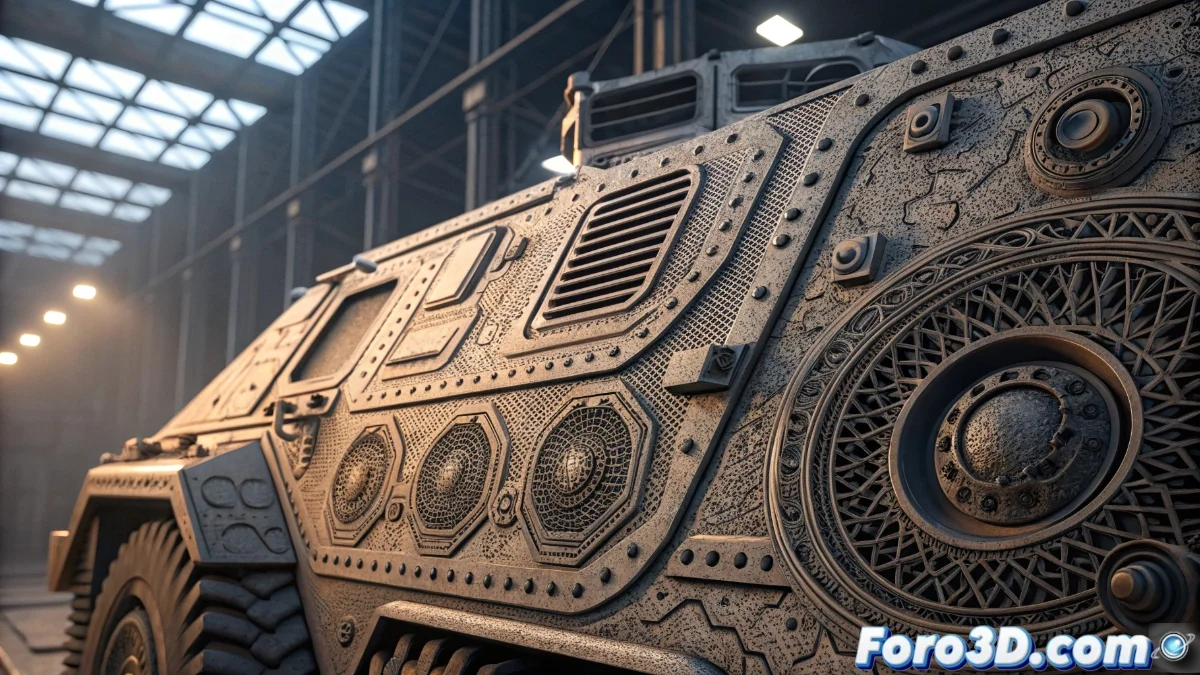
Nurnies in Industrial Design and Their Visual Impact
In the fascinating world of industrial design, there exists a little-known but fundamental concept for creating visually credible pieces: nurnies. These elements, named by the visionary Syd Mead, represent the equivalent in product design to the greebles used in cinematic scenography 🎬. Their main purpose is to enrich surfaces through small details that suggest functionality and advanced manufacturing.
The Essence of Surface Details
Nurnies detailing functions as disruptive elements that break the monotony of large flat areas, imitating the complexity found in real objects subjected to manufacturing processes and continuous use. In sectors such as automotive and aeronautics, these details transform generic designs into objects with history and unique personality ✨.
Practical Applications of Nurnies:- Apparently functional ventilation grilles on vehicles that are actually purely decorative
- Aesthetic panel lines that suggest complex assembly and advanced technology
- Chrome inserts and elements that simulate technical components without real function
"The best designs are those where every element seems to have a reason to exist, even when its function is merely aesthetic" - Syd Mead
Crucial Distinction: Nurnies vs Greebles
While greebles are mainly used in physical models to create the illusion of technological complexity in cinematic scenarios, nurnies are integrated directly into the digital or physical modeling of products 🚗. The fundamental difference lies in that nurnies act as high-level textures that are an intrinsic part of the final design.
Main Differences Between Both Techniques:- Greebles are predominantly three-dimensional and applied in post-production
- Nurnies are modeled directly as an integral part of the base design
- Mead perfected nurnies in works like Blade Runner and Tron, establishing new visual standards
Syd Mead's Legacy in Contemporary Design
The pioneering work of Syd Mead demonstrated how seemingly insignificant small details can dramatically elevate the visual credibility of a design 🏆. It is fascinating to observe how contemporary designers dedicate hours to modeling elements that may never be appreciated up close, but whose absence would make the designs seem like soulless prototypes without history. This philosophy of detail continues to profoundly influence how we conceive industrial aesthetics today.