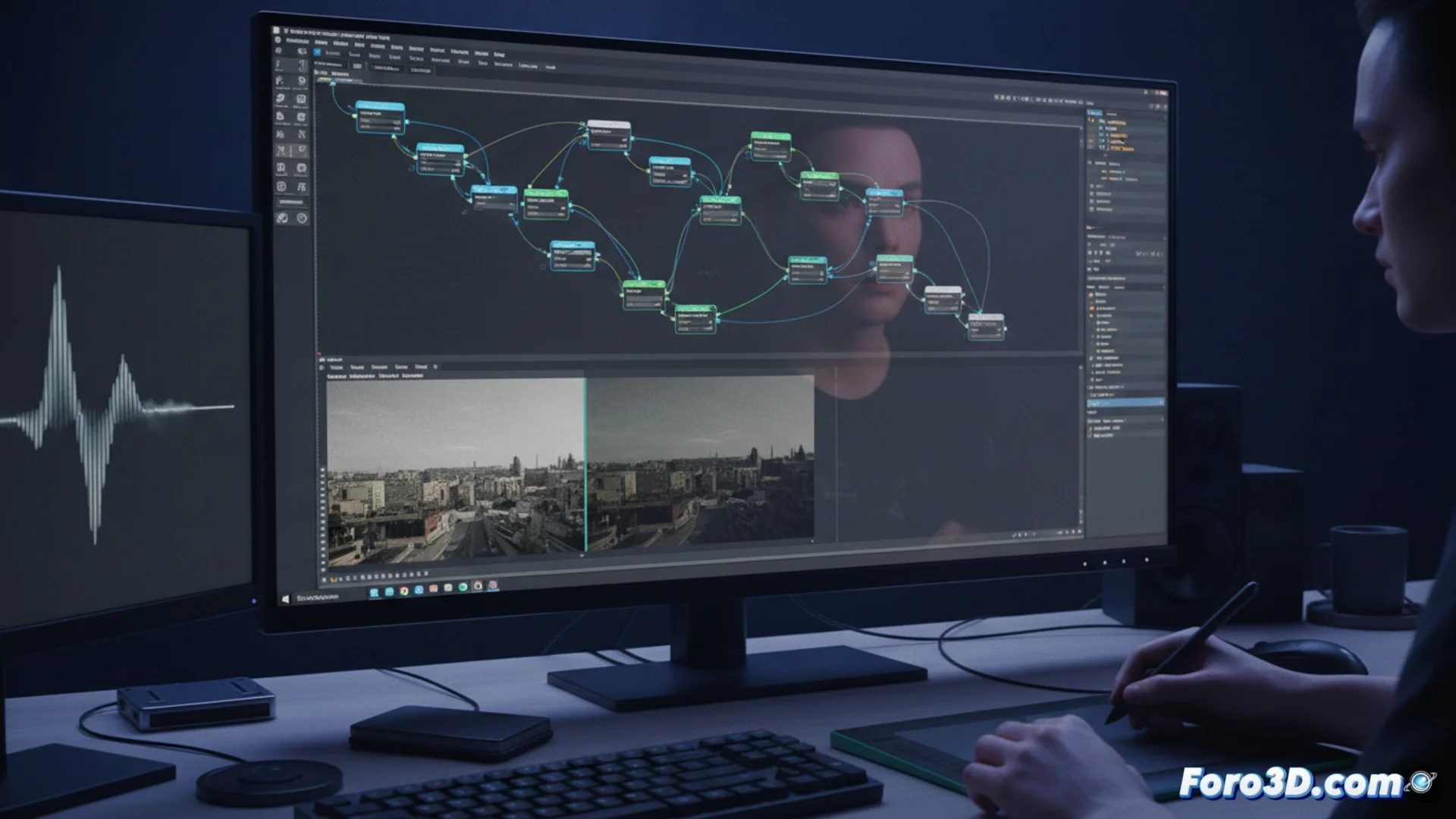
Nuke Enhances Its Workflow with Artificial Intelligence Nodes
The Nuke compositing environment now includes a group of specialized nodes that employ artificial intelligence algorithms. These modules automate and refine post-production processes that previously required significant manual effort. The integration is seamless within the nodal graph system, allowing artists to test these advanced features without leaving the main application. 🚀
Key Functionalities Powered by Machine Learning
These tools apply pre-trained machine learning models to address specific visual challenges. They enable effects that were difficult to achieve or required highly detailed manual execution. The system learns from vast visual datasets to predict and generate information, intelligently stabilizing adjustments.
Main Nodes Available:- AI Upscaling: Increases the resolution of a shot while maintaining fine details and minimizing unwanted artifacts.
- CopyCat: Trains a custom neural network within Nuke to transfer the style or corrections from a source clip to another material.
- Smart Vectors: Creates high-quality motion maps, useful for applying consistent color correction or effects across frames.
- Noise Remover: Cleans film grain or digital noise from the image while preserving the original texture and details.
The machine learns from large volumes of visual data to predict and generate missing information or to intelligently stabilize corrections.
Optimizing Repetitive Technical Processes
Using artificial intelligence in Nuke makes processing repetitive and time-consuming tasks more efficient. Artists can devote more energy to creative decisions rather than meticulous technical tasks. For example, scaling a shot or cleaning its noise no longer requires multiple steps and delicate manual adjustments.
Operational Advantages:- Speed Up Tasks: Process technical work faster and more consistently.
- Free the Artist: Allows focus on creative and visual judgment aspects.
- Maintain Control: Nodal integration gives the user total control over when and how to apply these automated processes.
The Balance Between Automation and Artistic Judgment
Although these tools promise to significantly speed up work, reflection arises on the artist's role. The key lies in knowing when to employ the power of machine learning and when to trust the trained eye and human experience. Technology presents itself as a powerful collaborator that handles the heavy lifting, but the final creative direction still depends on the professional. 🎨